Written Consent vs. Meeting Minutes: How to Organize Both
Two records, one action
To organize board minutes and written consents, start from what each record holds: a written consent captures who signed an action and when; a meeting record captures who attended and what was decided there. Board and committee actions can take either route, and each route leaves a different, equally usable set of facts behind.
Both are records of the same kind of event — a board or committee taking action — kept in the same reference set once the action is complete. Both belong in one place, in one order, under one identifier scheme — which is what lets an action be found whichever route it took.
This page covers board-level and committee-level action records only — officer appointments and signing authority carry their own record set, and entity ownership describes an owner’s written consent, covering shareholders, members, or partners.
Governing documents and law differ on when each route may be used and who has to sign. The record’s job is to hold what the organization did — what yours permits is a question for counsel.
Inside a consent record
Inside a consent record, each field documents one fact about the action rather than about the document itself:
- Consent type — which body acted, and at what level: board or committee
- Title — a short name for the action, so the record is scannable without opening the document
- Consent date — when signatures were obtained
- Effective date — the date the record carries for the action itself
- Related action reference — the decision this consent creates or relates to
- Signature-completion status — whether every signature line the organization requires has been recorded
- Notes — circumstances that would otherwise be lost between one action and the next
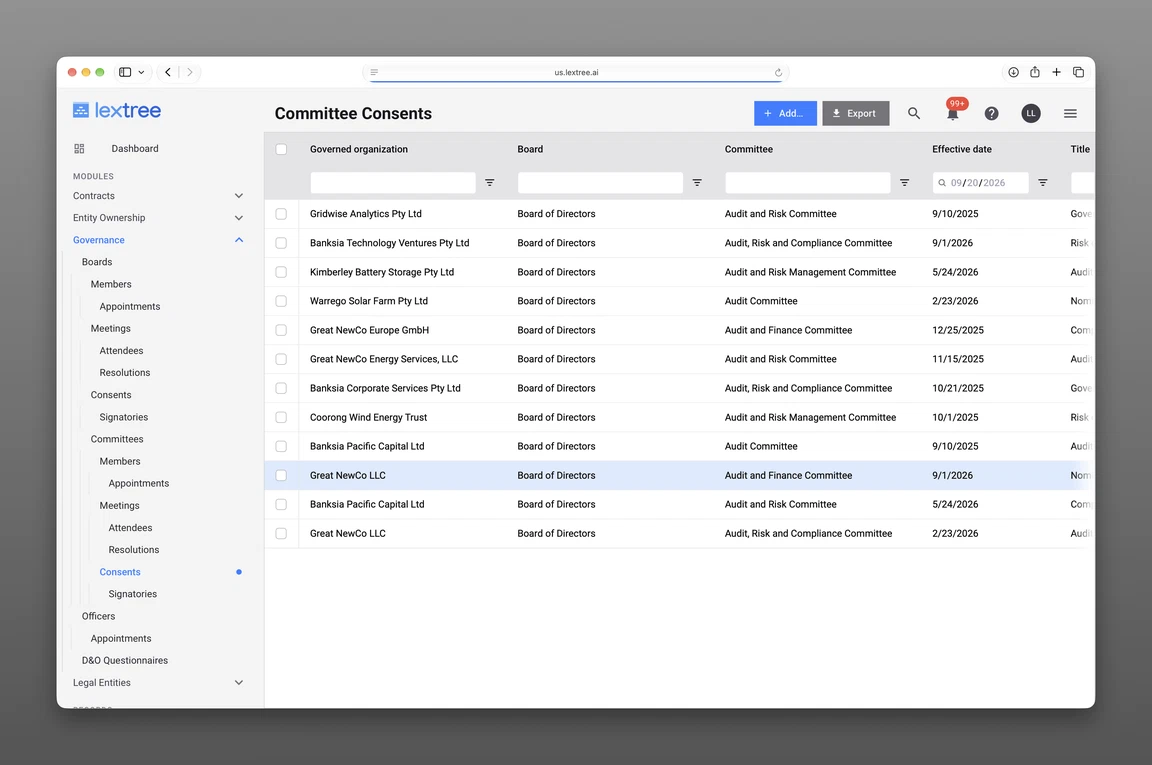
The record of a consent taken in lieu of a meeting uses the same field set. The signed document kept on its record is the counterpart to every field above — the fields make the action findable, the document proves it happened. Signature-completion status records what the organization counted as complete — not how many signatures were required.
Inside a meeting record
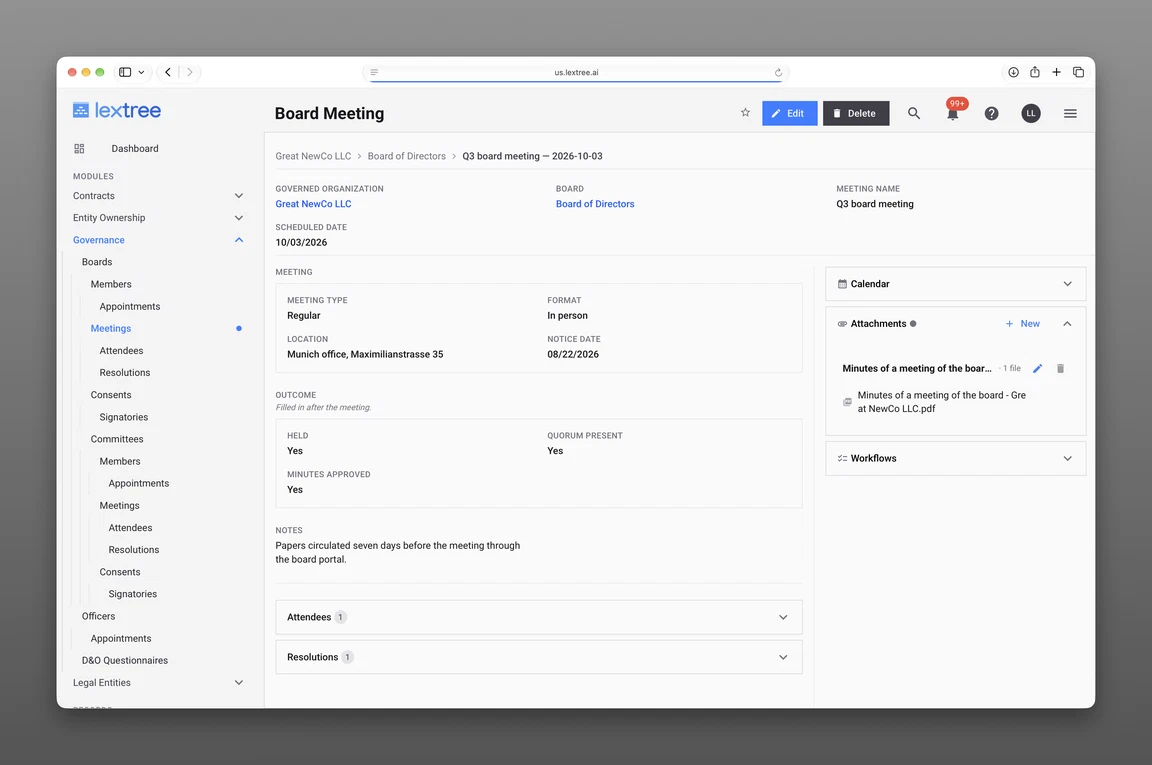
A meeting record carries a different set of facts, built around what happened at a scheduled gathering rather than around signatures:
- Meeting name — how the meeting is referred to afterward
- Meeting type — the classification the organization files the meeting under
- Scheduled date, and whether the meeting was held — two different facts, and the second is the one a later reader actually needs
- Location
- Notice date — the date notice went out, recorded as a fact and nothing more
- Whether quorum was recorded as present
- Minutes approved — a flag on the meeting record itself, not on the minutes document
Minutes approved often points to a later meeting than the one this record describes, as it does in the example below. The flag sits on the earlier meeting’s row, so a reader sees it without opening a document. On a meeting record, the action taken is its own entry underneath the meeting, the way a signature line is its own entry underneath a consent.
Signature lines and attendance lines
A signature is its own entry underneath the consent record, not a single name on the parent row: who signed, in what capacity, and when. That set of entries is the board consent signatories record — one row per person, each carrying its own date.
An attendance entry works the same way underneath a meeting record: who was present, in what role, and — when someone attended on another’s behalf — who that proxy holder was. Attendance is discussed here only as a recorded fact, not a rule.
Neither set of entries is decoration. A consent record with no signature entries is unfinished as a record; a meeting record with no attendance entries cannot answer who was in the room. Each entry is what the action rests on, one person at a time, and each can carry its own date, separate from the parent record’s.
The dates on each record
On the consent side, the consent date — when signatures were obtained — and the effective date answer different questions, and the last signature can arrive after the date the action is recorded as taking effect. A consent signed over several days can carry a consent date well after, or before, the action’s effective date; neither field substitutes for the other. Governing documents and law differ on what sets an effective date for a given action. Record what yours says, and confirm the specifics with counsel.
On the meeting side, the scheduled date, whether the meeting was held, and the date minutes were approved are three separate facts, and the third one usually belongs to a later meeting than the one it describes. A record that carries only “the meeting date” cannot tell a later reader whether what they are reading was ever approved, or is still waiting on that approval.
Sorting a year of actions by date only works if every record’s date means the same thing across the set. Pick the field that answers “when did this action happen for our purposes,” record the others beside it, and keep them distinct rather than collapsing them into one cell. That choice is what makes the filing scheme in the next section hold together at all.
One organization, two routes
Picture a fictional organization, Sample Kestrel Works, Inc., with a Board of Directors made up of Sample Director A, Sample Director B, and Sample Director C. In one year, the board takes one action by written consent and a different action at a meeting — the same kind of decision, recorded two different ways. Every value below — names, dates, capacities, and titles — is invented for illustration. This page is not legal advice, and it states nothing about what any law or set of bylaws requires.
A consent, annotated
The board acted by written consent on one item. The consent record itself carries:
- Consent record: SAMPLE-0000001
- Consent type: board-level consent
- Title: Approval of the 2027 operating budget
- Consent date: 2026-03-11
- Effective date: 2026-03-11
- Signature-completion status: complete
- Notes: circulated for signature 2026-03-06
- Signed document: the executed consent, kept on this record and filed under 2026, then 2026-03-11, then SAMPLE-0000001
| Signatory | Signing capacity | Date signed | Evidence kept |
|---|---|---|---|
| Sample Director A | Director | 2026-03-08 | Counterpart signature page, scanned 2026-03-09 |
| Sample Director B | Director | 2026-03-10 | Counterpart signature page, scanned 2026-03-10 |
| Sample Director C | Director, Board Chair | 2026-03-11 | Assembled consent with all pages, 2026-03-11 |
Sample Director A signed three days before the consent date on the parent row. In this example the organization recorded the consent date as the day the last signature came in. Each row is one person’s line on one action, and the last column says where that person’s page sits, so a later reader can get from the entry to the paper without opening the whole file. The table says nothing about how many signature lines an action like this one needs.
A meeting record, annotated
At a different point in the same year, the board took a separate action at a convened meeting. The meeting record carries:
- Meeting record: SAMPLE-0000002
- Meeting name: 2026 Annual Meeting of the Board
- Meeting type: Annual
- Scheduled date: 2026-05-14
- Held: yes
- Quorum: recorded as present
- Action recorded: Approval of the 2027 capital plan
- Minutes approved: yes, at the meeting held 2026-08-12 and filed as SAMPLE-0000003
- Approved minutes: kept on this record and filed under 2026, then 2026-05-14, then SAMPLE-0000002
| Attendee | Role on the record | Attendance entry |
|---|---|---|
| Sample Director A | Voting member | Present |
| Sample Director B | Voting member | Present |
| Sample Director C | Voting member | Present, joined after the meeting opened |
Each row is one person’s line on this meeting, doing the same job the signature lines do on the consent above. The difference is where the proof sits: a consent’s evidence is per person, a page at a time, while every attendance entry here is evidenced by the same approved minutes. That is why the consent table carries an evidence column and this one does not. Director C’s entry notes the late arrival because a later reader needs it and the parent row cannot hold it. Minutes approval came three months later and sits on the row of the meeting that gave it, SAMPLE-0000003. Sample Kestrel Works now has two board actions from the same year on two different record types, which is the problem the next section solves.
Where each record gets filed
Filing written consents with board minutes works best as one scheme, not two: both record types belong in the same place, in the same order, under the same identifier scheme, so an action is reachable whichever route it took. For most organizations that place is the minute book, kept by a corporate secretary as much as anyone’s job.
Filing by date and action
The filing sequence that keeps both record types reachable:
- File by year, then by the date the record carries for the action.
- Give every record a short title that names the action.
- Keep supporting material on the record it supports.
- Note where the signed document is kept, on the record itself.
- Give every record an identifier, and use that identifier in every cross-reference.
Date is the spine, not action type. An index built around action type fails the moment a single action has two types; action type still belongs on the record as a second field, not as the filing key. Filed this way, an auditor’s or an acquirer’s request for every board action in a year is answered by opening one folder, not two.
Finding the action either way
When a later meeting ratifies, amends, or refers back to an earlier consent, the meeting record names the consent by its title and date, and the consent record notes the meeting that referred to it. One pointer in each direction is cheap to write at the time and expensive to reconstruct later.
When the action recorded is a seat change, the term record is where who held a seat is answered — the consent or the meeting record is the authorizing action sitting beside that term record, not a substitute for it. The same discipline decides whether the scheme survives more than one organization. Keep the year-then-date order and the identifier scheme identical across every organization rather than letting each one grow its own, so a request that spans several of them is answered by one habit instead of several.
A filing scheme only holds what someone kept up, and a cross-reference exists only if whoever wrote the second record remembered the first one. That is where a growing set of consents and meeting records outgrows a manual file. If a board register is already where the board’s roster lives, these two record types sit beside it.
Frequently asked questions
Consents and signatures
What does a written consent record hold besides the signed document? A title, consent date, effective date, a reference to the related decision, and a signature-completion status — fields that make the action findable without opening the document — plus the signature lines underneath it and the signed document, kept as an attachment.
How do you record who signed a written consent, and when? Each signature is its own entry under the consent, not a note on the parent row: who signed, in what capacity, and the date they signed. That entry stands apart from the consent date on the parent record, so an earlier signature still shows its own date.
How can you tell whether a consent’s signatures are complete? Read it from the signature-completion status on the consent record — set once every signature line the organization expects has been recorded. Who must sign differs by governing document; record what yours requires, and confirm specifics with counsel.
How do you record signatures collected on separate pages? Each signature is entered as its own line, with its own date, even when the pages were signed separately — no single page needs every signature for the entries to be complete. The pages stay attached to the record; the entries are what track who signed and when.
Meetings and filing
What does a meeting record hold that a consent record does not? Facts a consent record has no reason to hold: whether the meeting was held, who attended and in what role, whether quorum was recorded as present, and whether the minutes were later approved.
Where do you file a written consent so it turns up with the meeting records? File it in the same place, under the same year-then-date order, as every meeting record, rather than in a separate consents-only folder a later search would have to know to check. The identifier and title on the record are what make it findable once it’s filed there.
Should you file by date or by action type? By date. A set of action-type folders works only as long as no action belongs in more than one type — the day one does, the index either duplicates the record or picks a folder and hides it from the other. Every record carries exactly one date, so a date-based scheme never faces that choice.
Whichever route the board took, board minutes and written consents belong in one file, filed the same way every time. That habit is what keeps the minute book — and the governance record behind it — answerable the first time someone asks.
Lextree Editorial
Author