Accreditation Calendar: Reports, Site Visits, Responses and Decisions
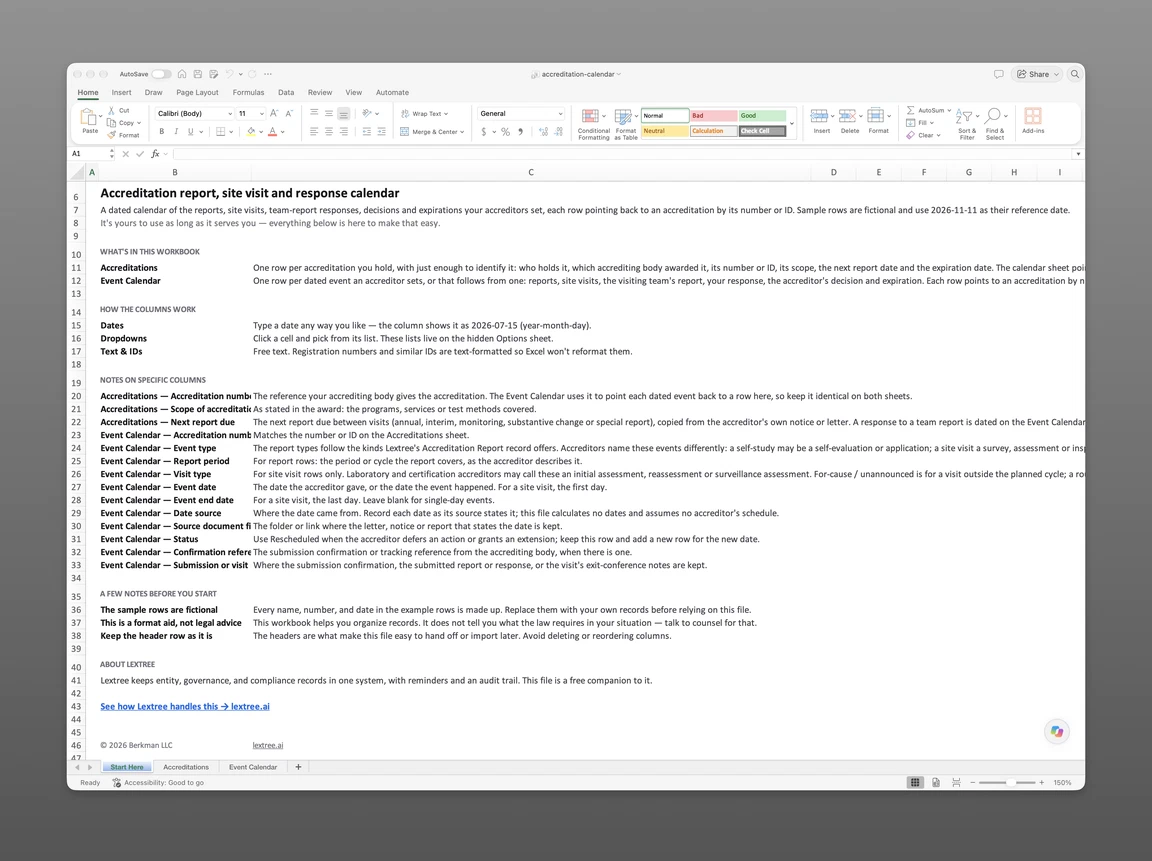
A Sample Accreditation Calendar
An accreditation calendar is a dated list of every report, site visit, team report, response, decision and expiration an organization’s accreditors set. Each date is tied to the accreditation it belongs to and to the letter, notice or report that set it.
The calendar and its file work for any accreditation from any accrediting body. The sample below mixes a hospital, a clinical laboratory and a nursing program on purpose, so no one accreditor’s vocabulary shapes the columns.
Colleges often post an accreditation schedule that lists each accreditor with its last and next reaffirmation and the cycle in years, or a visit term such as “Spring 2033” or “TBD”. That answers which year a review falls in. An accreditation calendar answers which day, and it holds the dates after the visit that a schedule leaves out.
Northfield’s Accreditations and IDs
Every calendar row points back to one accreditation by its number or ID, so the ID must read the same everywhere it appears.
- SAMPLE-0000101: Sample Hospital Accreditation, from Sample Hospital Accreditor, held by Sample Northfield Health System. Scope: acute care hospital: inpatient units, emergency department and outpatient clinics at the main campus. Next report due 2027-02-18; expiration 2027-09-14.
- SAMPLE-0000102: Sample Clinical Laboratory Accreditation, from Sample Laboratory Accreditation Body, held by Sample Northfield Health System. Scope: clinical chemistry, hematology and microbiology testing in the central laboratory. Next report due 2026-12-17; expiration 2027-06-24.
- SAMPLE-0000103: Sample Baccalaureate Nursing Program Accreditation, from Sample Nursing Program Accreditor, held by Sample Northfield School of Nursing. Scope: baccalaureate nursing program: traditional and accelerated tracks. Next report due 2027-03-23; expiration 2031-05-13.
Next report due is copied from the accreditor’s own notice or letter. The response to a team report is dated on the event rows only, because it is not a report between visits. A school whose programs answer to a programmatic accreditor as well as an institutional one, the situation behind compliance management for higher education, ends up with a row set like the nursing program’s.
Every Dated Event in Order
The table lists each dated event in the sample, earliest first. A visit shows its first and last day in one cell.
| Event date | Accreditation number / ID | Event type | Date source | Status |
|---|---|---|---|---|
| 2026-08-12 | SAMPLE-0000102 | Annual report (2026 annual report) | Accreditor notice | Submitted |
| 2026-09-22 to 2026-09-24 | SAMPLE-0000101 | Site visit (Reaccreditation) | Accreditor portal | Completed |
| 2026-10-14 | SAMPLE-0000103 | Monitoring or progress report (2026 progress report) | Decision or action letter | Submitted |
| 2026-10-20 | SAMPLE-0000101 | Team report received | Visiting team’s report | Received |
| 2026-12-09 | SAMPLE-0000101 | Response to team report | Visiting team’s report | In progress |
| 2026-12-17 | SAMPLE-0000102 | Special or focused report (Follow-up on the 2026 annual report) | Decision or action letter | In progress |
| 2027-01-19 | SAMPLE-0000102 | Self-study or application | Accreditor notice | Scheduled |
| 2027-02-18 | SAMPLE-0000101 | Annual report (2026 annual report) | Accreditor’s published calendar | Scheduled |
| 2027-03-16 | SAMPLE-0000101 | Accreditor decision | Accreditor’s published calendar | Scheduled |
| 2027-03-23 | SAMPLE-0000103 | Annual report (2027 annual report) | Accreditor portal | Scheduled |
| 2027-04-13 to 2027-04-14 | SAMPLE-0000102 | Site visit (Reaccreditation) | Accreditor notice | Scheduled |
| 2027-06-24 | SAMPLE-0000102 | Accreditation expiration | Decision or action letter | Scheduled |
| 2027-09-14 | SAMPLE-0000101 | Accreditation expiration | Decision or action letter | Scheduled |
| 2031-05-13 | SAMPLE-0000103 | Accreditation expiration | Decision or action letter | Scheduled |
Every name, number and date in the sample is invented, and nothing here is legal advice; each real date goes on the calendar as the accreditor’s own document states it.
The sample’s reference date is 2026-11-11, so earlier rows are Submitted, Completed or Received. Follow the hospital down the table: the visit ends 2026-09-24, the team report arrives 2026-10-20, the response is due 2026-12-09 with the Quality director as owner, the accreditor is expected to decide on 2027-03-16, and the accreditation expires 2027-09-14. The expected decision date carries a note to confirm it against the next accreditor notice.
Each accreditation’s Next report due matches its next report row: 2026-12-17, 2027-02-18 and 2027-03-23.
The Documents Behind Each Accreditation Date
Every row records a Date source and the place the source document is filed. The file calculates no dates and assumes no accreditor’s schedule; it keeps the date the document gives. For example, the federal criteria for recognized higher education accreditors say an agency must reevaluate “at regularly established intervals, the institutions or programs” it accredits, and that its approaches “must include periodic reports”, yet they set no number of years. Each agency picks its own interval, and a hospital’s or laboratory’s accreditor answers to different rules. Taken alone, the report rows (annual, interim or mid-cycle, monitoring or progress, substantive change, and special or focused) form the accreditation reporting calendar.
Decision Letters and Certificates
Decision or action letters set expirations, monitoring or progress report dates and special or focused reports; a certificate usually shows the expiration. In the sample, the nursing program’s 2026 progress report date came from its 2025 decision letter, and the laboratory’s follow-up report on 2026-12-17 came from a 2026 review letter. The three expirations trace to award and decision letters filed as 2023-award-letter.pdf, 2024-award-letter.pdf and 2025-decision-letter.pdf.
Terms differ by accreditor. For example, CSWE states that “Social work programs are accredited for a period of 8-years”. The calendar still copies the end date from the letter instead of counting forward from a term length, and the sample laboratory’s term ends on the date its 2023 award letter gives, whatever another accreditor’s term runs.
When a letter states a period and no date, record the date the accreditor confirms in its next notice, and keep the letter’s path in the source document column.
Notices, Portals and Published Calendars
An accreditor notice, an accreditor portal and an accreditor’s published calendar are the other date sources. The hospital’s annual report and expected decision came from published calendars, filed as 2027-reporting-calendar.pdf and 2027-decision-calendar.pdf. The nursing program’s 2027 annual report came from a portal calendar export. The laboratory’s reassessment notice set its 2027-01-19 self-study or application date, and a separate notice set its April 2027 visit.
Some accreditors publish one calendar of fixed dates. For example, FEPAC’s published timeline lists “15-Sep to 15-Oct On-Site Evaluation visits” and “1-Nov Program submits Annual Report.” Others, like the sample laboratory’s, set dates organization by organization in a notice.
Published calendars get revised. FEPAC’s timeline records a March 26, 2025 revision that included a “Date change of Annual Report due date,” so re-check the dates each cycle and file the version the date was copied from.
Team Reports and Internal Plans
The visiting team’s report is itself a date source. In the sample, the hospital’s team report, received 2026-10-20 and filed at Accreditations/Hospital/2026 visit/team-report.pdf, states the response date of 2026-12-09.
An internal plan is a date the organization sets for itself, such as a mock visit or an internal review date. Label it Internal plan so no one mistakes it for the accreditor’s date. Choosing those dates is a separate task, covered in setting internal evidence cutoffs before a visit.
The Accreditation Site Visit Schedule
The site visit schedule covers the visit row and the rows that follow it: team report, response, decision and expiration. Accreditors name the events differently. A self-study may be a self-evaluation or application, and a site visit a survey, assessment or inspection. The team report may be a survey, assessment or inspection report. The response may be a corrective action plan or plan of correction, and the decision a commission or board action. Add or rename types to match yours; an accreditor’s annual fee date, for instance, can get a type of its own. For a visit, the event date is the first day and the end date the last.
Announced and Unannounced Visits
Visit types run from initial accreditation and reaccreditation to mid-cycle review and For-cause / unannounced. Laboratory and certification accreditors may say reassessment or surveillance assessment.
A routine visit that arrives unannounced keeps its cycle type, such as Reaccreditation, with a note. The For-cause / unannounced type is only for a visit outside the planned cycle. The sample hospital row reads “Unannounced; the accreditor’s portal posted the visit on its first morning.”
For example, the Joint Commission’s laboratory survey guide says “The surveyors arrive unannounced or with short notice for most surveys.” CEPH works the other way: its FAQ says the preliminary self-study “is due five months before the site visit,” and CEPH “does not schedule site visits in July or August.”
Some rules give a window instead of a date. For example, CAP says “All inspections are performed within the 90-day period preceding the anniversary date.” A window is not a date, so the visit row gets real dates once the visit is confirmed or posted. Until then, enter what the notice gives with Status Scheduled and a note, as the sample laboratory’s row does: “Visit dates are tentative until the accreditor confirms the team.”
Team Report and Response Dates
Keep two rows: Team report received, dated the day it arrived with Status Received, and Response to team report, dated by the report or the accreditor. Accreditation deadlines for a response start at different events, so the receipt date has to be on record.
The clocks vary. For example, section 6.8 of CSWE’s handbook says its Program Response to the Site Visit Report is “due within 2-weeks of receiving the report from the specialist”. AAHRPP asks for its Response to the Draft Site Visit Report form “within 30 calendar days of your organization receiving it”. Others count from the final report instead: the AASHTO Accreditation Program requires corrective actions for each finding to be “completed within 60 days of the final report”.
Some accreditors explain the follow-up step at the visit’s close. The Joint Commission’s guide says “If follow-up is required in the form of an Evidence of Standard Compliance (ESC) the surveyors explain the ESC submission process.” Enter the due date once the accreditor’s report or notice states it.
The calendar holds the response date only. Findings are tracked outside it. In the sample, the Accreditation coordinator owns the team report row and the Quality director the response row, with the note “Draft with the chief nursing officer for review.”
Decisions, Deferrals and Expiration
An Accreditor decision row carries an expected date, often the meeting at which the accreditor’s board or commission acts. For example, the Canadian Architectural Certification Board’s visits calendar says “Accreditation visits are generally held in the spring, with final accreditation decisions rendered at the Board meetings held in the fall.” The sample hospital took its 2027-03-16 date from a published calendar, to be confirmed against the next notice. A term need not run from the visit. AAHRPP’s Council “makes a determination regarding accreditation”, and if it awards Full Reaccreditation, “the reaccreditation period is five years from the Council meeting date to which the organization was assigned.” The sample hospital’s expiration, by contrast, comes straight from its 2024 award letter.
When an accreditor defers its action or grants an extension, mark the row Rescheduled, keep it, and add a new row for the new date. Expiration rows move to the new term’s end when the reaccreditation decision is issued. For example, CEPH ties the visit to the term: “the site visit must conclude before the final day of the accreditation term.” The sample laboratory’s visit on 2027-04-13 to 2027-04-14 simply falls before its 2027-06-24 expiration.
A hospital’s clinician licenses and board certifications are a separate list from the accreditation the hospital holds, and credential expiration tracking covers that list.
Keeping the Calendar Current
Keep the number or ID identical on both sheets, and move Next report due forward when a report is submitted. Record each date as its source states it. Once a report is in, fill in the date submitted, the confirmation reference and where the submission is filed, as the sample does with SAMPLE-0000201 and SAMPLE-0000202. This calendar holds just enough about each accreditation to identify it; keep a full register of certifications and accreditations for the rest.
In accreditation records in Lextree’s Certifications module, each accreditation has its Accreditation Site Visits and Accreditation Reports underneath it. You create an event from the expiration date, one from Next report due, and one for each scheduled site visit. Lextree sends alerts before an accreditation expires, before a report is due and before the deadline to respond to a visiting team’s report. The dates appear on one calendar alongside the rest of your compliance calendar, and your team can subscribe to them in a calendar app. Lextree also records each accreditation’s and site visit’s state as it changes.
The file keeps its rows on the Accreditations and Event Calendar sheets. Accreditations holds one row per accreditation, with the number or ID the calendar points to. Event Calendar holds each dated report, visit, team report, response, decision and expiration, with its date source, its owner and where the proof is filed. The Sample Northfield rows show how each column reads; replace them with your own. Enter your email below and we’ll send the calendar to your inbox.
Get the accreditation calendar
Enter your email and we’ll send the accreditation calendar to your inbox. Free — no credit card, no call, no follow-up sequence you didn’t ask for.
Questions About Accreditation Deadlines
Cycles and Report Dates
How long is an accreditation cycle? Each accreditor sets its own. For example, CAP’s process runs on a two-year cycle, while CSWE accredits social work programs for eight years. Record the expiration the accreditor’s letter states, and let the row’s date source say where it came from.
How do annual, interim and monitoring reports differ? An annual report comes yearly. An interim or mid-cycle report falls between visits, at a point the accreditor sets. A monitoring or progress report is usually requested in a decision or action letter, like the sample nursing program’s 2026 progress report. Together with substantive change and special or focused reports, these rows are the accreditation reporting calendar.
How far ahead are accreditation site visits scheduled? Lead times vary. For example, CEPH schedules site visits “on a first-come, first-served basis, starting approximately a year and a half to two years before the visit.” APA’s 2025 site visit schedule lists “Self-Study Due September 1, 2024 – Projected site visit cycle: Spring 2025”.
Owners and Changed Dates
Who should own each accreditation date? Put a role in the owner column, not a person, so the row survives staff turnover. The sample uses Accreditation coordinator, Laboratory director, Program director and Quality director.
How should tentative visit dates be recorded? Enter the dates the notice gives with Status Scheduled and a note that they are tentative, as the sample laboratory’s visit row does. Keep the notice’s path in the source document column, and replace the dates when the accreditor confirms the team.
Lextree Editorial
Author