Accreditation Evidence Collection: A Request Plan Across Campus Offices
Accreditation Evidence Collection by Office
Accreditation evidence collection is the work of asking each campus office for the documents, data and policy records that a report or site visit will cite. Every request is tracked to a dated, sourced file, and the finished set goes to the writing team before an internal cutoff.
The person who runs it is usually the accreditation liaison officer or accreditation coordinator, working with institutional effectiveness staff and the self-study lead. At colleges and universities, the evidence sits in many offices, each with its own contacts and its own pace. Every item is mapped to the standard or criterion it supports, as your accreditor’s handbook frames it. Typical items include catalogs and handbooks, policy documents, committee minutes, program review and assessment reports, syllabi, institutional data tables, survey results and planning documents.
Academic Quality and Research
The academic quality or assessment office holds program review summaries and assessment cycle reports. It usually owns the report narrative as well, so it is both a contributor and a requester of evidence from other offices.
Institutional research holds the numbers: enrollment, retention and completion tables. A table is only usable with its data definitions and its reporting period, so the request names both before anyone pulls a single figure. Asking for “the retention table” without a period produces several versions that someone then has to reconcile.
Administrative Office Records
The registrar holds the catalog archive, the academic calendar and credit policy records. Where a request touches student records, redact them per your institution’s policy before the file joins the evidence set.
Human resources holds the faculty qualification file index and HR policy documents. Request the index, not the personnel files themselves; the files stay in HR. The provost’s office holds leadership sign-off and governance-level policy approvals.
For every office, record a primary contact and a backup contact by role, not by name, along with the date the office mapping was last confirmed. Offices reorganize, and a map that says “Director of Institutional Research” survives a retirement where a map that says a person’s name does not.
Policies and Adoption Records
Policy evidence is a short bundle: the current policy document (an original policy, an amendment or a restatement), its effective date, its last and next review dates, the organization that adopted it and the date it was adopted, and where the file is kept. The approval instrument itself stays in your institution’s own records system; the evidence file records the approval date and points to it.
Lextree’s Policies module follows the same shape. It keeps policy versions and adoption records together: each policy carries an Adoptions list with one row per adopting organization and its adoption date, so a question about which version applied, where and when has one place to look.
Sending and Tracking Evidence Requests
Each accreditation evidence request is one row of work with one owner. A request that lives in an email thread cannot be counted, sorted or handed to a successor. A request with a reference number can.
What Each Request Names
A complete request carries these fields:
- Your own request reference, so replies and files can be matched to it.
- The exact document or table asked for, with its period.
- The report, visit or workflow step it supports.
- The owning office.
- The requested-on date.
- The response-requested-by date, which is your internal working date and never an accreditor’s date.
- A status in plain words: Requested, In progress, Received, Under review, Accepted, Returned for revision, Not available.
- Where the evidence file is kept.
- Who reviews it.
- Any open question.
These statuses belong to the request plan, a set of words one team found workable. Change them to match how your offices talk.
Version, Date, and Source
Every accepted file carries three facts: its version, the date it was produced or approved, and the office it came from. A policy PDF with no effective date and a data table with no definitions fail the same test, and both go back as Returned for revision with a one-line reason.
A named reviewer role accepts each file before it reaches the writers. The liaison officer is the usual reviewer for institution-wide items; a program-level item can be reviewed by the person who owns that program’s report.
Fit matters as much as form. Prefer evidence that directly shows the point a standard or criterion addresses, and pair it with a second source that corroborates it, such as a policy and the committee minutes that applied it. A file that only hints at the point belongs on the gaps list, not in the evidence set.
Name each accepted file by standard or criterion, request reference, short title and date, for example Criterion-3_SAMPLE-0000104_Academic-Integrity-Policy_2023-08-21. Writers can then cite by file name, and a reviewer can trace any citation back to the request that produced it.
Gaps and Substitutions
Some requests come back unfilled. An office may never have produced the document, or may hold it only in a format that cannot be shared. Mark the request Not available, record the open question, name substitute evidence or a short narrative note, and escalate to the self-study lead or the provost’s office for a decision on which route to take.
Found early, a gap is a follow-up item with an owner and a date. Found during the visit, it is a question without an answer. The request log is where the first version of that story gets written, so a Not available status is a useful record.
Counting Back From the Site Visit
Anchor dates come from the accreditor: its correspondence, its visit letter or its handbook. Confirm each one with your accreditor, then set an internal evidence cutoff ahead of it. Working back from those two dates is the accreditation self-study timeline in practical form. No step needs a fixed number of weeks: each team counts back by its own pace and the size of its evidence set, as long as every date is written down and every response date lands before the cutoff.
- The accreditor’s date: the report due date or the site visit.
- Leadership review and sign-off of the finished report or evidence set.
- Writing-team handoff at the internal evidence cutoff.
- Response dates for each campus office, all before the cutoff.
- Requests sent, with each office’s contributor named.
- Office map confirmed, with primary and backup contacts current.
At the handoff, give the writing team the evidence organized by standard or criterion, each item with its source, date, version and file path. Lextree’s Certifications module holds each accreditation with accreditation site visits and reports underneath it, and its seeded Interim report and Reaccreditation workflows include steps named “Data and evidence collected from units” and “Evidence collected and self-study or application drafted”. Those seeded steps are defaults; a team can change them to fit its own process.
A Request Plan at Sample Ridgeview
Sample Ridgeview University is fictional. Every office, date and reference below is invented around a reference date of October 6, 2026, and nothing here is legal or accreditation advice. Any date an accreditor sets appears as “per the accreditor’s handbook; confirm with your accreditor.”
The Interim Report Requests
The sample interim report covers the period ending 2026-06-24. The accreditor’s date is 2026-12-10 (per the handbook), the internal evidence cutoff is 2026-11-12, and its status in the Report and Visit Dates sheet is Evidence gathering.
| Request reference | Request | Owning office | Response requested by | Status |
|---|---|---|---|---|
| SAMPLE-0000101 | Five-year enrollment and retention tables with data definitions | Sample Office of Institutional Research | 2026-10-20 | In progress |
| SAMPLE-0000103 | Program review summaries for each academic program | Sample Office of Academic Quality | 2026-10-13 | Under review |
| SAMPLE-0000104 | Current approved academic integrity policy | Sample Office of the Provost | 2026-10-09 | Accepted |
The first row’s open question is the cohort definition, which the liaison officer checks against the accreditor’s handbook. The second row has the gap: two program summaries are missing a signed cover page. The third row is accepted, and its policy record reads: Sample Academic Integrity Policy, Original policy, effective 2023-08-21, adopted by Sample Ridgeview University on 2023-06-14, next review 2027-05-12, kept in the Sample policy library.
All three response dates fall before the 2026-11-12 cutoff, so the two open items, the cohort definition and the missing cover pages, both have time to close.
The Program Visit and Self-Study
Two later events draw on the same offices. The Sample School of Sciences program accreditation has a mid-cycle review visit on 2027-04-21 (per the visit letter) and an internal cutoff of 2027-03-11. The Sample reaccreditation self-study sits at the workflow step “Evidence collected and self-study or application drafted”, with a self-study date of 2027-09-23 (per the accreditor’s correspondence) and an internal cutoff of 2027-03-18.
| Request reference | Request | Owning office | Response requested by | Status |
|---|---|---|---|---|
| SAMPLE-0000105 | Faculty qualification file index (index only, not the files) | Sample Office of Human Resources | 2026-11-19 | Requested |
| SAMPLE-0000102 | Catalog archive for the last two academic years | Sample Registrar’s Office | 2026-11-12 | Requested |
The visit’s cutoff falls first even though the self-study date is five months later. With the visit in April, the faculty index must reach the writers in March. The self-study cutoff sits in the same spring window, so drafting can run through the summer. Both requests went out within a week of each other, and each office sees one date for its answer.
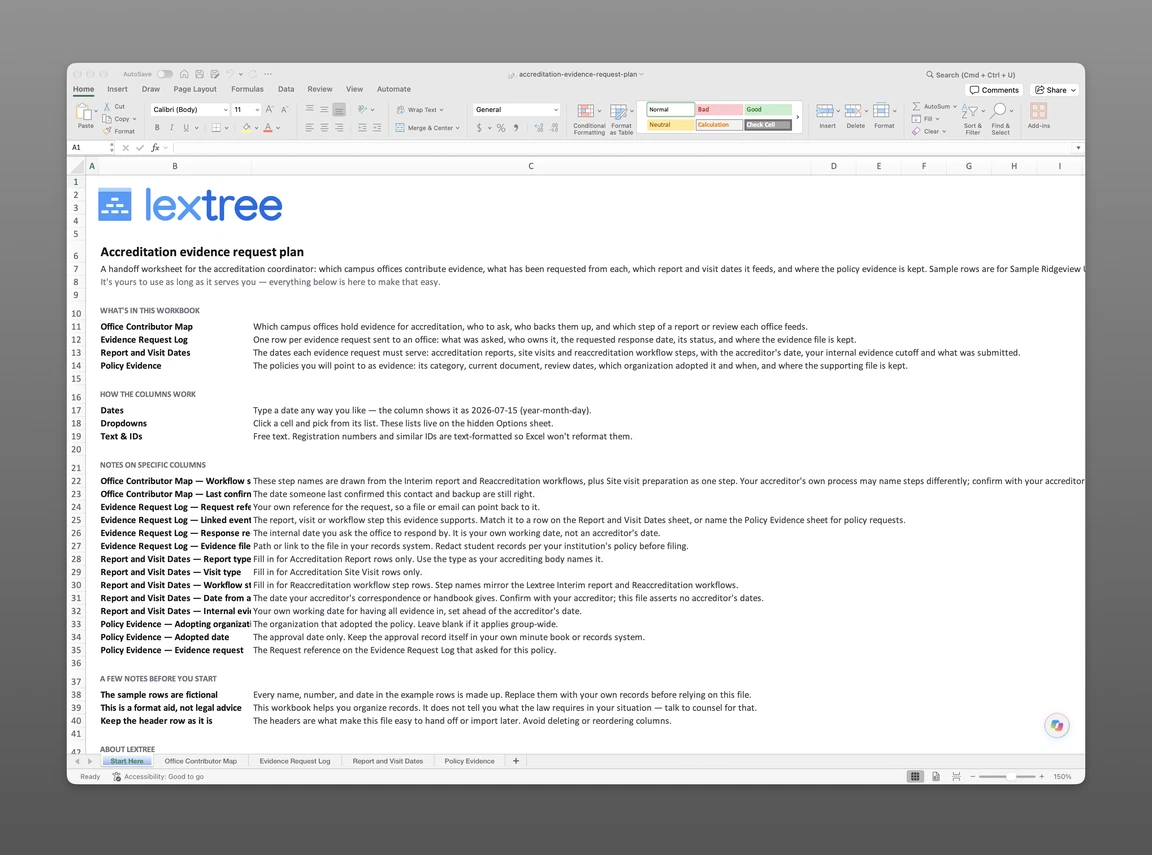
The 4 sheets of the request plan hold exactly this material. The Office Contributor Map lists which offices hold which evidence and who backs each contact up. The Evidence Request Log holds each request with its owning office, response date, status and file. The Report and Visit Dates sheet lists the report, visit and workflow dates each request serves, with internal cutoffs. The Policy Evidence sheet holds each policy’s document, review dates, adopting organization and adopted date. The request plan is sent to your email after the short form below.
Get the free playbook
Enter your email and we’ll send the accreditation evidence request plan to your inbox. Free — no credit card, no call, no follow-up sequence you didn’t ask for.
Frequently Asked Questions
Requests and Campus Offices
Who sends accreditation evidence requests to campus offices? The accreditation liaison officer or coordinator, or the self-study lead, depending on how your institution assigns the work. One sender keeps the log consistent and gives offices one place to ask questions.
What should an accreditation evidence request include? A reference, the exact document or table and its period, the report or visit it supports, the owning office, the requested-on and response-by dates, a status, where the file is kept, a reviewer and any open question.
How early should evidence requests go out? Count back from the accreditor’s date to your internal cutoff, then place each office’s response date before that cutoff. There is no fixed lead time; the size of the evidence set and each office’s workload decide it.
What counts as policy evidence? The policy document, its adoption or approval date, and a note of where the approval record is kept. The review dates show the policy is current.
Between Accreditation Cycles
How do you keep evidence current between accreditation cycles? Capture evidence when it is produced: file the program review summary when it is accepted, the policy when it is adopted and the data table when its reporting period closes, each under its standard or criterion. The next request plan then starts as a check of what is already on file rather than a fresh round of requests.
What is an accreditation evidence inventory? A list of the evidence you hold, organized by standard or criterion in whatever form your accreditor asks for. The request log feeds it: every accepted file is one line, with its source, date and version.
How long should accreditation records be kept? Accreditation records retention is set by your institution’s records retention schedule, so ask your records officer how long each category is held. As a working habit, keep the submitted report, the evidence it cited, the team report and your response together.
Where should evidence live between cycles? Keep the files in your institution’s own records system, and keep the accreditation record where the next team will look first. In Lextree, that is the accreditation in Certifications with its Site Visits and Reports beneath it, plus the seeded Interim report, Reaccreditation, Site visit preparation and Response to team report workflows. Policies live in Policies with their Adoptions. Campus offices and evidence requests are columns in the request plan, not records in the product. For the wider picture of keeping an institution ready for review, see audit readiness.
Lextree Editorial
Author