Board and Committee Appointment Records: One Row per Term
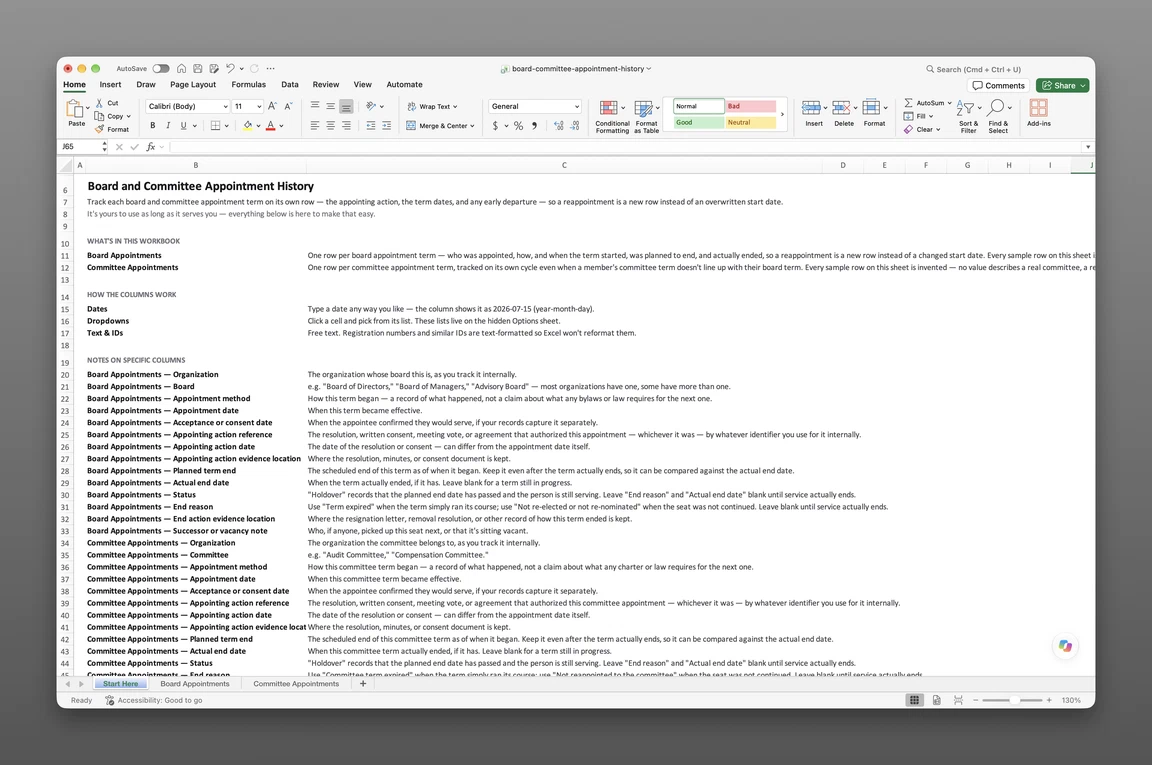
One record per appointment term
Board and committee appointment records document who held a board or committee seat, under what appointing action, for how long, and how it ended. Each term is its own row — the appointment date, the planned and actual end, and the reason it ended — so a reappointment adds a new record instead of overwriting the one before it. A board member appointment record and a committee member appointment record follow the same shape, so a director’s board history and committee history read the same way.
This record set covers directors and committee members; officer appointments and trustee appointments carry their own record sets.
What each appointment term carries
Each appointment term carries a consistent set of fields, whether it belongs to a board or a committee:
- Organization — which entity the seat belongs to. Because the organization sits on the term itself, one person’s board service across two different entities stays as two separate, continuous histories — one per organization, each intact on its own record.
- Board or committee — which body the term is on
- Member — who holds the seat
- Seat or role — chair, vice chair, or another named role, when the seat carries one
- Appointment method — a board term carries values such as elected by shareholders or members, elected or appointed by the board, appointed by the board to fill a vacancy, designated under a shareholders’, operating, or investor rights agreement, or ex officio, where the seat is tied to another position; a committee term carries values such as appointed by the board, the board chair, or the committee chair, or elected by the committee’s own members. Each value records what happened.
- Appointment date — when the term became effective
- Acceptance or consent date — when the appointee confirmed they would serve, if that’s tracked separately
- Term start — when service under this term begins
- Planned term end — the scheduled end as of when the term began
- Status — the value this field carries: scheduled, when the term hasn’t started yet; current; holdover, when the planned end has passed and the person is still serving; or ended.
Appointment date, acceptance date, and term start are three different dates. Collapsing them into one loses a common case — an election that takes effect on the vote date, while the term itself begins days or weeks later. Keeping all three shows exactly when each event happened, instead of picking one date to stand in for the rest.
Status carries the case a due-date field can’t: a planned end that passes while the person keeps serving. That’s recorded as a fact about this organization’s own record — a status. Governing documents differ on term length and appointment method; record what yours says, and nothing more specific than that.
The appointing action, recorded separately
The appointing action sits beside the term as fields of its own, not folded into the term’s dates:
- Appointing action reference — the resolution or written consent, meeting vote, or agreement that authorized the appointment, named by whatever identifier your records already use
- Appointing action date — the date of that resolution or consent, which can differ from the appointment date itself
- Appointing action evidence location — where the document is kept
The reference is free text because the authorizing instrument varies by organization and by appointment — a resolution adopted at a meeting, a written consent signed outside one, a vote recorded on its own, or an agreement that designates a seat. The record names whichever instrument it was, rather than forcing every appointment into a single type.
Evidence location points at where that instrument lives — the corporate records the appointment is proved from, not a copy pasted into the row itself. A reference with no location behind it is a claim; a reference with one is something closer to proof, and it’s the difference an auditor or a counterparty checks.
Committee terms, their own cycle
Committee appointment terms are their own records, built the same way as board terms, because a committee term rarely lines up with the board term running behind it. A member’s board term might run three years while their committee term runs on a two-year cycle that started on a different date and will end on one too.
Committee member appointment tracking differs from board tracking in two places. On the appointing side, the record names who made the appointment — the board, the board chair, the committee chair, or the committee’s own members, depending on how the organization runs its committees. On the ending side, the end reason carries a case unique to committees: service ending because board service itself ended, a different fact from a committee term simply running its course.
A committee appointment record works the same way for a company’s standing committees and a nonprofit’s alike. What differs from one organization to the next is the cycle a committee term runs on, not the kind of organization keeping the record.
Committee charters are the governing document behind a committee’s own term length and appointment method. This record keeps what the organization did against that charter.
When a term ends early
Board and committee appointment records show how a term began and how it ended. A resignation letter and a removal resolution each serve as evidence for a different end reason, so the record keeps them distinct. Director resignation and removal records sit on the same row as the term they close, giving every term both its planned end and its actual end.
Planned end and actual end
Keep both. The planned end is what the term was scheduled to be when it began; the actual end is when service stopped. Keeping both intact is what lets the record show whether a term was cut short or ran long.
A holdover status records that the planned end date has passed and the person is still serving, with the actual end date and end reason left blank until service stops.
- Actual end date — when the term stopped, left blank while service continues
- Status — current, holdover, or ended
- End reason — why the term ended
- End action evidence location — where the record of how it ended is kept
- Successor or vacancy note — who picked up the seat next, or that it’s sitting open
Resignation, removal, and vacancy
End reason is a recorded value, not an inference from a blank cell. The value it carries is one of several, for example term expired, not re-elected or not re-nominated, resigned, removed, withdrew or declined to serve, deceased, disqualified or ineligible, or board dissolved or seat eliminated. A term that ran its course and a seat that wasn’t continued are different facts, and they read differently to an auditor or a diligence request later.
The end action evidence location is the counterpart of the appointing action’s own evidence field — the resignation letter, the removal resolution, whatever proves how the term ended.
The successor or vacancy note carries the thread forward. The seat’s next occupant gets a row of their own, with an appointing action of their own, and this field is what links the two rows together. None of this states what any law or governing document requires about notice, acceptance, or grounds for removal — it records what this organization’s own term did.
A worked example in one organization
Picture a fictional organization, Sample Kestrel Works, Inc., with a Board of Directors and an Audit Committee. Every value below — names, dates, methods, and end reasons — is invented for illustration; none of it states what any bylaws or any law requires about appointment method, term length, or removal. This page is not legal advice.
Consecutive terms as separate records
Sample Director A served a first board term from 2022-05-01 to 2024-05-01, ending with the reason “term expired.” A second term begins as its own row: appointment date 2024-04-27, term start 2024-05-01 — the election took effect on the date of the vote, with the term itself starting a few days later, which is exactly why appointment date and term start are separate fields.
| Term | Appointment date | Term start | Planned end | Actual end and reason |
|---|---|---|---|---|
| First term | 2022-05-01 | 2022-05-01 | 2024-05-01 | 2024-05-01 — term expired |
| Second term | 2024-04-27 | 2024-05-01 | 2027-05-01 | — current |
The first row keeps its own dates untouched. Recording the second term as a new row, rather than editing the start date on the single row already on file for Sample Director A, is what keeps the first term’s dates from disappearing.
Early departure, then a vacancy
Sample Director B’s term started 2023-06-01 with a planned end of 2027-06-01, but actually ended 2025-02-15 with the reason “resigned,” the resignation letter’s location recorded alongside it. Sample Director C was then appointed to the seat on 2025-03-01, by a different appointment method — the board filling the vacancy — carrying the same planned end date as the term being completed.
The gap between Sample Director B’s planned end and actual end is the fact worth keeping. Two rows, one seat, one continuous history.
A separate committee cycle
Sample Director A’s Audit Committee terms run on a cycle of their own: 2022-06-15 to 2024-06-15, then a second term beginning 2024-06-20, five days later, unrelated to the board term dates above. Sample Director C joins the committee 2025-04-01, about a month after joining the board.
Who sat on the board on a given date comes out of exactly these rows — term start and actual end, read across every record for that date.
Two kinds of term record
Board and committee term records belong in one place because they share the same keys — the member, the organization, and the appointing action. A committee term only reads clearly against the board service sitting behind it when both are kept together.
A kept history answers what a current roster can’t. It shows who held a seat across a range of dates, how each term ended, and which appointing action authorized it. For a corporate secretary, that’s the difference between confirming who serves today and proving who served on any date an auditor names.
This tracker has a companion file, sent to your email, with two sheets: Board Appointments, one row per board appointment term, and Committee Appointments, one row per committee appointment term, on its own cycle. Both sheets open in Excel, and both carry the same invented-values caution as the worked example above.
Enter your email and we’ll send the board and committee appointment history tracker to your inbox. Free — no credit card, no call, no follow-up sequence you didn’t ask for.
A kept file holds only what someone typed into it, and a term expiring next quarter surfaces only when someone opens the file and looks. That’s where a record set like this one outgrows the file — the same rows, with term expiration reminders instead of a quarterly check. If a board register is where your roster already lives, this tracker is the next record set for it — the history behind each row, not a replacement for it.
Frequently asked questions
Terms and reappointments
Should a reappointment be a new record or an edit to the existing one? A new record. The second term gets its own row, its own appointment date, and its own planned end, so the first term’s dates stay exactly as they were.
What is the difference between the appointment date and the term start date? The appointment date is when the appointing action became effective — often the date of a vote. The term start is when service under that term begins, which can fall a few days or weeks later.
Do committee appointments need their own record? Yes. A committee term rarely runs on the same schedule as the board term behind it, so it needs its own appointment date, planned end, and appointing action to be tracked accurately.
Endings and evidence
How do you record a director who resigns before the term ends? Record the actual end date, an end reason of “resigned,” and where the resignation letter is kept. The planned end date stays on the row, so the gap between planned and actual remains visible.
What do you record when a planned term end passes and someone keeps serving? A status of holdover, with the actual end date and end reason left blank until service stops. That records the fact of continued service without asserting what happens next.
How do you show who served on a committee on a given date? Read it from the rows themselves — the term start and actual end on each committee appointment record answer who sat on the board on a given date, without a separate lookup.
Lextree Editorial
Author