Board meeting records checklist: notice, attendance, votes and approved minutes
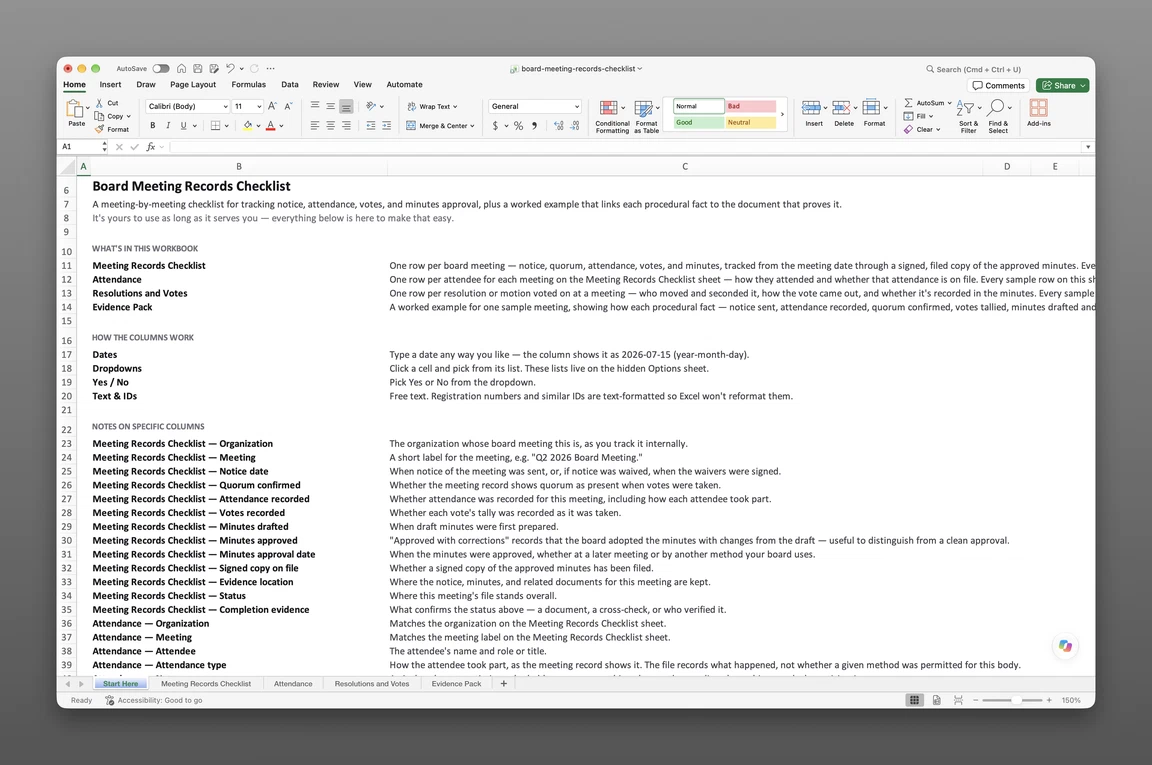
What a board meeting records file contains
A board meeting records checklist starts from one question: could someone who wasn’t in the room reconstruct what happened, from the file alone? A complete meeting file is the set of records showing that one meeting was called, noticed, attended, quorate, voted, and minuted. It also shows that the approved minutes were signed and filed. The list below covers what records to keep from a board meeting — not what happened at it, but what proves that it happened:
- meeting type, date, time, location, call to order, and adjournment time
- the notice and any waivers
- the agenda and board packet as distributed
- the attendance record
- the quorum statement
- each resolution with its vote tally
- recorded abstentions and recusals
- draft minutes and approved minutes
- the signed copy
- where each item is filed
A per-meeting file like this is different from a standing register of directors, officers, and meeting dates. That register tracks who serves and when meetings occurred, not the evidence behind any one meeting. Action by written consent is also out of scope here — see when a board acts without meeting for that route. Everything that follows describes corporate meeting records for one convened meeting, start to finish.
Notice and waivers of notice
The notice record holds a copy of the notice sent, the send date, and the method — email, courier, portal, or mail. It also holds the recipient list and any delivery confirmation or transmittal log. The agenda that went out with the notice is filed alongside it. Notice and quorum anchor the rest of the file. These board meeting notice and quorum records come first, since attendance and quorum have nothing else to reference back to.
A waiver works the same way: a signed waiver goes in the file with the notice it waives, not loose among the minutes. If a director attended the meeting without objecting to notice, the minutes note that attendance.
What the notice record shows is that notice was sent, by what method, to whom, and when. Notice periods and permitted methods come from governing documents and applicable law, so confirm the specifics with counsel before setting a standard notice practice.
Attendance and quorum
The attendance record lists:
- each director by name
- how each attended — in person, by video, by phone, or through a proxy holder where the organization allows it
- anyone who joined late or left early
- non-director attendees, such as counsel, officers, or guests
The quorum record is simpler: the minutes state that quorum was recorded as present at the call to order. The attendance record at that moment is its backing. If a departure changes the count before a vote, the quorum entry is noted again at that point in the meeting. It isn’t noted only at the opening. A director who joins remotely gets the same attendance entry as one sitting in the room, with the method noted alongside the name.
Attendance ties back to who was eligible to be there in the first place. For who held a seat on the meeting date, the appointment record is the source, not the meeting file.
Votes, abstentions, and recusals
Each resolution record holds:
- a reference or number
- its title and text, or the text attached as an exhibit
- the mover and seconder
- the tally of votes for, votes against, and abstentions
- the result
Abstentions and recusals are both recorded by name. A recusal links to the conflict disclosure already on file and notes that the director left the discussion or took no part in it. Neither the abstention record nor the recusal record states whether that vote counted toward any particular threshold. That’s a question the resolution’s own governing rules answer, not something the meeting file decides.
Put together, the resolution text, the tally, and the minutes entry are the evidence of board approval for that decision. Any one of the three alone leaves a gap; all three together are what a later reviewer needs.
From draft minutes to approved minutes
The file isn’t complete the moment the meeting ends. It’s complete once the minutes are approved, signed, and filed — which happens at a later date than the meeting itself.
Drafting and circulating corrections
A draft is dated, versioned, and circulated to directors for review. The circulation record — who received which version, and when — is kept alongside any corrections received back. That record lets the approved version be traced to the draft it started from. A draft is unfinished as a record, not merely “not yet valid.” It’s real evidence of what was discussed — it just hasn’t been confirmed yet.
Recording approval and signature
Approval goes into the minutes of the next meeting, or whatever approval step the organization uses between meetings. That entry records the motion to approve, any corrections adopted along the way, and the date approval happened. Because approval happens later, one meeting’s file isn’t finished until the following meeting’s minutes exist.
Signature and filing come last: the secretary or whoever the organization designates signs the approved copy. That signed copy is then filed together with the notice, the attendance record, and the resolutions it approved. The file for a given meeting only closes out once all four pieces sit in the same place.
To make this concrete, the companion checklist that goes with this page comes as four sheets. The Meeting Records Checklist sheet tracks one row per meeting, from notice through a signed, filed copy of the approved minutes. The Attendance sheet records who attended each meeting and how. Resolutions and Votes lists each motion, its mover and seconder, and its tally. Evidence Pack works through one sample meeting, tying each procedural fact to the document that proves it. Enter your email below, and we’ll send the file to your inbox.
Get the free checklist
Enter your email and we’ll send the board meeting records checklist to your inbox. Free — no credit card, no call, no follow-up sequence you didn’t ask for.
A worked example, fact by fact
Consider the regular third-quarter board meeting of an invented company, “Sample Calder Point Holdings, Inc.” Five directors sit on the board. Four attend in person or by video. The fifth, a director serving on the audit committee, did not see the notice before the meeting and later signs a waiver. During the meeting, one director recuses from a resolution approving a related-party office lease, disclosing the conflict before the discussion starts. A different director abstains on a second resolution, an amendment to the expense reimbursement policy, without a stated conflict. The table below pairs each procedural fact from that meeting with the document that proves it and where the file keeps it.
| Procedural fact | Document that proves it | Where it is filed |
|---|---|---|
| Meeting called | Calendar notice, meeting ID CPH-BM-Q3-01 | Meeting file, notice folder |
| Notice sent to directors | Notice transmittal log, all five directors | Meeting file, notice folder |
| Notice waived by one director | Signed waiver, audit committee director | Meeting file, notice folder |
| Attendance at call to order, including the video attendee | Attendance record, four present | Meeting file, attendance folder |
| Quorum recorded as present | Quorum statement, draft and approved minutes | Meeting file, minutes folder |
| Conflict disclosed and director recused | Conflict disclosure form, lease resolution | Meeting file, resolutions folder |
| Lease resolution adopted, with its tally | Resolution CPH-BM-Q3-02, 3 for, 0 against, 1 recused | Meeting file, resolutions folder |
| Second resolution adopted, with one abstention | Resolution CPH-BM-Q3-03, 3 for, 0 against, 1 abstaining | Meeting file, resolutions folder |
| Draft minutes circulated | Draft minutes, version 1, circulation log | Meeting file, minutes folder |
| Corrections received | Marked-up draft, two director comments | Meeting file, minutes folder |
| Minutes approved at the following meeting | Q4 meeting minutes, approval entry | Meeting file, minutes folder |
| Signed copy filed | Signed final minutes, secretary’s signature | Meeting file, minutes folder |
Every name, date, and identifier in this example is invented for illustration. This page describes what a meeting file can hold. It is not legal advice, and it does not describe the requirements of any specific board, bylaws, or jurisdiction.
Keeping meeting evidence in Lextree
Lextree’s Governance module records each board meeting as its own item, with the attendees and resolutions for that meeting tracked beneath it. That includes any proxy holder who attended on a director’s behalf. The meeting record itself carries the meeting type, its format, its location, and its notice date. Those logistics sit with the meeting, not in a separate log.
Alongside that, the record tracks whether the meeting was held, whether quorum was present at the time, and whether the minutes have since been approved. These are three simple checks that stay attached to the meeting, not living only in someone’s memory. A seeded Board Meeting Preparation workflow comes set up as a six-step sequence — notice, packet assembly, quorum confirmation, the meeting, minutes drafting, and minutes approval. A meeting moves through the same steps every time. Every scheduled meeting also comes set up with the same two-stage advance notice by default. The notice, the board packet, and the approved minutes are stored as attachments directly on the meeting record. That’s how the signed minutes kept on the meeting’s record stay next to the meeting they belong to, not in a separate document library. Resolutions carry their own reference number, tying each one back to the minutes that recorded it, along with a vote date and a result. Where a vote’s breakdown matters, that tally is kept as an attachment on the resolution as well.
For board meeting and resolution records by entity, the module keeps every board’s meetings and resolutions together under the entity they belong to. A director, secretary, or reviewer can then find one meeting’s full file without cross-referencing a separate index.
Frequently asked questions
Notice and attendance
What should a board meeting file contain? The notice and any waivers, the attendance record, and the quorum statement. Each resolution with its tally, recorded abstentions and recusals, draft and approved minutes, and the signed, filed copy.
How do you prove notice was given for a board meeting? The notice copy itself, its send date, the method used, and the recipient list together show that notice went out. Any delivery or transmittal confirmation shows to whom it was sent.
Where is a waiver of notice filed? With the meeting’s notice, in the same folder — not loose among the minutes. The waiver is also referenced in the minutes themselves.
How do you record attendance and quorum for directors who join remotely? The same attendance entry as an in-person director, with the method and any join or leave time noted. The quorum statement is recorded at the call to order.
Votes, minutes, and retention
How should votes, abstentions and recusals appear in the records? A tally for each resolution — for, against, and abstaining — with any abstaining or recused director named. Each recusal is linked to its conflict disclosure.
When are minutes approved, and how is approval recorded? Approval goes into the minutes of the meeting where it happens, with the approval date and any corrections adopted noted alongside it.
What goes in a board meeting evidence pack? Each procedural fact from the meeting — notice, attendance, quorum, votes, minutes — gets paired with the document that proves it. That pairing also names where the document is filed. The worked example above walks through one meeting this way.
How long should board meeting records be kept? Many organizations keep approved minutes and resolutions permanently and set a separate retention schedule for supporting items like draft minutes and transmittal logs. Set that schedule with counsel, since it depends on the organization’s own governing documents and jurisdiction.
How are executive session records kept? An executive session gets its own set of minutes, kept separate from the main meeting record and restricted to the board members entitled to attend. That separate record is filed with the rest of the meeting’s file, not merged into it.
Lextree Editorial
Author