Certificate of Insurance Expiration Tracking by Coverage Line
List Each Vendor’s Required Coverage Lines
Certificate of insurance expiration tracking by coverage line gives every line a vendor must carry a row of its own, with minimum limits, an expiration date copied from the latest certificate, and the certificate row that date comes from. Teams that track vendor insurance certificates with one date per certificate end up with the date of whichever policy was typed first. A single certificate can show three policies that end on three different days, and the earliest one is the first to need a renewal.
Set up and run the log in this order:
- List the coverage lines each vendor has to carry.
- Log every line that each certificate shows.
- Keep each line’s dates current from its latest certificate.
- Chase renewals in date order.
If the required lines already sit in a counterparty and coverage-requirement register, start from there and add the dates in the steps below.
Minimum Limits for Each Line
Four sample vendors carry the example through this page. Sample Harbor Janitorial Services LLC is a cleaning contractor. Sample Ridgeline Software Consulting builds software for clients. Sample Brightfield Security Services provides guard services. Sample Pinecrest Landscaping maintains grounds. The vendors, policies, limits and dates are invented. This page covers record-keeping and gives no legal or insurance advice.
Each vendor gets one row per coverage line, and each row holds the minimum recorded for that line in the units its certificate will print. Harbor has three lines. General liability is recorded at 1,000,000 for each occurrence and 2,000,000 general aggregate. Workers’ compensation is recorded at 500,000 for employers’ liability each accident, with 500,000 for each of the two disease limits. Commercial auto is recorded at a 1,000,000 combined single limit for each accident, with no aggregate. Ridgeline’s professional liability line is recorded at 1,000,000 each claim and 2,000,000 aggregate, its cyber line at 1,000,000 each claim and 1,000,000 aggregate, and its general liability line at the same 1,000,000 and 2,000,000 as Harbor’s.
When Each Line Applies
Each line also carries the date it applies from, and a date it applies until when the vendor no longer has to carry it. Brightfield’s commercial auto line is the example. An amendment dropped mobile patrols from its services on 2026-08-19, so that line was given an applies-until date of 2026-08-19. The auto certificate stays on file, and its policy period still runs to 2026-12-18. Brightfield’s general liability and umbrella lines have no applies-until date and keep running. Harbor’s lines apply from 2026-03-16, and the other vendors’ lines from their own start dates.
Log Every Line on Each Certificate
Logging by coverage line turns each line printed on a certificate into its own row, and every row from the same certificate shares one certificate ID. Harbor’s certificate, CERT-01, was received on 2026-03-10. It lists three lines, so it produces three rows, and those rows end on three different dates. Each line is a separate policy, written on its own date and sometimes by a different insurer, so Harbor’s auto, workers’ compensation and general liability policies started in September, December and February and end in those months.
Reading the ACORD 25 Grid
The ACORD 25 Certificate of Liability Insurance lays its coverages out in a grid. Each coverage row has an INSR LTR, a TYPE OF INSURANCE, a POLICY NUMBER, a POLICY EFF date and a POLICY EXP date, followed by the LIMITS. The INSR LTR points to an insurer block listing INSURER A through INSURER F, so one certificate can show several insurers. That grid is why certificate of insurance tracking by coverage type works: every TYPE OF INSURANCE row has its own effective date, expiration date, policy number and insurer, and each one is its own row in the log.
Harbor’s grid reads like this. The limits are copied the way the form prints them.
| Type of insurance | Insurer | Policy eff | Policy exp | Limits as printed |
|---|---|---|---|---|
| Commercial general liability | Sample Insurer One | 2026-02-25 | 2027-02-25 | Each occurrence 1,000,000; general aggregate 2,000,000 |
| Workers’ compensation and employers’ liability | Sample Insurer Two | 2025-12-10 | 2026-12-10 | Per statute; E.L. each accident 500,000; E.L. disease, each employee 500,000; E.L. disease, policy limit 500,000 |
| Automobile liability | Sample Insurer One | 2025-09-23 | 2026-09-23 | Combined single limit, each accident 1,000,000 |
The form opens with a statement that the certificate is “issued as a matter of information only,” and that it does not amend, extend or alter the coverage the policies afford. A certificate records what the agent or broker who issued it reported on that day. That is why these rows say “latest certificate” and record only the dates and limits the certificate shows, with no claim about the policy behind it.
When someone asks for one expiration date for the whole certificate, why a certificate’s expiration date is the earliest of the policies it lists explains where that date comes from. The log keeps each line’s own date instead.
Limit Labels Line by Line
The form prints different limit labels for different lines, and the two limit columns take whatever label that line prints. General liability prints each occurrence and general aggregate. Umbrella or excess prints each occurrence and aggregate. Professional and cyber policies have no printed row of their own on the form, and their certificates generally show each claim and an aggregate. Commercial auto prints a combined single limit, each accident, and has no aggregate box. Workers’ compensation prints a PER STATUTE box instead of a dollar figure, followed by E.L. each accident and the two E.L. disease limits. Copy the values as printed and leave the aggregate blank where the form has none. For workers’ compensation, E.L. each accident goes in the per-occurrence limit column, and the PER STATUTE mark and the two disease limits go in Notes, as on Harbor’s rows. Keeping the labels line by line means a reader who opens the row a year later sees the same words the certificate used.
A Renewal for Two Lines
Ridgeline’s first certificate, CERT-02, arrived on 2025-11-18. Its professional liability, cyber and general liability policies all end on 2026-11-13. On 2026-10-08, 36 days before that date, a renewal certificate arrived. CERT-03 covers professional liability and cyber only, for policy periods running 2026-11-13 to 2027-11-13. The professional line goes from 1,000,000 each claim to 2,000,000 each claim, with the aggregate unchanged at 2,000,000, and the cyber limits stay at 1,000,000.
CERT-03 adds two new rows, CR-07 and CR-08. The two old rows for the same lines, CR-04 and CR-05, name the row that replaced them. The general liability row, CR-06, is written with a different insurer, and no renewal certificate for it has arrived. It stays the latest row for its line, with no replacement named and the same 2026-11-13 end date.
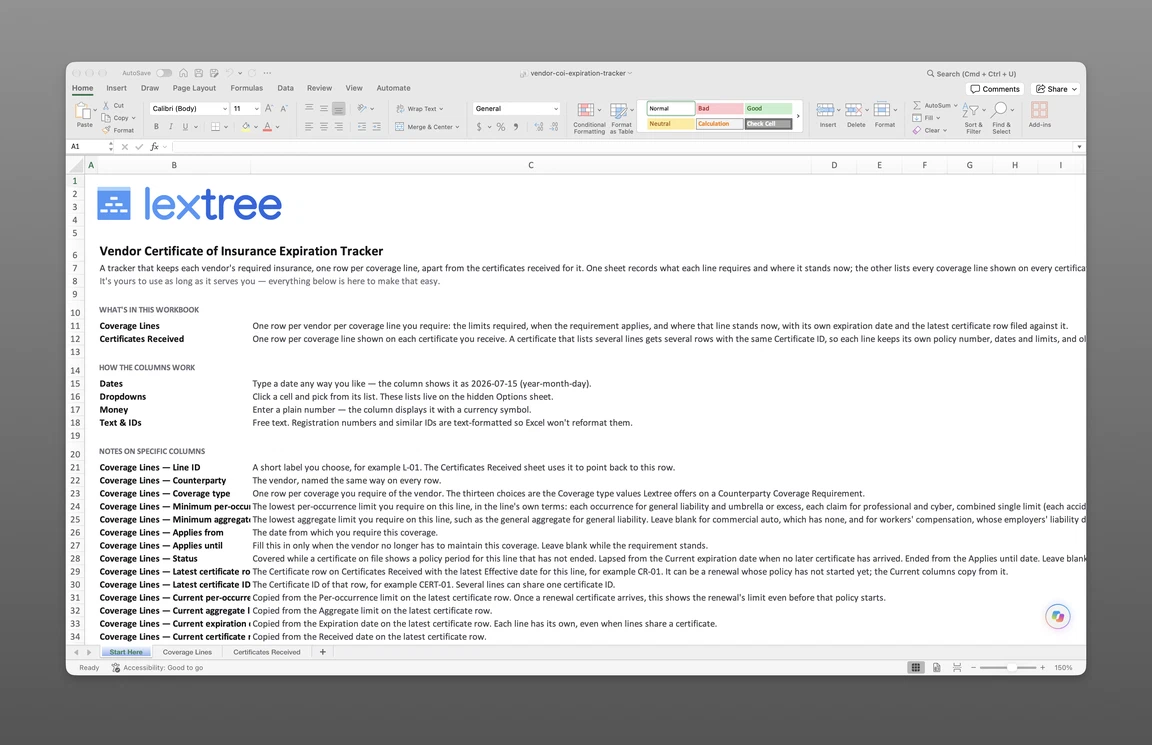
The COI expiration tracker that goes with this page keeps those two levels in two sheets. Coverage Lines holds one row for each line you require of each vendor, with that line’s current dates and limits and the latest certificate it rests on. Certificates Received holds one row for each line shown on each certificate, with the later row that replaced it. It comes filled in with the sample vendors on this page and is sent to your email.
Get the expiration tracker
Enter your email and we’ll send the certificate of insurance expiration tracker to your inbox. Free — no credit card, no call, no follow-up sequence you didn’t ask for.
Tracking Certificate of Insurance Expiration Dates
Here is how to track certificate of insurance expiration dates once every line has its rows. Give each line the current expiration date, limits and received date of its latest certificate row, and read its status from dates alone. The statuses below are read as of 2026-10-16.
The Latest Certificate Rule
“Latest” means latest by effective date. The date a certificate was received does not decide it. A renewal that arrives early becomes the latest row at once, so the line shows the renewal’s future terms before they start.
Ridgeline’s professional liability line shows how that looks. As of 2026-10-16, the old professional policy is still in force until 2026-11-13. The line’s current columns already read 2,000,000 each claim, an expiration date of 2027-11-13 and a received date of 2026-10-08, because CR-07 is the latest row by effective date. The cyber line moves the same way. The general liability line still rests on CR-06 from CERT-02, so it shows the 2026-11-13 date and the 2025-11-18 received date.
Lapsed and Ended Lines
Status comes from dates only. A line is Ended once the requirement’s applies-until date has passed. A line is Lapsed when its latest certificate’s expiration date for that line has passed and the requirement still applies. Any other line is Covered. A status says what the dates show and nothing about the quality of the coverage.
Harbor’s commercial auto line is Lapsed. Its policy period on CR-03 ended 2026-09-23 and no renewal certificate has arrived. Its general liability and workers’ compensation lines, on the same certificate, are both Covered, because their dates are 2027-02-25 and 2026-12-10. Brightfield’s commercial auto line is Ended from 2026-08-19, and it still names CR-10 as its latest certificate. A lapsed or ended line keeps naming its latest certificate.
The sample policies run one year and end on the anniversary of their effective date. A policy period generally begins and ends at 12:01 a.m. standard time at the named insured’s address, so a policy that expires on 2026-09-23 stopped covering at the start of that day. The renewal certificate should be on file before the expiration date arrives.
POLICY EXP is the scheduled end, and the form’s cancellation box says notice goes out under the policy provisions. If a vendor reports a mid-term cancellation, the row on file does not change, and the status column keeps reading dates. Write the notice in the line’s Notes and move the line to the top of the chase list.
Chase Renewals in Date Order
Sort the lines that still apply by current expiration date, earliest first. Lapsed lines come first and ended lines leave the list. Lines that share a certificate and a date go into one request, as Pinecrest’s two lines do. Ridgeline’s professional and cyber lines sit at the bottom, because their renewal is already on file. As of 2026-10-16 the sample list runs like this:
- Harbor, commercial auto, lapsed since 2026-09-23.
- Ridgeline, general liability, ends 2026-11-13.
- Harbor, workers’ compensation, ends 2026-12-10.
- Brightfield, general liability, ends 2027-01-20.
- Harbor, general liability, ends 2027-02-25.
- Brightfield, umbrella or excess liability, ends 2027-03-07.
- Pinecrest, general liability and commercial auto, both end 2027-05-14.
- Ridgeline, professional liability and cyber, renewal on file, both end 2027-11-13.
When a renewal certificate arrives, log its lines as new rows and name the new row on each old row it replaces. The line’s current columns then move onto the new terms, and the line moves down the list to its new date. Ridgeline shows the sequence. Once CR-07 and CR-08 are logged and CR-04 and CR-05 name them, the professional line and the cyber line read 2027-11-13 and move to the bottom, while the general liability line stays second. Because the dates are kept by coverage line, a sort by current expiration date puts the lapsed line first and pushes the lines that renewed early to the bottom.
Each Coverage Line as a Lextree Record
In Lextree, a required coverage line is a Counterparty Coverage Requirement under the vendor. It records the coverage type, chosen from a fixed list that includes general liability, professional liability, workers’ compensation, commercial auto, umbrella or excess liability and cyber liability. It also records the minimum per-occurrence and aggregate limits and the applies-from and applies-until dates. Filling in the applies-until date ends the line and stops its expiration reminder. Certificates are filed under the requirement as Counterparty Insurance Certificates, each with its policy type, insurer, broker, policy number, limits, effective date, expiration date and received date. A three-line ACORD 25 is entered as three certificate records, one under each line. Lextree’s Counterparties module keeps each certificate file against the record it documents.
The requirement’s Current Coverage section copies from the latest certificate by effective date, so a renewal certificate entered before the current one expires moves the section onto the new terms straight away. The requirement’s status moves through Covered, Lapsed and Ended from the same dates. A Coverage expiration event reminds you 60, 30 and 14 days ahead while the requirement still applies, with a note to ask the vendor or its broker for a renewal certificate and file it as a new certificate.
A seeded report, Expiring Counterparty Coverage Requirements, lists each line with its coverage type, minimum and current per-occurrence limit, current expiration date and status. Teams that would rather not maintain a file by hand can read about certificate tracking software for vendor COIs.
Lextree Editorial
Author