Covenant Compliance Certificate Due Dates, Facility by Facility
Where Certificate Due Dates Come From
A covenant compliance certificate is the officer-signed certificate a borrower delivers to its lenders, usually through the administrative agent. It states that no default exists and shows the covenant calculations for the period. The covenant compliance certificate due dates are set by the reporting covenant in each credit agreement, so the schedule starts with that clause.
The Reporting Covenant Clause
In most credit agreements the certificate has no date of its own. The reporting covenant says the borrower will deliver a compliance certificate together with each delivery of financial statements, so the certificate is due when the financial statements are due. Take the credit agreement dated as of February 24, 2014 between IntraLinks, Inc. and JPMorgan Chase Bank, N.A. as administrative agent, filed with the SEC as Exhibit 10.1 to a Form 8-K. Together with each delivery of financial statements, the borrower delivers an Officer’s Certificate and a Compliance Certificate “demonstrating in reasonable detail compliance” with the agreement’s negative covenants, which include its leverage ratio test.
The form of certificate is usually an exhibit at the back of the agreement. Read it early. It shows what the officer has to certify and which calculations have to be attached, and that tells the finance team how much work sits behind each date. The Plantronics credit agreement with Wells Fargo, also on EDGAR, attaches its form as Exhibit A.
Quarter-End and Year-End Windows
The date is period end plus a window. In the IntraLinks agreement, quarterly financials are due within 45 days after the end of each of the first three fiscal quarters. Year-end financials are due no later than 90 days after the end of the fiscal year. Those figures are that agreement’s terms. Another agreement may set shorter or longer windows, and the credit agreement you signed controls. This page is general information and is not legal advice.
The fourth quarter is where schedules go wrong. In agreements written like this one, which ask for quarterly statements only for “the first three Fiscal Quarters,” it has no quarterly row, because the year-end delivery covers it. The Q4 test is therefore certified on the longer annual window, later than the tests for the first three quarters. A schedule that copies the quarterly window onto the fourth quarter shows a due date weeks earlier than the one the lenders will hold you to. A treasurer who sees it may rush a certificate that is not yet due. The reverse error is worse: a calendar that carries the annual window into every quarter shows the first three certificates due weeks after the date the agreement sets.
Other frequencies exist. Some agreements call for monthly certificates. Others require one only on request, or only after a trigger in the agreement is met, as in a springing test. Record these as rows without a fixed date and note the condition that creates one.
Public Filer Deadlines
For a borrower that files with the SEC, the filing calendar and the certificate calendar often move together. Form 10-Q is due 40 days after the end of the fiscal quarter for large accelerated and accelerated filers, and 45 days for all other registrants. It covers the first three fiscal quarters only. Form 10-K is due 60 days after fiscal year-end for large accelerated filers, 75 days for accelerated filers, and 90 days for all other registrants.
The IntraLinks agreement adds a detail that matters here: financial statements included in its SEC filings count as delivered on the date they are publicly available as posted on EDGAR. A public borrower’s statement delivery date and its SEC filing date can therefore be the same event. The certificate still has to be delivered. Deliver it to the agent separately, even when the filing is already public.
Building the Delivery Schedule by Facility
With the clause in hand, you can turn each facility’s covenant compliance certificate due dates into a dated schedule. A compliance certificate delivery schedule is a list of periods, and each period carries a computed date that someone can re-derive. If you only want the covenants themselves in one register, the loan covenant tracking page covers that. This section deals with the dates and the proof around them.
Dating Each Reporting Period
Give every period its own row. Each row records the facility, the borrower entity, the period end, the window from the agreement, the computed due date, the signer, the recipient, and the delivery status. Keep the clause reference next to the computed date, so a reviewer can open the agreement and arrive at the same date.
Compute the date from the agreement’s own wording. Some agreements count calendar days and others count Business Days, and a date that lands on a weekend is handled differently from one document to the next. Read the day-count and Business Day definitions in the agreement you hold and apply them as written. A rule remembered from another facility is the likeliest source of an error here.
Add a status that tells the next reader where each period stands: not yet due, in preparation, signed, delivered. The word “delivered” should mean the delivery record exists, so the status and the evidence for that period are never out of step. When an agreement is amended, change the window on the periods that have not yet closed and leave the closed ones alone.
Several Facilities Side by Side
One borrower group often has a term loan, a revolver, and a bilateral line, each with its own agent. They may define fiscal periods differently, set different windows, and name different recipients. The dates stagger, and the earliest one drives the close calendar. Preparation for that certificate has to begin well before the date, since the calculations depend on closed books. Set the start of preparation from how long your own close takes.
Also write down which entity delivers. When a parent signs for a group, the agreement says whether the borrower or the holding company owes the certificate, and the row should say the same. If the same dates also feed a wider entity schedule, one calendar for every entity deadline is the place to carry them.
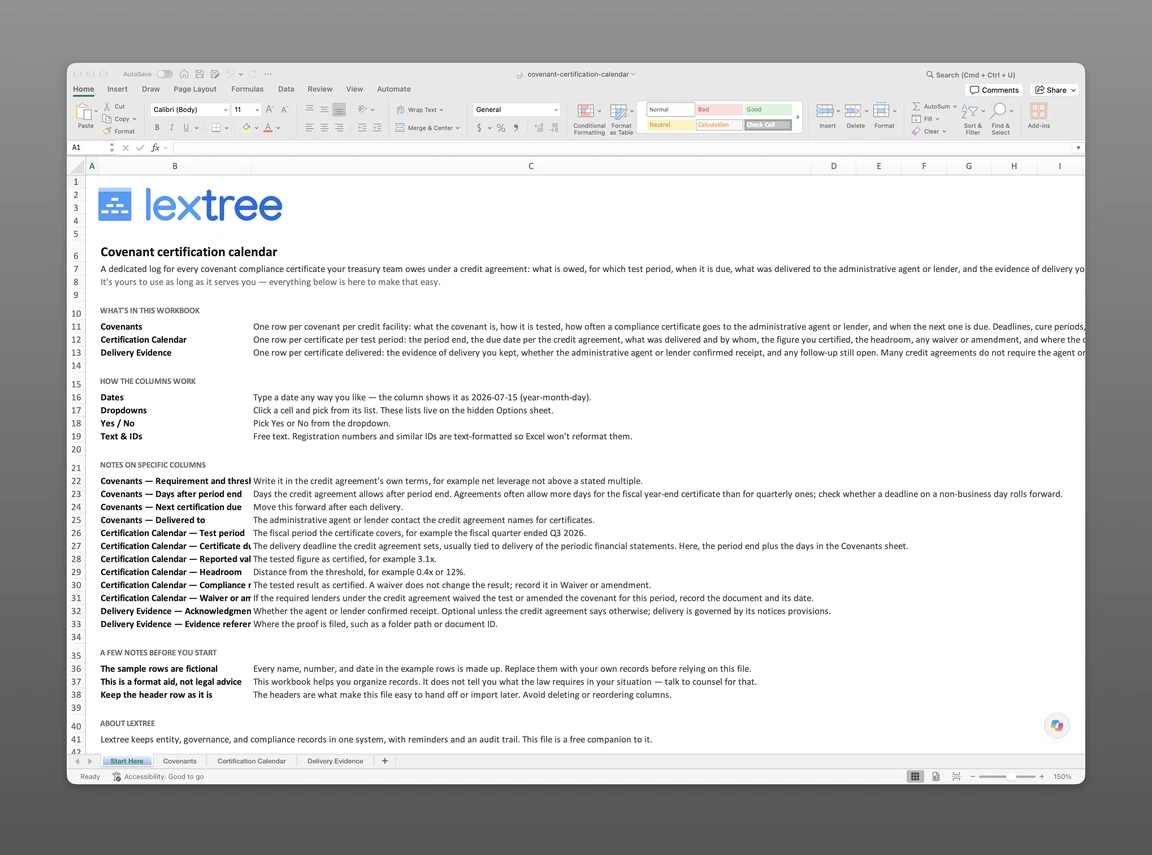
The covenant certification calendar that goes with this page is organized around 3 sheets. Covenants holds each facility’s covenants, how each is tested, how often a certificate is due, and the days allowed after period end. Certification Calendar has one dated row per certificate and test period. Delivery Evidence records when each certificate was delivered, the evidence you kept, whether the agent or lender confirmed receipt, and any follow-up still open. The file is sent to your email after you complete the form below.
Get the certification calendar by email
Enter your email and we’ll send the covenant certification calendar to your inbox. Free — no credit card, no call, no follow-up sequence you didn’t ask for.
Who Signs and Who Receives It
The Financial Officer’s Signature
Agreements commonly define Financial Officer as the chief financial officer, principal accounting officer, treasurer, or controller of the borrower. The definition varies, so check the one in your agreement. Some agreements use a broader Officer definition; the IntraLinks agreement also includes the president and chief executive officer. The officer certifies having reviewed the agreement and the period’s transactions, either in the certificate itself or in a separate Officer’s Certificate delivered with it. The certification states that no Default or Event of Default exists, or else describes the one that does and the action being taken. Forms like the Plantronics exhibit attach a calculation schedule for the financial covenants.
The edge case is the named officer being out when the deadline arrives. Look at who else the definition allows to sign before the date, and not on it. A certificate signed by someone outside the definition invites a question from the agent that nobody wants to answer on the due date. Finance leaders who own lender reporting, as in the CFO role overview, can name the backup signer when the facility closes rather than on the due date.
Agent, Platform, and Lenders
In a syndicated facility the borrower delivers to the administrative agent. The agent may post borrower materials for the lenders on an electronic system that agreements call the Platform. The IntraLinks agreement uses IntraLinks itself, and other agreements name Debtdomain, SyndTrak, or a similar system.
Some lenders do not want material non-public information, so the borrower marks materials “PUBLIC” when they may go to those lenders. A certificate posted to the wrong side is a real failure, and it is easy to make when several people upload to the same Platform. Name one person who marks each upload and a second who checks the marking before it goes to the agent, and record both names with that period’s submission record.
The IntraLinks agreement also has the borrower notify the administrative agent by fax or email when documents are posted, and it says the agent has no duty to monitor the borrower’s compliance with lender delivery requests. Keep your own record of what was posted and when. A bilateral facility skips the Platform and delivers straight to the lender contact named in the agreement.
Evidence of Each Submission
Compliance certificate submission evidence is what you can produce later to show when each certificate went out and to whom. Keep four things for every period.
- The signed certificate as delivered, with its calculation schedule.
- The financial statements it accompanied.
- The delivery record: the Platform upload confirmation or posting notice, or the sent email to the agent or lender, with the date and time.
- The recipient, by name.
Store them together under the facility and the period end, so one search finds the whole package. Save the email as a message file rather than a screenshot, because the headers carry the time stamp. Some agents and lenders confirm receipt, and many agreements do not require them to. When an acknowledgment arrives, file it with the submission record. Do not treat its absence as a failure to deliver. A later lender audit or due-diligence request will ask when each certificate went out, and a folder organized by facility and period answers it in minutes.
When a Due Date Slips or Moves
A certificate delivered after its date is a matter for the amendment, waiver, and consent provisions of the agreement. These often involve a vote of the lenders the agreement defines as Required Lenders (Requisite Lenders in some agreements, including the IntraLinks one). How amendments, waivers, and consents differ is covered separately. For the schedule, record the instrument that extended the date, whether an amendment, a waiver, or a one-time extension letter, and the new date.
Dates also move without anything going wrong. A change in fiscal year, an amendment that changes the reporting frequency, a new facility, or a refinancing can each reset the windows. Re-derive the future rows from the new terms, and leave the earlier rows as they were delivered, so the record still matches what the lenders received.
In Lextree’s Treasury module, each covenant carries its certification frequency and next certification due date, with reminders as the date approaches.
Lextree Editorial
Author