Equipment Inspection Log: Defects, Correction Due Dates and Proof of Repair
What Each Inspection Leaves Behind
A crane certifier’s signed report, a decal on a trailer door and an aircraft mechanic’s logbook entry all belong in one record. An equipment inspection log gives each periodic inspection of one piece of equipment its own row. The row holds the inspector and date, the result, the defects noted, the certificate, report or decal number, the date set for any fix and the date it was done, the proof of repair, and the next due date.
A qualified inspector examines the equipment periodically and usually leaves a certificate, a report or a decal behind. Each row is tied to the item by its asset tag or unit number. Whoever answers for the equipment keeps the log, often a fleet or compliance manager. It is the record they hand over when an auditor or an insurer asks whether a unit is current.
The log works for any equipment and any inspection type, whether a federal rule, a state or local program, an insurer, a lessor, a lender or the company’s own policy calls for the inspection. Federal rules appear below as labelled examples, because their text is public and quotable. Each one sits beside a case that has no regulation behind it.
The Inspections This Log Covers
Vehicles and trailers, aircraft, vessels, heavy equipment, and cranes or lifts all fit. The log holds the periodic inspection by a qualified inspector. For example, under 29 CFR 1926.1412, OSHA’s inspection rule for cranes used in construction, a competent person begins a visual inspection “prior to each shift”, while a qualified person inspects the crane “at least every 12 months”. The annual is the row this log holds. Cranes used outside construction fall under other OSHA rules with their own intervals, such as 29 CFR 1910.179 for overhead and gantry cranes and 29 CFR 1910.180 for crawler, locomotive and truck cranes.
Trucks split the same way. Under 49 CFR 396.11, a driver prepares a written report “at the completion of each day’s work” on each vehicle operated, though no report is needed when no defect or deficiency is found or reported. The periodic inspection under 49 CFR 396.17 goes in the log. An insurer’s yearly inspection of a forklift, or an annual check of a scissor lift that an outside inspector does because company policy calls for it, gets the same kind of row.
Daily checks belong on their own checklist or report form, and routine service belongs in an equipment maintenance log. When a repair answers an inspector’s write-up, the maintenance log records the work and this log names it as the proof of repair.
The item itself, with its ownership and title papers, sits in a fixed asset register. This log borrows only its identifier. Worksite inspections by a regulator or insurer have their own inspection findings tracker.
Report, Decal or Signed Logbook
Each inspection leaves the inspector’s name, the date, the inspection type and, when one exists, a document number. For example, under 49 CFR 396.21 the qualified inspector who performs a DOT annual inspection prepares a report that names the inspector, the carrier, the date and the vehicle. It also lists the components inspected and the results, and certifies that the inspection is accurate and complete. Under 49 CFR 396.17(c), documentation of the inspection must be on the vehicle, and it may be that report or another form based on it, such as a “sticker or decal”. The report or decal number goes in the certificate column.
An aircraft inspection leaves something different. Under 14 CFR 43.11 the person approving or disapproving return to service makes a maintenance record entry. The entry gives the type and extent of the inspection, the date and the aircraft’s total time in service, that person’s signature and own certificate number, and a certifying statement. That number identifies the mechanic, and the inspection gets no certificate number of its own, so the certificate column stays blank. An insurer’s survey or a lessor’s inspection may leave only a dated letter or service sheet, so log its date and reference.
The rows in this guide come from the companion file’s fictional Sample Freight Co., and every value is invented. This page is not legal advice. The first two sample rows show the difference between a report and a logbook entry.
| Unit | Inspection | Date | Inspector | Result | Certificate number | Note |
|---|---|---|---|---|---|---|
| SAMPLE-UNIT-01 (day cab tractor) | DOT Annual Inspection | 2026-03-04 | Sample Inspection Services Inc. | Pass | SAMPLE-0000101 | Inspection report scanned the same day. |
| SAMPLE-UNIT-03 (single-engine utility aircraft) | FAA Annual Inspection | 2026-02-12 | Sample Aviation Maintenance LLC | Pass | (blank) | Recorded as a signed logbook entry, with no separate certificate. |
When the Inspector Finds Defects
The crane certifier’s report comes back with two items written up. Record the result as the inspector states it; the file offers Pass, Pass with Defects, Conditional and Fail.
Copying Defects From the Report
Copy the defects in plain words from the inspector’s document, item by item, without re-grading them. A DOT report identifies “those components not meeting the minimum standards” (49 CFR 396.21(a)(5)). When an aircraft is found unairworthy, the inspector gives the owner or lessee “a signed and dated list of those discrepancies” (14 CFR 43.11(b)). The crane annual documentation records “the items checked and the results of the inspection” (29 CFR 1926.1412(f)(7)(i)). An insurer’s survey letter with recommendations gets copied the same way.
The crane (SAMPLE-UNIT-02, mobile crane, yard) was inspected on 2026-01-20 by Sample Lift Certifiers Inc. and came back Pass with Defects: “Worn wire rope near the hook block; load chart plate faded.” The tractor (SAMPLE-UNIT-01) failed its emissions test on 2026-05-20 at Sample Testing Station: “Check-engine light on, with a fault code for an exhaust sensor.” The harbor work boat (SAMPLE-UNIT-04) came back Pass with Defects from its USCG Safety Examination on 2026-04-22: “Two spare flares past their expiry date. The required flares are in date.” Filtered to the rows with defects, the log works as an equipment defect log for the whole fleet.
Setting a Repair Deadline
The date set for the fix comes from the inspector’s report when it gives one, or from a rule, contract or policy that sets a repair period. Otherwise your team agrees it. Some defects bar use until fixed, so check the report and read the next section before you set a later date.
When a fix runs late, keep the original date set, enter the real completion date and note why. Moving the due date to match the repair erases the evidence that it was late. The table below shows an early fix, a late one and an open one.
| Unit | Inspection | Date set for the fix | Completed | What happened |
|---|---|---|---|---|
| SAMPLE-UNIT-01 | Emissions Test, 2026-05-20 | 2026-06-19 | 2026-06-12 | Fixed a week early and re-tested the same day |
| SAMPLE-UNIT-02 | Crane / Lift Certification, 2026-01-20 | 2026-02-19 | 2026-03-05 | 14 days late, parts back-ordered; out of service until the new rope was fitted |
| SAMPLE-UNIT-02 | Crane / Lift Certification, 2026-09-08 | 2026-10-08 | open | Past the date set; tagged out of service |
| SAMPLE-UNIT-04 | USCG Safety Examination, 2026-04-22 | 2026-05-22 | 2026-05-18 | Flares replaced before the date |
Tagged Out Until Repaired
Whether equipment with an open defect stays in service depends on the defect and on any rule, contract or policy that applies. Record the decision on the row, in the notes. For example, under OSHA’s construction crane rule, 29 CFR 1926.1412(f)(5), the qualified person may decide that a deficiency found in the annual inspection is a safety hazard. In that case the crane “must be taken out of service until it has been corrected”. The rule makes an exception when “temporary alternative measures are implemented” for certain operational aids, as 29 CFR 1926.1416(d) and 1926.1435(e) specify. A company policy can be just as strict, such as parking a forklift with a failed brake test until it is repaired.
The sample’s second crane inspection shows the edge case. On 2026-09-08 Sample Lift Certifiers Inc. rated the crane Conditional and wrote up this defect: “Cracked weld on the outrigger beam.” The row carries certificate SAMPLE-0000202 and a next due date of 2027-09-08. The date set for the fix was 2026-10-08, with no completion date. The note reads: “Still open and past the date set. Crane tagged out of service until the weld is repaired. Chase the repair vendor.” A cracked weld is the kind of item an annual crane inspection looks for. For example, OSHA’s construction crane rule lists “Welds for cracks” among the items a qualified person inspects at least every 12 months (29 CFR 1926.1412(f)(2)(i)(C)).
The certificate runs for another year, yet the open fix decides whether the crane can lift today. This sample row does not claim the rule above applied; the sample company’s team chose to tag the crane out.
Proof of Repair, Then the Next Inspection
A row with a defect stays open until it has a completion date and a named piece of proof. After a re-test or re-inspection, the next due date comes from that newest certificate or report. A repair invoice on its own does not move the next inspection date.
Work Orders, Invoices and Photos
Proof of repair is a document you can name, with its date and the place it is filed. A work order, an invoice, a re-inspection certificate and a dated photo all qualify. The crane’s wire rope fix is logged with “Invoice for new wire rope and plate, photos of both, dated 2026-03-05”, filed in “Equipment folder / UNIT-02 / Corrective actions”. The tractor’s sensor repair is logged with “Work order WO-SAMPLE-1 and invoice for the replacement sensor, dated 2026-06-12”, filed in “Fleet folder / UNIT-01 / Repairs”. The boat’s flares are logged with “Receipt for replacement flares and a dated photo of the stowed kit”.
A log that keeps the proof on the same row as the inspection is an equipment inspection and corrective action log in one.
Reading the Next Due Date
The sample’s failed emissions test has no certificate and no next due date of its own. After the repair on 2026-06-12, the same-day re-test passed and is logged as a new row, with certificate SAMPLE-0000102 and a next due date of 2027-06-12. The note says the date comes from the test certificate, which is also the proof listed on the failed test’s row.
Take the next due date from the certificate, report or decal. The boat’s note reads “Next due date taken from the exam decal. Intervals vary by vessel type.” For example, under 14 CFR 91.409(a), an aircraft may not be operated unless it has had an annual inspection “within the preceding 12 calendar months”. Paragraph (c) makes exceptions, such as an aircraft that carries a special flight permit. The 12-calendar-month count is why the sample aircraft’s 2026-02-12 annual carries a next due date of 2027-02-28, the end of the 12th calendar month. An insurer’s or lessor’s yearly inspection is dated from the letter or the contract instead.
A Trailer Past Due
The overdue example is the sample’s dry van trailer, SAMPLE-UNIT-05. Its DOT Annual Inspection was done on 2025-10-28 by Sample Inspection Services Inc. and passed, with certificate SAMPLE-0000501 and a next due date of 2026-10-28. The note reads: “Next due date has passed and no later inspection is logged. Schedule it before the trailer goes back on the road.”
The trailer gets a separate row and a separate date, and the tractor’s annual, next due 2027-03-04, says nothing about the trailer’s. For example, under 49 CFR 396.17(a) the term commercial motor vehicle “includes each vehicle in a combination vehicle”, so a semitrailer is inspected on its own, apart from the tractor that pulls it. Under 396.17(c), a carrier may not use a commercial motor vehicle unless it passed an inspection “at least once during the preceding 12 months”. A lessor’s or insurer’s annual inspection of a forklift sets the same kind of date.
To find overdue rows in an equipment inspection log, sort by next due date and look for a newer row of the same inspection type. The file is a plain log with no status column and no formulas, so it does not flag a late row for you.
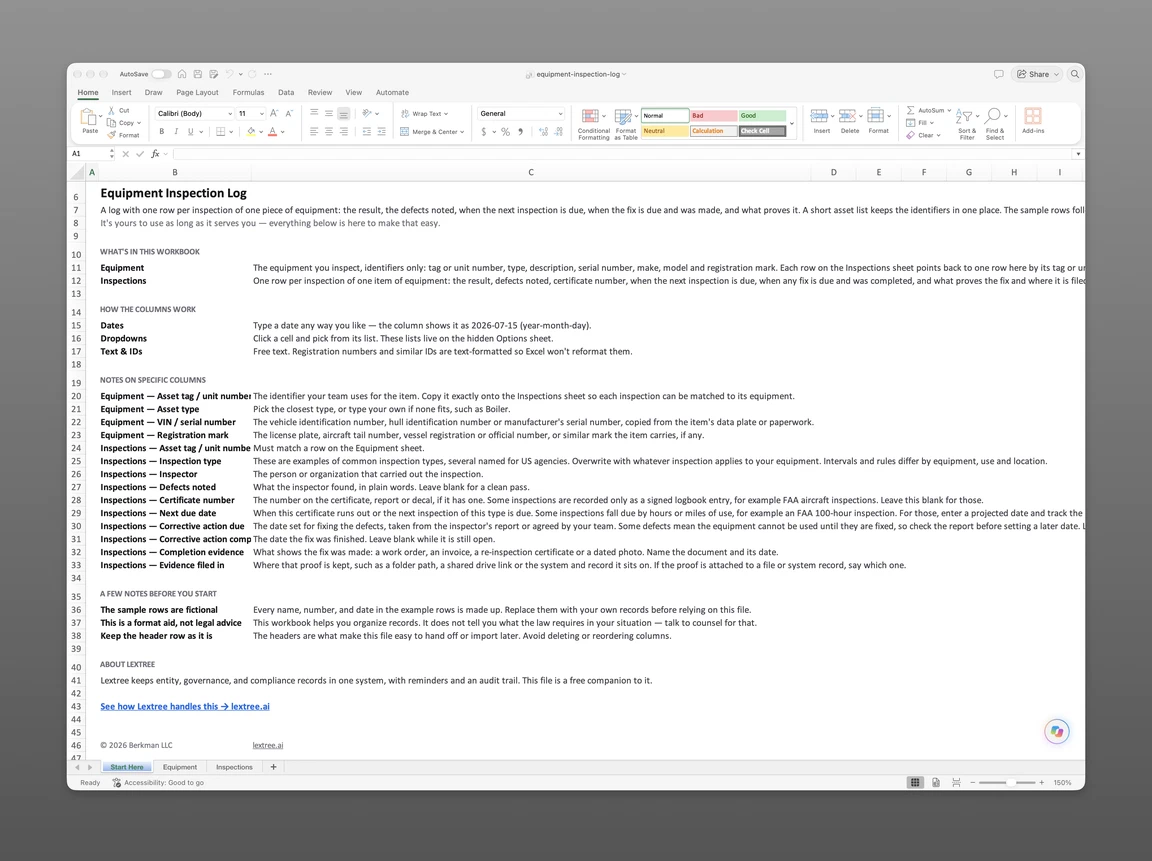
The companion file holds the equipment inspection log on its Equipment and Inspections sheets. The Equipment sheet keeps each item’s identifiers under its asset tag or unit number, and the Inspections sheet gives every inspection one row with its result, defects, dates and proof of repair. The Sample Freight Co. rows show how the columns read. Replace them with your own once the file reaches your email.
Get the equipment inspection log
Enter your email and we’ll send the equipment inspection log to your inbox. Free — no credit card, no call, no follow-up sequence you didn’t ask for.
Questions About Equipment Inspection Records
Due Dates for One Asset
How do you set a next due date for an inspection that falls due by hours or miles?
Enter a projected date and track the hours or miles too, because the hours decide. For example, an aircraft carrying people for hire needs an annual or 100-hour inspection “within the preceding 100 hours of time in service” (14 CFR 91.409(b)). The sample aircraft’s 100-hour inspection of 2026-06-15 has no certificate number and a projected next due date of 2026-09-15. Its note ends: “The logbook shows the 100 hours are used up and no later inspection is logged. Schedule it before the aircraft flies for hire again.” The date is only a projection, and the logbook hours, not the calendar, show that this inspection is now due. A heavy equipment hour-meter interval set by a manufacturer or lessor works the same way.
What if one asset has more than one inspection?
Each inspection type keeps separate rows and a separate next due date, and the newest row of each type is the one to watch. The sample tractor has a DOT annual due 2027-03-04 and an emissions test due 2027-06-12, and the sample aircraft has an annual and a 100-hour inspection. A 100-hour inspection replaces the annual only if it “is performed by a person authorized to perform annual inspections and is entered as an ‘annual’ inspection in the required maintenance records” (14 CFR 91.409(a)). An insurer’s survey likewise does not replace a crane’s annual.
Leased Units and Old Reports
What about equipment someone else inspects, such as a leased trailer or a rented lift?
Log it anyway, with a copy of the latest report. For example, a motor carrier sometimes operates a vehicle whose last annual inspection it did not perform. That carrier “is responsible for obtaining the original or a copy of the last annual inspection report upon demand of an authorized Federal, State, or local official” (49 CFR 396.21(b)(3)). For a rented lift, ask the rental company for its latest inspection certificate at delivery.
How long should equipment inspection records be kept?
Rules differ by equipment. In two federal examples, the motor carrier or other entity responsible for a DOT annual inspection keeps the report “for a period of fourteen months from the date of the inspection report”. It is kept where the vehicle is housed or maintained (49 CFR 396.21(b)(1)). Under OSHA’s rule for cranes used in construction, the employer that conducts the annual inspection keeps its documentation “for a minimum of 12 months” (29 CFR 1926.1412(f)(7)). An insurer, a lender, a lessor or your own policy may ask for a longer history. A simple practice is to keep each row for as long as you hold the asset, and each report at least as long as the longest period that applies.
Equipment Inspection Tracking in Lextree
In Lextree’s Assets module, each inspection is an Asset Inspection record under the asset it covers, titled from its inspection type and date. Its fields are Inspection type, Inspection date, Inspector (an organization or a person), Result, Defects noted, Certificate number, Next due date, Corrective action due, Corrective action completed and Notes. The Result options come seeded as Pass, Pass with Defects, Conditional and Fail, and they are defaults. Each inspector’s record also lists the inspections it carried out.
Lextree suggests an “Inspection Due” event from the next due date, with reminders 30, 14 and 7 days before. It suggests a “Corrective Action Due” event from the corrective action due date, with reminders 14, 7 and 1 day before, and entering the completed date stops that reminder. Both are seeded defaults, and event reminders come by email and in-app. The inspection certificate and the proof of repair, such as work orders, invoices and photos, are kept as attachments on the record.
The Annual Inspection workflow is launched by hand from the asset’s page and is due 30 days after launch. Its steps cover inspection scheduling, asset preparation and the inspection outcome, where you record the result, certificate number and next due date and note any defects. For a failed or conditional result, a corrective action determination step sets the due date and describes the work. On completion it creates the Asset Inspection record linked to the asset. See how inspections sit under an asset in the help center.
Lextree Editorial
Author