How to Extract Obligations From a Contract, With Each Clause Cited
What Contract Obligation Extraction Should Produce
A supply agreement has just been signed, the first quarterly report and insurance certificate are still ahead, and someone asks for a list of what each side owes. Whoever takes the request needs to know how to extract obligations from a contract in a form a second reader can check against the signed text.
The output of contract obligation extraction is a list with one entry per obligation. Each entry says what must be done, who owes it, how often it recurs, when it falls due next and which clause it comes from. Alongside the entries sits a record of every clause read.
The method needs only the signed agreement and a place to write the entries, so it works by hand, with no contract-reading software. The sections below run it on one sample agreement.
The Sample Supply Agreement
The example is the Sample Supply Agreement between Sample Fasteners LLC and Sample Components Inc. Sample Fasteners is the customer and the party whose records these are, so the entries call it Our party. Sample Components is the supplier, the Counterparty. The agreement took effect March 9, 2026, has an initial one-year term ending March 8, 2027, and renews for one-year terms under clause 8.1.
The clauses, in printed order, are 1.1 Defined terms, 1.2 Business Day, 2.1 Delivery of ordered goods, 2.2 Forecasts, 3.1 Payment of invoices, 3.2 Price review notice and 4.1 Certificate of insurance. They continue with 5.1 Quarterly delivery report, 6.1 Audit access, 6.2 Audit hours, 7.1 Confidentiality, 8.1 Term and renewal and 9.1 Entire agreement, followed by Schedule 2, Insurance requirements. Each was read between October 12 and 14, 2026, and the dates below are as of October 15, 2026.
Every party, clause and date in this example is invented, and nothing on this page is legal advice.
The Obligations, Clause by Clause
In this contract obligation extraction example, each row is one obligation the agreement creates, with the clause it comes from:
| Clause | Obligation | Obligor | Type | Frequency | Next due |
|---|---|---|---|---|---|
| 2.1 | Ship each accepted purchase order to Sample Fasteners LLC | Counterparty | Reporting / Deliverable | On Trigger | Blank until an order is accepted |
| 2.2 | Send Sample Components Inc. a rolling six-month forecast of order volumes | Our party | Reporting / Deliverable | Monthly | November 6, 2026 |
| 3.1 | Pay each undisputed invoice from Sample Components Inc. | Our party | Payment | On Trigger | Blank until an invoice arrives |
| 3.1 | Notify Sample Components Inc. in writing of any disputed invoice amount | Our party | Notification | On Trigger | Blank until an invoice arrives |
| 3.2 | Give Sample Fasteners LLC written notice of any proposed price change | Counterparty | Notification | One-Time | November 12, 2026 |
| 4.1 | Deliver a certificate of insurance to Sample Fasteners LLC | Counterparty | Insurance | Annual | March 9, 2027 (provisional) |
| 5.1 | Send Sample Fasteners LLC a report of units shipped and on-time delivery for the quarter | Counterparty | Reporting / Deliverable | Quarterly | October 21, 2026 |
| 6.1 | Give Sample Fasteners LLC access to production and quality records | Counterparty | Audit & Records | On Trigger | Blank until a written request arrives |
| 7.1 | Keep the other party’s confidential information from third parties | Both | Restrictive Covenant | Continuous | Not dated |
| 8.1 | Give written notice before the term ends if the agreement should not renew | Both | Renewal & Termination | Annual | December 8, 2026 |
Clauses 1.1, 1.2, 6.2 and 9.1, and Schedule 2, produced no obligation of their own, yet each was read and recorded. Three entries, for 2.1, 4.1 and 6.1, still wait on an answer. Clause 3.2 states November 12, 2026 itself, and 2.2 falls due on the 6th of each month. Counting from the clause gives two other dates. The quarter ended September 30, 2026, so 21 days later is October 21, 2026. The term ends March 8, 2027, so counting 90 days back from the end of the term gives December 8, 2026.
How to Identify Obligations in a Contract
Six steps show how to extract obligations from a contract and tie each one to its clause.
- Read the definitions first and mark every defined term that sets a time or a trigger.
- Go through every clause, schedule and exhibit in printed order and record what each one turned out to be, including clauses with no obligation.
- For each obligation, write the clause reference exactly as printed and copy the clause’s operative words.
- Record which party owes it, what kind of obligation it is, how often it recurs, and how its due date follows from the clause.
- Log every ambiguity as a question and hold the dates it affects until it is answered.
- Check each entry against the clause it cites before anyone relies on its next due date.
Definitions Before Duties
Clause 1.1 lists the defined terms, which appear capitalized in later clauses and keep their capitals when copied into an entry. Clause 1.2 defines Business Day, which sets the clock for 2.1 (10 Business Days after acceptance) and 6.1 (5 Business Days after a written request). It does not say whether holidays observed where the supplier ships from count, so the gap was logged as a question before either one was dated.
A definition or exclusion can narrow an obligation. The exclusion in 7.1 for information already public through no fault of the receiving party limits the confidentiality obligation, and the 7.1 entry carries it.
Words That Create an Obligation
To identify obligations in a contract, read for “shall” plus a verb, which marks a duty. Clauses 2.1, 2.2, 3.1, 3.2, 4.1, 5.1 and 6.1 all use it. “Shall not” marks a restriction, as in 7.1, where neither party may disclose the other’s Confidential Information. In 8.1, “unless either party gives written notice” hands each party a choice with a deadline attached.
“Will”, “must” and “agrees to” can also create a duty, and “may” grants a choice. A passive clause such as “invoices are to be paid” hides who owes it, so check whom the clause binds. In 2.2, “use reasonable efforts” sets a standard that the entry carries as a condition. A clause can create a duty, a right or a restriction, and the extraction covers all three.
Timing words get copied as written, because each fixes a date differently: within, after, on or before, each year, each calendar quarter, not less than … before.
In a supply agreement, obligations usually sit in the clauses on delivery, payment, price changes, insurance, reporting, audit, confidentiality, and term and renewal. Boilerplate such as 9.1, Entire agreement, held none, but it is still recorded as read, so a reviewer can see it was not skipped.
Clauses That Qualify Other Clauses
Clause 6.2 limits audit hours and creates no duty of its own. It is recorded as a condition on another clause, and its limit goes into the 6.1 entry, whose condition reads “Written request only; once in any 12 months (6.1); normal business hours (6.2)”. Clause 4.1 requires a certificate “evidencing the coverage required by Schedule 2”, so the schedule is read too, and its limit, general liability coverage of at least $2,000,000 per occurrence, goes into the 4.1 entry.
Clause 2.1 names no delivery term. When a delivery clause does name one of the ICC’s Incoterms® 2020 rules, the rule allocates costs, risks and obligations between seller and buyer. Each of the eleven rules is set out in numbered articles, A1 to A10 for the seller and B1 to B10 for the buyer. Record the rule, its named place and its edition with the delivery entry, and ask counsel which of those articles to log as separate entries.
Recording Each Obligation Against Its Clause
Cite the Clause as Printed
A second reader can verify contract obligations with clause references, so every entry starts with the reference exactly as the agreement prints it: “7.2(b)”, “4.1” or “Schedule 2”. Never renumber or tidy it.
One clause can produce more than one entry. Clause 3.1 produces two, one for paying undisputed invoices and one for disputing an amount, and two clauses can feed a single entry, as 6.1 and 6.2 do for audit access.
When an amendment replaces a clause, the reference finds every entry that clause touched. When a tool drafted the list, it is how a person checks the tool.
Copy the Operative Words
Beside a plain-language version that starts with a verb, each entry carries the clause’s own trigger and timing words, copied exactly. For 5.1, the operative words are “shall deliver to Customer a written report of units shipped and on-time delivery performance within 21 days after the end of each calendar quarter”. The plain version reads “Send Sample Fasteners LLC a report of units shipped and on-time delivery for the quarter”, and the date basis is “21 days after quarter end”.
A note that paraphrases the clause drops the words that decide the date. Each calendar quarter can end on different days from a fiscal quarter, and “after the invoice date” in 3.1 starts the count earlier than “after receipt” would. Clause 3.1 also runs a second clock, 14 days after receipt of the invoice for disputing an amount, which a note reading “pay within 45 days” leaves out.
Party, Type and Timing
The obligor is the party that bears the obligation or, for a right, the party that holds it: Counterparty for 4.1, Our party for 3.1 and Both for 7.1. The type is the closest fit, such as Insurance for 4.1 and Audit & Records for 6.1.
Frequency says how often an entry recurs. The date basis says how the due date follows from the clause, and the next due date stays blank while the clause waits for a trigger, as it does for 2.1, 3.1 and 6.1. When the clause supplies a count, the entry supplies a date, as 5.1 does with October 21, 2026 and 8.1 with December 8, 2026.
Where an audit clause asks for a report each year instead of access on request, that delivery is an annual entry with its own due date. A SOC 2® report from a service provider and a SOC for Supply Chain report from a manufacturer are two examples, and both belong to the AICPA’s System and Organization Controls suite.
Checking the Extraction Against the Contract
“Where does it say that?” is the question a second reader asks of every entry. Each entry starts as a draft. The second reader, or the same reader on another day, opens the agreement at the cited clause and checks that the operative words match exactly and that the obligor follows from whom the clause binds. The date has to recompute from the date basis, and any qualifying clause or schedule has to be carried into the entry. In the sample, the entries for 2.2, 3.1, 3.2, 5.1 and 8.1 have been checked against their clauses, 2.1, 4.1 and 6.1 wait on a question, and 7.1 is still a draft.
Ambiguities to Resolve First
Three questions came up while reading the sample.
Clause 1.2: does Business Day exclude holidays observed where Sample Components Inc. ships from, or only weekends? The question went to our counsel on October 12, 2026, and no answer has come back, so the dates for 2.1 and 6.1 are on hold.
Clause 4.1: does “each year” run from the Effective Date or from the date the supplier’s policy renews? The question went to the counterparty’s contract contact on October 13, 2026. The certificate will arrive as an ACORD 25 Certificate of Liability Insurance, and ACORD says the majority of certificates are issued upon policy renewal, so the certificate date and the agreement’s anniversary can differ. March 9, 2027 stays provisional until the answer arrives. A certificate “is NOT an insurance policy” in ACORD’s words, so the $2,000,000 limit is checked against what the certificate lists. See also what a certificate shows and what the policy holds.
Clause 8.1: do the 90 days count back from the last day of the initial term or from the first anniversary of the Effective Date? The counterparty’s contract contact answered on October 14, 2026 that the initial term ends March 8, 2027. The next due date became December 8, 2026, and the entry moved to Checked against clause. See also how a notice deadline differs from the end of the term.
For each question, record the question, who was asked, the answer and what changed.
Reviewing AI-Extracted Obligations
If a tool drafted the list, every entry stays a draft until a person has read the clause it cites. A reviewer looks hardest where a sentence read alone gives the wrong answer. In the sample, the definition in 1.2 changes 2.1 and 6.1, the audit hours in 6.2 limit 6.1, the limit in Schedule 2 belongs to 4.1, and 7.1 binds both parties. The “each year” in 4.1 also needs a start date before it becomes a date.
The cited clause has to contain the words copied into the entry. If they are missing, the entry is unchecked, whoever or whatever drafted it.
Where the Extracted Obligations Go Next
In Lextree’s Contracts module, each obligation as its own record under the contract carries a clause reference, written like “13.2”, “Clause 6.6” or “§2.2”. The record also holds a description with the clause language as extracted and the party it binds. It takes an obligation type from a list the module comes set up with and your team can extend, along with a frequency, a threshold, and a next due date.
The next due date drives the Obligation Deadline Reminder, which the module suggests at 60, 30 and 7 days before the date when the record is created or the date changes, and only when a date is filled in. For a recurring obligation, the date is moved forward after each performance. The full contract register keeps obligations beside each contract’s parties and documents.
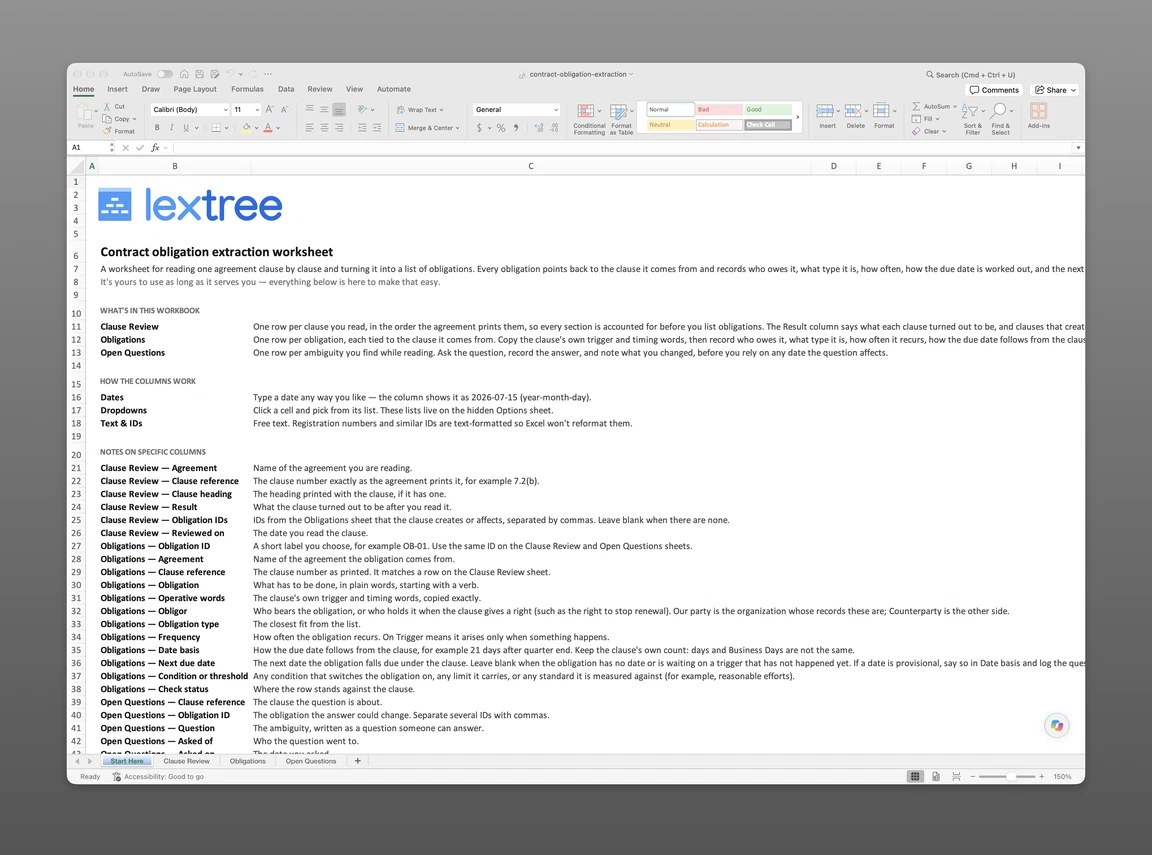
The file has 3 sheets. Clause Review holds each clause read, in printed order, with what it turned out to be. Obligations holds each obligation with its clause reference and the clause’s operative words, and Open Questions holds the ambiguities to settle before anyone relies on a date. It comes with the Sample Supply Agreement filled in, and it is sent to your email.
Get the contract obligation extraction file
Enter your email and we’ll send the contract obligation extraction file to your inbox. Free — no credit card, no call, no follow-up sequence you didn’t ask for.
Lextree Editorial
Author