Inspection Findings Tracker: Corrective Actions and Closure Evidence
How an Inspection Finding Is Raised
On the calendar, an inspection is finished the day the inspector drives away. The report that arrives a few weeks later says otherwise. Every finding in it is still open and needs a corrective action, a date and proof. An inspection findings tracker gives each finding a separate row, with the corrective action, owner, due date, corrected date, closure evidence and status, so the visit stays open until the last finding is closed.
The life of a finding runs in five steps:
- The finding is raised in the inspection report.
- A corrective action, an owner and an action date are recorded.
- The work is finished, and the corrected date is entered.
- The evidence that the work was done is filed, with a note of where it lives.
- Someone other than the owner checks the evidence, and the finding is closed.
The inspection itself closes only when every one of its findings has reached the end of that list. The rest of this page follows two fictional inspections through those steps, an internal audit at a distribution center and a regulatory safety inspection at a plant. Both are in the companion file, with a reference date of October 15, 2026.
Regulator, Insurer, and Internal Findings
Findings come from more than regulators. A regulatory environmental or safety inspection, a fire or building inspection, an insurer’s loss-control survey, an internal audit and a customer or supplier audit all end in a list of items someone must fix. Tracking corrective actions from inspections works best when all of them share one structure, because the same person usually chases the work whatever the source.
Regulator inspection findings arrive in writing, often well after the visit, so a finding row usually starts on the date the report was received. Two federal examples show how different the paper can be. A federal OSHA citation must “describe with particularity the nature of the alleged violation” and “fix a reasonable time or times for the abatement of the alleged violation” (29 CFR 1903.14(b)). An EPA Notice of Violation says the agency believes a violation occurred and explains how to return to compliance, and EPA states that “NOVs are not a final EPA determination that a violation has occurred.” Either document can be disputed, which is why the tracker has a place to record a contested finding.
Insurer and internal findings carry dates the parties agree between themselves, since no regulation sets them.
Use the Report’s Item Numbers
Each finding row carries the inspection reference and the report’s own numbering: “Citation 1, Item 2” on an OSHA citation, “Item 3” on an internal audit. Copy it as printed and do not renumber. A federal OSHA abatement submission must state “the citation and item numbers to which the submission relates” (29 CFR 1903.19(h)(1)), so evidence filed under the report’s numbering is ready to send without a translation step.
If the report classifies a finding in its own words, record those words. Your own rating can sit beside them, but an inspector will recognize the report’s wording.
The Corrective Action and Its Date
Write the corrective action as the fix, such as “restock the kit and set a monthly stock check”, and name one accountable person as owner. A department cannot answer a question about status. An observation with nothing asked for gets “None required” and the status No action required, so it stops appearing as open work.
The due date, which the companion file calls the action date, comes from different places. On a federal OSHA citation the agency fixes it. An EPA Notice of Violation gives instructions for coming into compliance. An insurer’s recommendation or an internal audit carries a date your team agrees. Copy the date from the report or the correspondence. The companion file does not calculate or confirm any date.
Dates move, and the tracker should show how. Sometimes an employer makes a good-faith effort and still cannot finish for reasons beyond its control. Under 29 CFR 1903.14a it may file a written petition for modification of abatement date with the Area Director “no later than the close of the next working day following the date on which abatement was originally required.” The petition lists the steps already taken and their dates, the extra time needed, the reasons and the interim protection for employees. It also certifies that a copy has been posted at the workplace and, where employees have a representative, served on that representative (1903.14a(b)–(c)). In the tracker, enter the current date in the action date column and keep the original in Notes. On a federal OSHA citation, the employer has 15 working days from receiving the notice of proposed penalty to file a notice of contest (29 U.S.C. § 659(a); 29 CFR 1903.17(a)). The employer may contest the citation item itself. If the contest is in good faith, and not solely for delay or avoidance of penalties, the correction period does not begin to run until the Review Commission enters a final order (29 U.S.C. § 659(b)). The notice of contest must say whether it is directed to the citation, the proposed penalty, or both (29 CFR 1903.17(a)). A citation item that is not contested keeps the later of the abatement date in the citation and any date set by a petition for modification or an informal settlement agreement (29 CFR 1903.19(b)). Asking for an informal conference does not extend the 15 working days (29 CFR 1903.20). While a contest of the citation item is pending, leave the action date blank and keep the citation’s original date in Notes. If only the penalty is contested, the citation’s date stays in the action date column.
Corrected Is Not Yet Closed
A finding is corrected when the corrective action is finished. It is closed when the evidence of that work is on file and a second person has checked it. Most trackers fail in the gap between the two, because a single “done” column records the first event and assumes the second.
Recording the Corrected Date
The corrected date is the day the work was completed, kept apart from the action date. Comparing the two tells you whether the work was on time. Entering the corrected date does not close the finding.
Federal OSHA adds a second date to track. Within 10 calendar days after the abatement date, the employer must certify to OSHA that each cited violation has been abated. The certification gives “the date and method of abatement” and a statement that affected employees and their representatives were informed (29 CFR 1903.19(c)). No certification is needed where the compliance officer saw the abatement happen within 24 hours of identifying the violation and noted it in the citation (1903.19(c)(2)). A finding the citation notes as abated on site still needs a row: record the date of that abatement and use the citation itself as the evidence reference. A finding fixed during the visit but not noted that way in the citation still needs the certification. In states that run an OSHA-approved State Plan, the state agency issues the citations and its own rules on contests, petitions and certification apply, so check them before relying on the federal dates here.
What Counts as Closure Evidence
Corrective action closure evidence is whatever a skeptical reader could use to confirm the problem is gone without visiting the site. Typical items include:
- Dated photos of the corrected condition, and not only of the original defect
- A vendor service record or receipt
- A completed work order
- A training or attendance record
- A revised procedure, with its effective date
- Written confirmation from the inspecting party
For willful and repeat violations, and for serious violations where the citation requires it, federal OSHA requires abatement documentation with the certification. Under 29 CFR 1903.19(d)(2), documents showing abatement is complete can include, among others, evidence of the purchase or repair of equipment, photographic or video evidence, or other written records. The tracker’s evidence reference field records where the proof lives, such as a photo set, a work order number or a file path. It does not hold the proof itself. A finding with a corrected date and an empty evidence reference is corrected only.
A Second Person Verifies
Someone other than the action owner looks at the evidence, decides whether it shows the finding is fixed, and records their name and the date. Only then does the status become Closed - evidence verified. An owner who checks their own work will usually pass it. When an earlier inspection raised the same condition, the checker should also ask whether this fix will hold, since a condition that comes back suggests the last fix did not hold.
The inspecting party may judge the response differently. When a confirmation comes back from a regulator or an insurer, file it as evidence. A contested finding stays contested, with the outcome of the review written in Notes, and is never closed by doing the work and moving on.
Tracking Corrective Actions From Inspections
The sample data in the companion file shows why this matters. Here are the two inspections as they stand on October 15, 2026. The internal audit at Sample Distribution Center East took place on August 12 and its report arrived on August 26. The regulatory safety inspection at Sample Plant North took place on September 8 and its report arrived on September 24.
Where Each Finding Stands
| Inspection and item | Action date | Corrected | Evidence | Status |
|---|---|---|---|---|
| Audit, Item 1: unlabeled waste containers | Sept. 15 | Sept. 12 | Photo log, verified Sept. 18 | Closed - evidence verified |
| Audit, Item 2: low spill kit stock | Sept. 30 | Sept. 28 | None filed | Corrected - evidence not filed |
| Audit, Item 3: open drain valve | Oct. 5 | Blank | None | Open |
| Audit, Item 4: loading bay lighting | None | Not applicable | Not applicable | No action required |
| Plant, Item 1: eyewash flushing gaps | Nov. 15 | Blank | None | Open |
| Plant, Item 2: conveyor guard | Paused by contest | Blank | Contest filed Oct. 2 | Open, contested |
| Plant, Item 3: extinguishers past service date | Oct. 12 | Oct. 9 | Vendor receipt filed | Evidence filed - awaiting check |
Only the first item is done. The drain valve is the one to escalate: the valve was closed on the day of the audit, but the daily check that would keep it closed is not in place, and the action date of October 5 has passed. A plain done-or-not-done tracker would count the spill kit and the extinguishers as finished, though one has nothing on file and the other has a receipt no second person has seen. The eyewash item is open and not yet due. The conveyor guard is disputed, because the site says the guard was off for scheduled maintenance, and its contest, filed on October 2, is still undecided. Its action date is blank, and the citation’s original date sits in Notes.
Why Both Inspections Stay Open
An inspection gets a closed date only when every one of its findings shows Closed - evidence verified, Withdrawn after review, or No action required. On October 15, neither sample inspection qualifies, though both visits ended weeks ago.
Lextree’s Environment, Health & Safety module keeps inspections as dated regulator, insurer or internal inspections and audits of a site, each with finding records of its own. As seeded defaults, which a subscriber can rename or change, a finding record has a finding reference, a corrective action, a “Corrective action due” date, an “Abated / corrected” date and an “Abatement evidence reference”. A reminder event for the due date is suggested while the corrected date is empty, and a finding moves to a Corrected state on the timeline once that date is filled. The inspection has a closed state of its own, and a “Respond to inspection” workflow template can walk the response through its steps. A seeded report named Open Inspection Findings lists each finding with its site, inspection type and date, severity, corrective action due date and corrected date.
One Row per Finding, Not per Visit
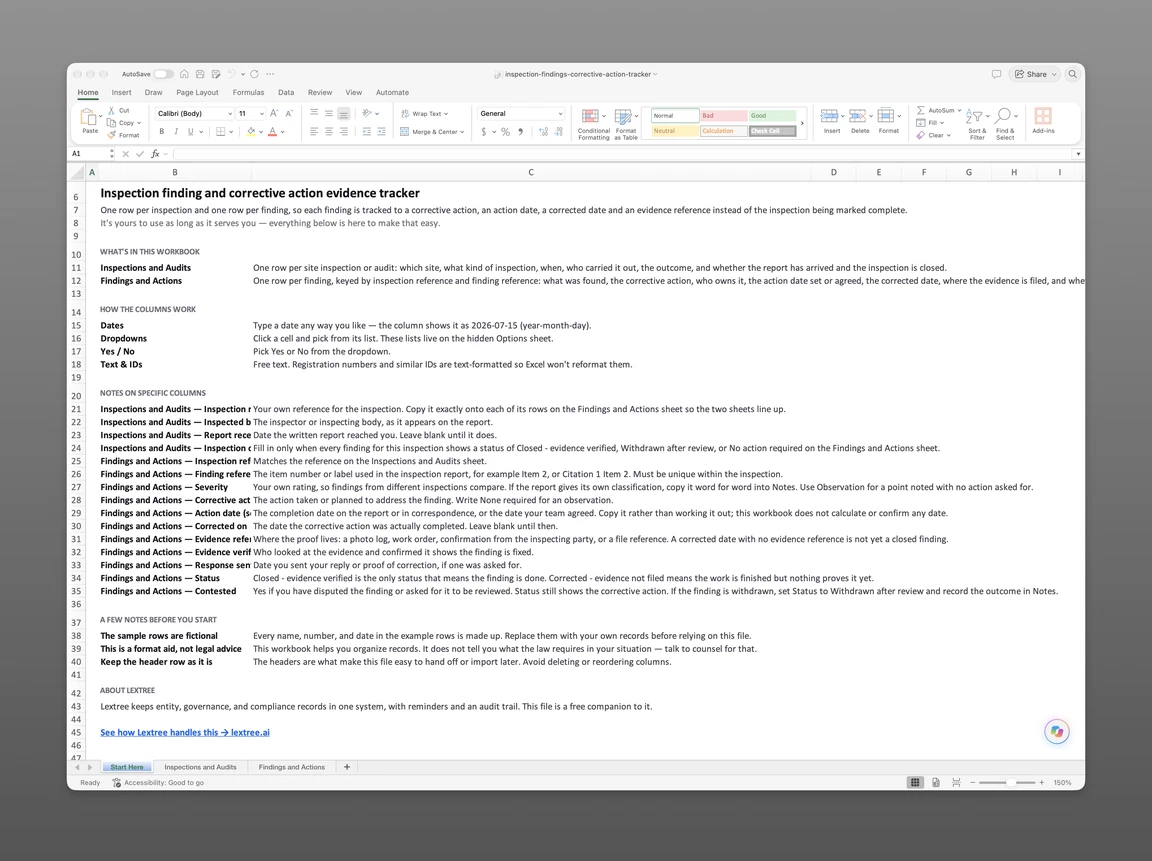
The companion file is an inspection corrective action tracker built on one idea: a row for each inspection, a row for each finding, and the inspection reference joining the two. The finding row carries the action, the owner, the action date, the corrected date, the evidence reference, who verified it and when, and a status. Closed - evidence verified is the only status that means done, and Corrected - evidence not filed says the work is finished while nothing yet proves it.
It leaves some things out on purpose. It holds no penalty totals and does no deadline arithmetic, since the dates come from your reports and correspondence. If you also need a site-by-site environmental compliance register of standing obligations and incidents, that is a separate record from this finding-level one.
The file opens with a Start Here sheet of notes on filling it in. “Inspections and Audits” holds one row for each visit, with its type, date, inspector, result, report date and closed date. “Findings and Actions” holds one row for each finding, from the corrective action to the verified evidence. It comes filled in with the sample inspections above, and it is sent to your email when you submit the form below.
Get the findings and corrective action tracker
Enter your email and we’ll send the inspection findings and corrective action tracker to your inbox. Free — no credit card, no call, no follow-up sequence you didn’t ask for.
Lextree Editorial
Author