Comparing Expiring and Renewal Insurance Policy Terms
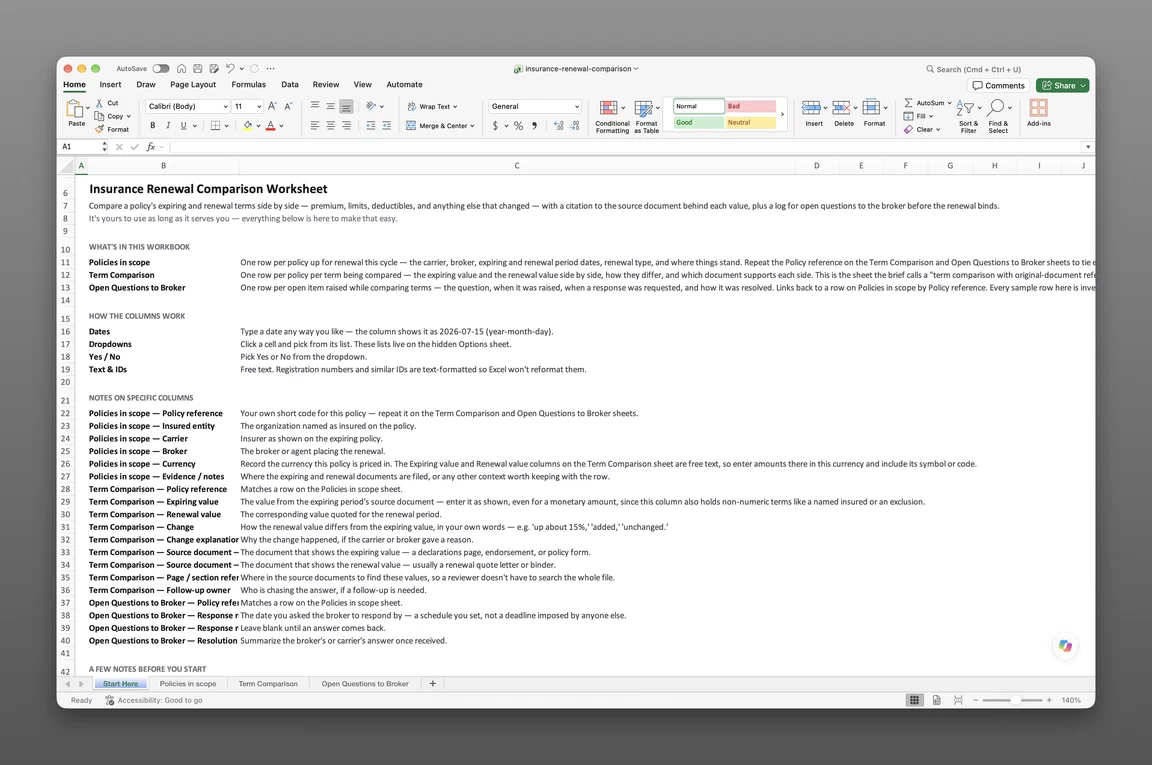
Comparing expiring and renewal terms
Comparing expiring and renewal insurance policy terms means putting the value on the expiring policy beside the value on the renewal, term by term, with a field that states how each one changed. A risk manager running renewals across several entities keeps a row for every watched term, not just the premium line a broker leads with. That includes an aggregate limit, a deductible, a named-insureds count, and a sublimit that appears on one side and not the other.
The unit of comparison
The row is one policy plus one term, not one policy. A single D&O policy with six terms worth watching produces six rows, one per term, all pointing back to the same policy.
Three policies coming up for renewal in the same cycle produce a block of rows small enough to read in one sitting across several entities. Every row carries a policy reference — a short code, assigned once — that ties the comparison to the scope list and the questions log.
Limits, deductibles, and premium
Insurance renewal changes to limits, deductibles, and premiums are the ones most worth a row of their own, because each can move independently:
- Aggregate limit — the aggregate limit on the expiring policy against the aggregate limit on the renewal.
- Deductible — the deductible stated on each side.
- Annual premium — the premium quoted for the expiring period against the premium quoted for the renewal.
- Period start and end dates — the expiring policy’s effective and expiration dates against the renewal’s.
- Named insureds — every insured named on the policy, not only the primary insured.
- Exclusions and conditions — any exclusion or condition stated on one side and not the other.
Name the field on the row and move on. A row records that a term changed, not why — the difference between a deductible and a self-insured retention, or a per-occurrence limit and an aggregate one, is a separate question. Answer it once; don’t re-litigate it on every comparison.
Citing both sides
A citation is the document a value was read from, recorded once for each side of the row. Put the expiring declarations page and the renewal declarations page side by side, and record which one each value came from before either is filed away.
Every row in the comparison carries two citations: the source behind the expiring value, and the source behind the renewal value. A limit read off an expiring declarations page isn’t the same kind of fact as a limit read off a renewal quote.
One is confirmed coverage; the other is an offer that hasn’t bound yet. A row citing only one side can’t be re-checked months later by someone who wasn’t in the room when the comparison was made.
Questions raised before binding
Every difference a comparison surfaces resolves one of two ways before binding: explained, or still open. What changed at insurance renewal is usually easy to see once two values sit on the same row. What’s harder to know is whether the broker has accounted for the difference or is still sitting on an unanswered question when the binder goes out.
An open item takes its own row on the questions log. Each row states the question as asked, the date it was raised, the date a response was wanted, and the resolution once it lands.
A deductible that doubled with no stated reason is a question, not a fact to accept as given. A named-insureds count that grew from two entities to three deserves the same treatment before anyone signs off on the renewal. Ask the carrier or broker to put every explanation in writing rather than settling for a verbal answer on a renewal call. An answer given on a call and never logged is the same as no answer once the renewal has bound and weeks have passed. The question log is what a written answer has to land on.
Three entities at renewal
Comparing insurance policy periods at renewal looks like this in practice. Picture a fictional group at one renewal cycle: Sample Cedar Ridge Holdings, Inc. (the parent), Sample Cedar Ridge Properties LLC, and Sample Cedar Ridge Services Ltd. Three policies come up together — a D&O policy covering the parent and both subsidiaries, a general liability policy on the properties entity, and a cyber policy on the services entity.
The policies in scope
| Policy reference | Insured entity | Line of coverage | Carrier | Expiring period end | Renewal period start |
|---|---|---|---|---|---|
| POL-101 | Sample Cedar Ridge Holdings, Inc. | Directors & Officers | Sample Continental Assurance | 2026-11-01 | 2026-11-01 |
| POL-102 | Sample Cedar Ridge Properties LLC | General Liability | Sample Harbor Mutual | 2026-11-15 | 2026-11-15 |
| POL-103 | Sample Cedar Ridge Services Ltd. | Cyber Liability | Sample Vantage Underwriters | 2026-12-01 | 2026-12-01 |
Every value in this table is invented for illustration — nothing here is insurance advice. The D&O row names the parent as the insured entity. The subsidiaries it also covers show up on the comparison’s named-insureds row, not as separate rows here.
Where the terms differ
| Policy | Term compared | Expiring | Renewal | Change | Sources (expiring / renewal) |
|---|---|---|---|---|---|
| POL-101 | Aggregate limit | 5,000,000 USD | 5,000,000 USD | Unchanged | expiring declarations page / renewal declarations page |
| POL-101 | Deductible | 25,000 USD | 50,000 USD | Increased | expiring declarations page / renewal quote |
| POL-101 | Annual premium | 41,800 USD | 52,350 USD | Increased | expiring premium invoice / renewal quote |
| POL-102 | Named insureds | 2 entities | 3 entities | Changed | expiring declarations page / renewal declarations page |
| POL-103 | Ransomware sublimit | — (never stated) | 250,000 USD | Newly stated | — / renewal declarations page |
Read three of these rows aloud and the pattern holds. POL-101’s aggregate limit is Unchanged — same figure, two sources, nothing to chase. Its deductible moved from 25,000 to 50,000 USD, and its premium moved with it.
That’s two separate rows, because a limit, a deductible, and a premium are three different terms, even when they shift together at the same renewal. The page or section reference behind each source, who reviewed the row, and whether it’s flagged for follow-up stay off this table to keep it readable. But they live on the same row underneath it.
A blank on one side
A blank in the expiring column is not the same fact as a matching pair, and the Change field is what tells the two apart.
POL-101’s aggregate limit reads Unchanged because the same figure appears on both sides. POL-103’s ransomware sublimit reads Newly stated, not Increased. The expiring policy never mentioned a ransomware sublimit, so there’s no prior figure for the renewal’s 250,000 USD to have grown from.
A term both sides state identically is unchanged. A term the renewal states that the expiring policy never stated is newly stated.
A term the renewal is silent on, when the expiring policy did state it, is neither of those. It’s a question for the log, not a zero to record and move past.
Next renewal’s expiring policy period
This cycle’s renewal column becomes next cycle’s expiring column, but only if you keep the values with their sources instead of overwriting them. Keeping a record of prior insurance policy periods is also what a diligence reviewer reads for audit and diligence readiness. It’s proof of what a group’s coverage did across several renewals, without anyone rebuilding the record from scratch.
This comparison lives in a companion file with 3 sheets, sent to your email: Policies in scope, the renewals being worked this cycle with carrier, broker, and the expiring and renewal period dates; Term Comparison, one row per policy per term with the expiring and renewal values side by side and the document behind each; and Open Questions to Broker, each item raised while comparing, when it was raised, and how it was resolved.
Get the free template
Enter your email and we’ll send the insurance renewal comparison to your inbox. Free — no credit card, no call, no follow-up sequence you didn’t ask for.
A file records the comparison but never notices on its own that a renewal has come round again or that an open question went unanswered. The Insurance module keeps each policy period as its own record, with that period’s limits, deductible, and premium. So next year’s comparison already has this year’s values in it before anyone opens a blank sheet. That’s a different job from a ready-made policy register file, which holds today’s terms for every policy the group carries. This comparison holds what moved between two of them.
Frequently asked questions
Terms, documents, and changes
How do you tell what changed at an insurance renewal? Put the expiring value and the renewal value on one row and let a Change field state the difference. Reading the expiring declarations page and then the renewal quote in sequence, days apart, is what produces the “I think the deductible moved” answer instead of a checked fact.
Which policy terms should you compare at renewal? Aggregate limit, deductible, annual premium, the period start and end dates, the named insureds on the policy, and any exclusion or condition stated on one side and not the other. Each earns its own row because each can move independently of the others.
What documents do you need to compare a renewal? The expiring declarations page, the renewal declarations page — or the binder or quote standing in for it until the renewal issues — and the premium invoice for each side, with each document named on the row it supports rather than filed loose.
What is the difference between an expiring policy and a renewal policy? The expiring policy is the bound coverage whose period is ending, backed by its own declarations page. The renewal is the insurer’s offered terms for the next period, which may sit on a quote or binder until the renewal declarations page issues.
Blanks, questions, and prior periods
What if a term appears on only one side? Three different findings share that shape, and only the Change field tells them apart: a term the renewal states that the expiring policy never stated is newly stated; a term both sides state identically is unchanged; a term the renewal is silent on, where the expiring policy did state it, is a question for the log — not a change to record on faith.
When should you raise a question with the broker? While comparing, before binding — with the question, the date it was raised, and the date a response is wanted recorded on its own row. A resolution that only shows up after binding is a note for next time, not something that shaped this renewal.
How do you keep a record of prior insurance policy periods? Keep each cycle’s completed comparison instead of overwriting the values once the next renewal lands. The expiring column of last cycle’s comparison is the evidence of what the prior period said, with the sources that back it up still attached.
Lextree Editorial
Author