Intercompany Loan Documentation From Signing to Maturity
What Each Loan Record Holds
Intercompany loan documentation is the signed record of a loan between two entities in the same group. With it, anyone can open the file and see who lent to whom, on what signed terms, under whose approval, and what was decided when the loan came due. This page covers that legal record. Pricing the loan at arm’s length is transfer-pricing work and is outside its scope.
A complete file for one loan holds these items:
- The signed loan agreement or promissory note.
- The approval record for each entity that acted: a board resolution, a unanimous written consent, or the delegation relied on.
- Each signed change to principal or maturity.
- Evidence that the funds moved: the bank reference for the advance and for each interest payment.
- Any security document or guarantee given for the loan.
- Evidence of repayment, or the payoff letter that closes the loan.
- The transfer-pricing support, kept alongside and prepared separately.
Lending and Borrowing Entities
Record both legal entities by their registered names, the jurisdiction of each, and one loan reference that the finance teams on both sides use. A loan between Sample Holdings B.V. and Sample Operating Ltd. is two balances, one receivable and one payable, and they should trace to the same row.
The reason to name both sides is disclosure. Under IAS 24, a group company’s own financial statements report its related-party transactions and outstanding balances with other group entities, even though those balances are eliminated on consolidation. Each entity’s preparer needs its own balance, and the intercompany loan register is where it comes from. One row per loan across the group, with lender and borrower both filled in, gives each preparer the same source.
Note or Full Loan Agreement
A promissory note is the borrower’s written acknowledgment that it owes a stated amount, and it usually stops at the amount, the date, and the rate. A loan agreement is a full contract that adds the repayment schedule, how interest is calculated, default terms, prepayment, and covenants. Record which instrument governs and where the signed original is kept. If a group has both, say which one controls.
Record the currency, whether the rate is fixed or a reference rate plus a margin, and how often interest is paid. Each ledger accrues against these terms.
Record the role of each signatory as well as the name, and the authority each person signed under. A note is typically signed by the borrower, and an agreement by both entities. A controller who later asks who could bind the lender needs more than a name on a signature page. The signing authority matrix lays out who may sign what, and the signing authority records in Lextree’s Authority module keep each grant with a dated record.
Board Approval Before Funding
The controller should hold a record of board approval for intercompany loans before the cash moves. Whether the board itself must act, or a delegation of authority covers the loan, depends on each entity’s own governing documents. The file cannot settle that. It captures which approval was relied on, for the lender and for the borrower where it acted.
The approval usually takes one of two forms. One is a resolution adopted at a meeting, filed with the minutes. The other is a unanimous written consent, signed by every director entitled to vote and filed with the corporate records, which carries the same effect as a vote at a convened meeting. Record the type, the date, and which board acted. The board resolutions and written consents and the board meeting records that hold them are the documents an auditor will ask for by date.
Every Signed Change After Funding
Log one row for each signed document under the loan, and give each its effective date and its signed date. They can differ: an extension signed on October 3 may take effect on a maturity date weeks away. The fuller treatment of that gap sits in how amendments, waivers, and consents differ.
Only a document that sets the principal or the maturity should fill those two values. The loan’s current principal and current maturity are whatever the latest such document says, judged by effective date. A signed extension sets the new date, the approval behind it is recorded, and the register moves only when both exist. An email agreeing to push the date does not move it. An amendment and restatement replaces the agreement in full, so the earlier documents stay in the history but stop governing.
If the group also borrows from banks, keep those facilities in a separate record. A register of bank facilities and covenant dates follows different documents and different deadlines from a loan between two group companies.
Intercompany Loan Tracking Through Maturity
A maturity date that passes without a recorded decision leaves the register showing a loan in default, or an undocumented rollover that nobody approved. An auditor finds that situation in the year-end balance, so prevent it. Good intercompany loan tracking gives every loan a named review owner and a decision date well before maturity. How much lead time the owner needs depends on the approvals involved, so set it loan by loan.
A loan payable on demand has no maturity date to watch. Record it as a demand loan and give it a review date, so it does not sit open for years without a decision.
Repay, Extend, Convert, or Forgive
Four decisions are available, and each has its own paper trail. Before choosing, confirm the outstanding balance on both entities’ books and record the borrower’s ability to repay beside the decision.
Repayment needs evidence that the cash moved, or a payoff letter. A payoff letter states the amount owed and sets out the conditions on which the lender ends the loan documents and releases any security. Extension needs a signed extension and the approval behind it. Conversion to equity needs approval from each entity that acts, plus the share issuance record at the borrower. Forgiveness needs an approval at the lender, recorded as a governance act.
A loan that rolls over at every maturity with no repayment starts to look like capital rather than debt, and an auditor will ask which it is. Each rollover therefore gets its own signed extension and its own recorded decision.
Evidence That Closes the Decision
For every outcome, record two things: the reference to the decision (a resolution, a consent, or a delegated sign-off) and the evidence that it was carried out. That evidence is the bank reference for a repayment, the signed extension, the share issuance record, or the forgiveness approval.
When a loan is repaid in full, file the payoff letter as the loan’s closing document. It is the last item in the file, and it is the one that shows the lender released its rights.
Building the Intercompany Loan Register
Start from the ledger. Pull every open intercompany balance, then match each one to its signed intercompany loan documentation in each entity’s files. A balance with no signed document is the first gap to close. From then on, take current principal and current maturity from the latest signed document, never from memory.
At each close, agree the lender’s receivable to the borrower’s payable by loan reference. A difference usually traces to a missed interest accrual, a repayment posted on one side only, or currency remeasurement. Correct the ledger, and change the register only when a signed document is missing.
In the Treasury module, Lextree keeps each intercompany loan as one Loan Made record at the lending entity, and the borrower’s page shows the same loan under Loans Received. Signed documents go into the loan’s Documents register with a document type, an effective date, and values for Sets principal to and Sets maturity to. The record’s principal and maturity are copied from the latest document that sets them. An Approving action field holds the resolution or delegation the loan was made under. A Loan maturity event reminds the team at 90, 30, and 7 days by default. The maturity review workflow opens by confirming the outstanding balance and the borrower’s position, then records the choice to extend, collect, refinance, forgive, or defer.
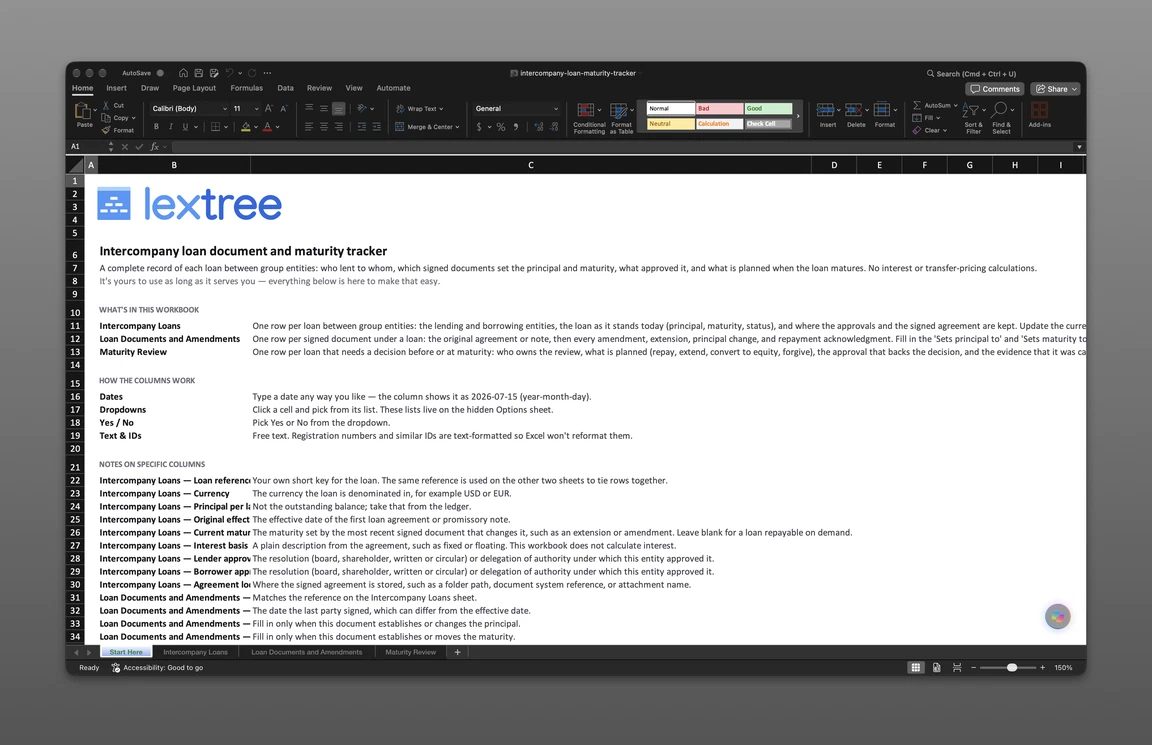
The companion file has 3 sheets. Intercompany Loans holds one row per loan, with the lending and borrowing entities, current principal, current maturity, approval references, agreement location, and status. Loan Documents and Amendments holds one row per signed document, with its type, its effective and signed dates, the values it sets for principal and maturity, the signatory roles, and the approval references. Maturity Review holds one row per loan that needs a decision, with the review owner, the planned action, the decision reference, and the evidence it was carried out. It is sent to your email when you submit the form below.
Get the free template
Enter your email and we’ll send Intercompany loan document and maturity tracker to your inbox. Free — no credit card, no call, no follow-up sequence you didn’t ask for.
What Auditors Ask to See
The audit request for intercompany loan documentation is usually short: the agreement, the approval, and proof of what happened at maturity. Keep the transfer-pricing file too, since it defends the rate and the tax position, and prepare it separately from the legal record.
What the Auditor Inspects
ISA 550 on related parties asks the auditor, for significant related-party transactions outside the entity’s normal course of business, to inspect the underlying contracts or agreements and to obtain evidence that the transactions were appropriately authorised and approved. Each of those maps to a field in the register: the signed agreement row gives the contract, and the approval reference gives the authorisation. PCAOB AS 2410 on related parties applies to US audits and calls for specific procedures on each related-party transaction that must be disclosed or that is a significant risk.
Disclosure by Each Entity
Each group company discloses its own related-party transactions and outstanding balances, including commitments, under IAS 24. The preparer of each set of statements draws on the per-entity view of the register, the lender side and the borrower side of the same loan. That ties back to naming both entities on every row. The financial statements records hold the resulting disclosures, and the loan file behind them is the evidence the auditor will follow.
Lextree Editorial
Author