IP Due Diligence Checklist for Fundraising: Assignments, Recorded Owners and Gaps
IP Assignment Agreements Before a Funding Round
Before an investor financing closes, the investors’ counsel asks who owns the company’s patents, marks, code and designs, and the company answers in writing. Use this IP due diligence checklist for fundraising in a priced round, where the company sells preferred stock under a stock purchase agreement.
A common starting point for the purchase agreement in a priced round is the NVCA Model Stock Purchase Agreement, which the NVCA updated in October 2025. Its intellectual property representation has the company say that each current and former employee, and each consultant involved in developing its IP, assigned that IP to the company and signed a “Confidential Information Agreement.” It also has the company say that no one excluded IP that would be material to the business from that assignment. Anything the company cannot say cleanly goes on the Disclosure Schedule as an exception. Those signed agreements are the IP ownership documents investors ask for, and the rest of the diligence is mostly a check that the registries agree with them. Collecting IP assignment agreements before a funding round, rather than during the data-room scramble, leaves time to fix what turns up.
A short IP due diligence checklist for startups lists the signed assignments and stops. Investors’ counsel also looks at what the patent, trademark and copyright registries show, so the four steps below cover both.
- Collect the signed assignment behind each right.
- Write down the owner each registry shows beside the entity that should own the right.
- Log every mismatch or missing document.
- Hand the log to your adviser before the data room opens.
This page covers ownership proof only. Renewal and fee dates belong in a register of every patent, mark, copyright and domain the company holds. Good standing, consents and the cap table belong to entity-wide diligence for technology companies. Freedom-to-operate searches, infringement claims and litigation history are separate reviews for counsel and are not in this file.
Founders’ Pre-Formation Technology
Code, designs and prototypes written before the company existed belong to the founders until they sign them over. Collect these:
- The founders’ signed assignment of pre-formation technology, usually found in the formation set.
- The registry or registrar record for any mark or domain registered in a founder’s own name.
If a founder worked for an employer or a university, or the early work was funded by a grant, tell your adviser. The NVCA representation covers government and university funding separately, and whether it applies is a question for counsel.
Employee and Contractor Agreements
Collect these:
- For each contractor, a signed assignment or an engagement letter, signed by the contractor, that contains an assignment clause.
- For every current and former employee, the signed confidential information and invention assignment agreement, sometimes called a PIIA.
- The signed copy behind any offer letter that refers to an agreement.
- Each prior-inventions schedule.
Do contractors need to sign an IP assignment? Payment for the work does not by itself give the company the copyright in code a contractor wrote. Under 17 U.S.C. §204(a), a transfer of copyright ownership, other than by operation of law, is not valid unless an instrument of conveyance, or a note or memorandum of the transfer, is in writing. The owner of the rights conveyed, or the owner’s duly authorized agent, must sign it. An engagement letter with no assignment clause is the case to flag.
Check the prior-inventions schedules, because anything an employee listed there is excluded from the assignment, and the NVCA representation asks whether any excluded IP is material to the business. Ask your adviser whether the wording reads as a present assignment (“hereby assigns”) or a promise to assign later.
Recordings, Licenses and Security Interests
For each registered right, collect these:
- The signed assignment, which for a patent means the assignment from each inventor to the company.
- The recordation notice and its registry reference, a reel and frame number at the USPTO, with the cover sheet that accompanied the assignment.
- For a mark, the assignment showing it was assigned with the goodwill of the business.
- Any lender security agreement recorded against the right, with the recorded release if the loan is repaid.
- The inbound licenses, an inventory of open source and third-party components with their license terms, and the registrar record showing the registrant for each domain name.
Ask whether the assignments cover future filings such as continuations, a check that Knobbe Martens also lists in its published diligence checklist.
Match Recorded Owners to the Company
For every registered or applied-for right, write the owner name exactly as the registry shows it, with its punctuation and company suffix, beside the legal name of the entity that should own it. Sometimes that entity is a subsidiary rather than the parent. A registry that lists a co-owner beside the company is a check for your adviser. Under 35 U.S.C. §262, absent any agreement to the contrary, each joint owner of a patent may make, use, offer to sell or sell the patented invention within the United States, or import it into the United States. Each may do so without the consent of and without accounting to the other owners. Mark each pair as a match, a no match, or a check. “Inc.” against “Incorporated” is a check for your adviser.
Searching USPTO Assignment Records
Do IP assignments have to be recorded with the USPTO? Recording puts the assignment on the public record. MPEP 301 says “Recordation of the assignment provides legal notice to the public of the assignment,” and that recording “is merely a ministerial act.” Under 35 U.S.C. §261 and 15 U.S.C. §1060(a)(4), an assignment is void against a later purchaser for value without notice. It escapes that result if it is recorded at the USPTO within three months of its date or before the later purchase. The patent statute also covers a later mortgagee. Whether that matters for a given right is a question for your adviser.
Since October 20, 2025, the USPTO’s Assignment Search, inside Assignment Center, has replaced the older Patent Assignment Search and Assignments on the Web, according to the USPTO announcement. Search there by each patent or application number and each trademark serial or registration number, and copy the assignee, the conveyance type and the reel and frame of each recorded document.
Each recorded document travels with a cover sheet. MPEP 302.07 says Form PTO-1595 may be used as the patent cover sheet, and trademarks have Form PTO-1594. The trademark sheet’s nature-of-conveyance boxes are Assignment, Merger, Security Agreement, Change of Name and Other. Read them, because a Change of Name is not a transfer, and a Security Agreement with no later release is a gap to log. Under MPEP 323.01, the USPTO records cover-sheet data “exactly as it appears” and does not compare the cover sheet with the assignment document. A misspelled assignee on the cover sheet therefore becomes the recorded name.
If a mark’s maintenance filings also come up in diligence, see trademark maintenance filings and their evidence.
Copyright Office Transfers
A copyright registration names the claimant at the time of registration, and a later transfer does not change it. Circular 8 says a supplementary registration cannot reflect a transfer; you record the document that transferred the copyright instead. So look for a separate recorded document and its certificate of recordation in the Copyright Office’s public records. New documents are submitted through the Recordation System.
Recording a copyright transfer is voluntary, and the paper route uses the optional Form DCS cover sheet. Under 17 U.S.C. §205(c), a recorded document gives constructive notice only if it, or material attached to it, specifically identifies the work to which it pertains, and the work is registered.
Log Each Chain of Title Gap
Every exception becomes one row in the log, and the rows are where the chain of title gaps get named and tracked. Each row holds the right or document involved, a gap type, a plain description, a risk note, a proposed fix, an owner and a status. Write the risk note as what investor counsel may not be able to trace, and leave the legal conclusion to your adviser. Begin each proposed fix with “ask whether to…”
Naming the Gap Type
Give every row one of these types.
| Gap type | What you found | Question for your adviser |
|---|---|---|
| Missing assignment | No signed transfer to the company from a founder, contractor or other prior owner | Should an assignment or confirmatory assignment be prepared, and should it be recorded? |
| Recorded name differs | Registry spelling does not match the legal name | Is this a typo to correct or a different entity? |
| Name change not recorded | The company changed its name and the registry still shows the old one | Should the change be recorded? |
| Unsigned agreement | An agreement exists in the file without a signature | Can a signed copy be located or re-executed? |
| Missing inventor assignment | One inventor’s transfer is absent from the record | How should the record be completed? |
| Unrecorded assignment | A signed assignment exists but the registry does not show it | Should it be submitted for recordation? |
| Recorded security interest | A lender’s interest is recorded against the right | Has the release been signed and recorded? |
| Third-party code, license not identified | A component has no license terms on file | What terms govern it, or should it be replaced? |
Founder Mark, Contractor Code
What if the trademark is in the founder’s name? In the file’s sample rows, Sample Northwind Robotics Inc. has a word mark whose registry record, number SAMPLE-0000301, shows the founder personally as owner, and no assignment to the company has been found. The row is logged as a missing assignment. The proposed fix asks the adviser whether to prepare a founder-to-company assignment of the mark and its goodwill, and to record it. If the application was filed on an intent-to-use basis, tell the adviser, because 15 U.S.C. §1060(a)(1) restricts assigning such an application before use is alleged.
The control software, registered as SAMPLE-0000401 in the company’s name, includes code a freelance developer wrote under an engagement letter with no assignment clause. That is another missing assignment. The proposed fix asks the adviser whether to approach the former contractor for a signed confirmatory assignment, and the row is marked In progress while the developer is contacted. The operator manual, SAMPLE-0000402, shows “Incorporated” where the legal name ends in “Inc.” The row is a recorded name difference, the adviser accepted it, a note sits in the data room index, and the row is closed. A fourth row covers a motion planning application, SAMPLE-0000102, where the registry lists only the inventor and the signed founder assignment was never recorded.
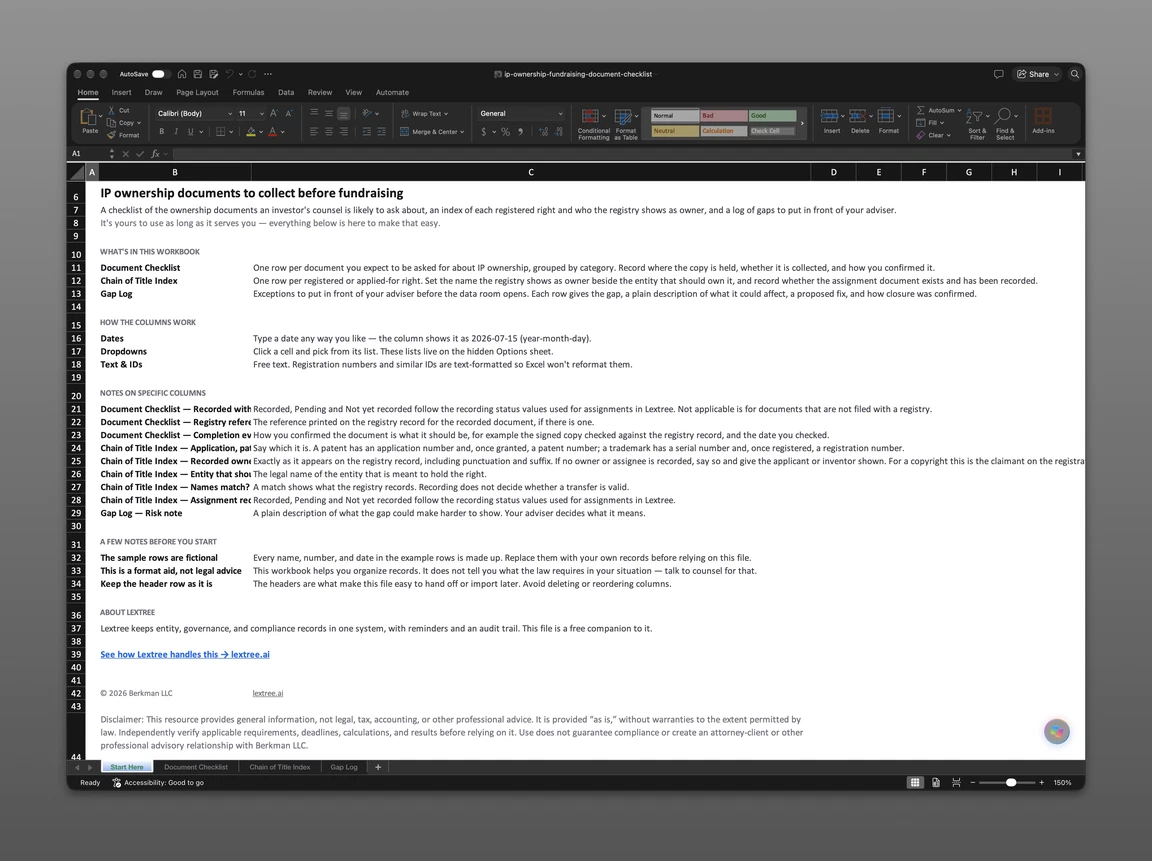
The IP due diligence checklist for fundraising comes as a file you keep working in. The Document Checklist lists each document and where the signed copy is held. The Chain of Title Index sets each recorded owner beside the entity that should own the right. The Gap Log is the list for your adviser. The file is sent to your email after you submit the form.
Get the IP ownership documents checklist
Enter your email and we’ll send the IP ownership documents checklist to your inbox. Free — no credit card, no call, no follow-up sequence you didn’t ask for.
Hand the Gap Log to Your Adviser
Send the log to the adviser who will sit across from investor counsel a week or two before the data room opens, with the response date you need beside each open row.
Fixes Counsel May Propose
Every fix below is the adviser’s call, so each goes into the log as a question.
- Ask whether to record an assignment that was signed but never recorded.
- Ask whether to obtain a confirmatory assignment from a former contractor.
- Ask whether to prepare a founder-to-company assignment of a mark, with its goodwill.
- Ask whether a corrective document is right for a recorded error. Every document submitted for recording needs a cover sheet under 37 CFR 3.28, and the USPTO gives a corrective document a new reel and frame number and a new recording date (MPEP 323).
- Ask whether to record a lender’s release.
- Ask engineering to confirm a library’s license or replace the library.
Closure and the Disclosure Schedule
What happens if diligence finds a problem? Counsel decides whether a gap that stays open becomes an exception on the Disclosure Schedule. Close a row only when you hold evidence for it: the USPTO recordation notice with its reel and frame, the Copyright Office certificate of recordation, a signed copy of the missing agreement, or the adviser’s written acceptance. For a copyright, Circular 12 says only the certificate of recordation shows the date of recordation, so file the certificate itself.
The NVCA agreement makes it a condition of closing that the company’s representations, as modified by the Disclosure Schedule, are true as of the closing, so a row marked closed weeks earlier still needs a second look just before closing.
Recording Status in Lextree
In Lextree’s Intellectual Property module, Patent, Trademark and Copyright Assignment records sit under the right they transfer. Each carries an assignment type, a recording status of Recorded, Pending or Not yet recorded, a recording reference such as a reel and frame, and the assignor and assignee names as the registry shows them. Trademark assignments also record whether the goodwill was included. The assignment types are seeded defaults, and you can add your own. Key Person Agreements in the Employment module carry a yes/no field for an invention assignment clause. See the assignment records kept on each patent and trademark.
Lextree Editorial
Author