Litigation Exposure Assessment for Financial Reporting: What Legal Hands Finance at Period End
What Finance Asks Legal at Period End
At period end, finance asks legal for a dated view of every open matter, and that view is the litigation exposure assessment for financial reporting. It gives the likelihood of an unfavorable outcome, a low and high loss estimate (or a statement that none can be made yet), and the basis for the view. It also carries a reference to any reserve finance has recorded.
Finance sometimes calls the same exercise a loss contingency assessment, and the paperwork around it is often called legal contingency reporting. Finance makes the accrual and disclosure decisions under ASC 450 (formerly FAS 5), and the assessment is the evidence it starts from.
Every Open Matter, Listed Once
Completeness comes first. The list covers every pending lawsuit and arbitration, plus threatened claims, pre-suit demands, regulatory inquiries, and government or internal investigations. A demand letter with no complaint behind it still belongs on the list, because finance cannot weigh a matter it never heard about.
Claims no one has asserted yet can matter too. ASC 450-20-50-6 says disclosure of an unasserted claim is not required where no potential claimant has shown awareness of it. The exception is when it is considered probable that a claim will be asserted and there is a reasonable possibility of an unfavorable outcome. Whether a given claim needs disclosure is finance’s call, drawing on counsel’s view of whether anyone is likely to assert it.
Give each matter one stable reference. Every period’s assessment then points at the same matter, and a renamed caption does not split it in two. A team with no list yet can start from a matter-by-matter litigation register and add the assessment on top.
For SEC registrants that report under Regulation S-K, the same list feeds the legal-proceedings description under Regulation S-K Item 103, which asks for “material pending legal proceedings, other than ordinary routine litigation incidental to the business.” Paragraph (b)(2) of the item leaves out a proceeding that involves primarily a claim for damages. That applies only if the amount involved, exclusive of interest and costs, does not exceed 10 percent of the current assets of the registrant and its subsidiaries on a consolidated basis. Proceedings raising largely the same issues are added together for that test. Paragraph (c) still requires some proceedings to be described regardless, including certain bankruptcy, insider and environmental proceedings. Counsel and finance settle whether a given matter falls inside those rules.
Management’s View or Counsel’s
Legal prepares the assessment and finance receives it, usually the controller or the CFO. The view can be management’s own, from in-house litigation counsel or the general counsel, or outside counsel’s view on a matter that firm handles. When both give a view as of the same date, that is two assessments, each naming whose view it is, and finance sees both rather than a blended number.
Deloitte’s Roadmap on contingencies calls counsel’s opinion “a critical piece of evidence that needs to be analyzed carefully”. Treat the document as evidence finance weighs. When outside counsel gives neither a likelihood nor a range, the assessment is still dated, records that no view was given, and says why. The year-end letter that asks outside counsel to respond directly to the auditor is a separate exchange.
Where Legal’s Part Ends
The assessment records a view and decides nothing. ASC 450 involves two basic concepts, accrual and disclosure, and both are finance and management decisions. A reserve reference appears only after finance has booked something, and then only as a pointer to the entry or memo.
IFRS reporters work from IAS 37, which describes a provision as “a liability of uncertain timing or amount” and calls for contingent liabilities to be disclosed in the notes unless an outflow is remote. The dated view legal supplies has the same shape under either framework. IAS 37 gives “probable” a different meaning from ASC 450-20, so an IFRS reporter’s finance team says which likelihood terms it wants recorded.
What Each Litigation Exposure Assessment Records
Each litigation exposure assessment, as of its date, holds:
- the date the view was taken, and the reporting period it serves
- whose view it is
- the likelihood of an unfavorable outcome
- a low and a high loss estimate, in a stated currency
- the reserve finance recorded, as a reference
- the basis, and what changed since the last view
- the intended response
- the audit period it fed
- when it went to finance, and to whom
The assessment date is when the view was taken, and the reporting period says which close it serves. A view taken after quarter-end but before finance closes the books keeps its own date, so finance can see what was known and when.
Likelihood in ASC 450-20 Terms
Finance’s vocabulary is Probable, Reasonably possible, and Remote, the three likelihood terms in ASC 450-20. The assessment records which one the assessor gave. ASC 450-20 provides no quantitative thresholds for them, so many teams agree before the first period on how an assessor arrives at a label.
Many legal departments still call this the FAS 5 assessment, after the pre-codification FASB Statement No. 5, whose guidance ASC 450 now carries. A fourth choice, Not determinable, records that counsel cannot give a view yet. It is not an ASC 450-20 term, and the basis says why no view can be given and what would change that.
The Low and High Estimate
Record two amounts and name the currency. Finance wants a range in part because, where disclosure is required, ASC 450-20-50-4 calls for “an estimate of the possible loss or range of loss,” or a statement that such an estimate cannot be made. For SEC registrants, SEC staff guidance in Staff Accounting Bulletin Topic 5Y addresses the statement that a contingency “is not expected to be material.” That statement does not satisfy ASC 450 where two things hold. There is at least a reasonable possibility that a loss exceeding amounts already recognized may have been incurred, and the additional loss would be material to a decision to buy or sell the registrant’s securities. Both rules concern finance’s disclosure, and legal’s job is to supply the range, or the reason there is none.
When no range exists yet, leave both amounts blank. Say in the basis what is missing, such as an unquantified demand or damages discovery that has not started, and what would produce a range. Say too whether the range includes defense costs and whether it is before or after any insurance or indemnity recovery. The amount a claimant demands sits on the matter itself.
Basis, Response, and Reserve
The basis says why this view and what changed since the last one: a motion ruling, a document production, a mediation session. It leaves the legal department, so keep it to the facts that moved the view and cite counsel’s memo by reference instead of pasting privileged analysis. Because the assessment may reach the outside auditors, and sharing privileged analysis with them can put privilege at risk, your legal team decides how much detail goes in.
The intended response is contest, seek settlement, cooperate with an inquiry, monitor, or not yet determined. The reserve takes a single line, the reference to the entry or memo where finance recorded an accrual for that period, never a copy of the ledger. The audit period names the fiscal-year audit the assessment fed, such as FY2026. The date it went to finance and the recipient’s role prove the handoff happened. A new view is a new dated assessment, and the earlier view stays as it was.
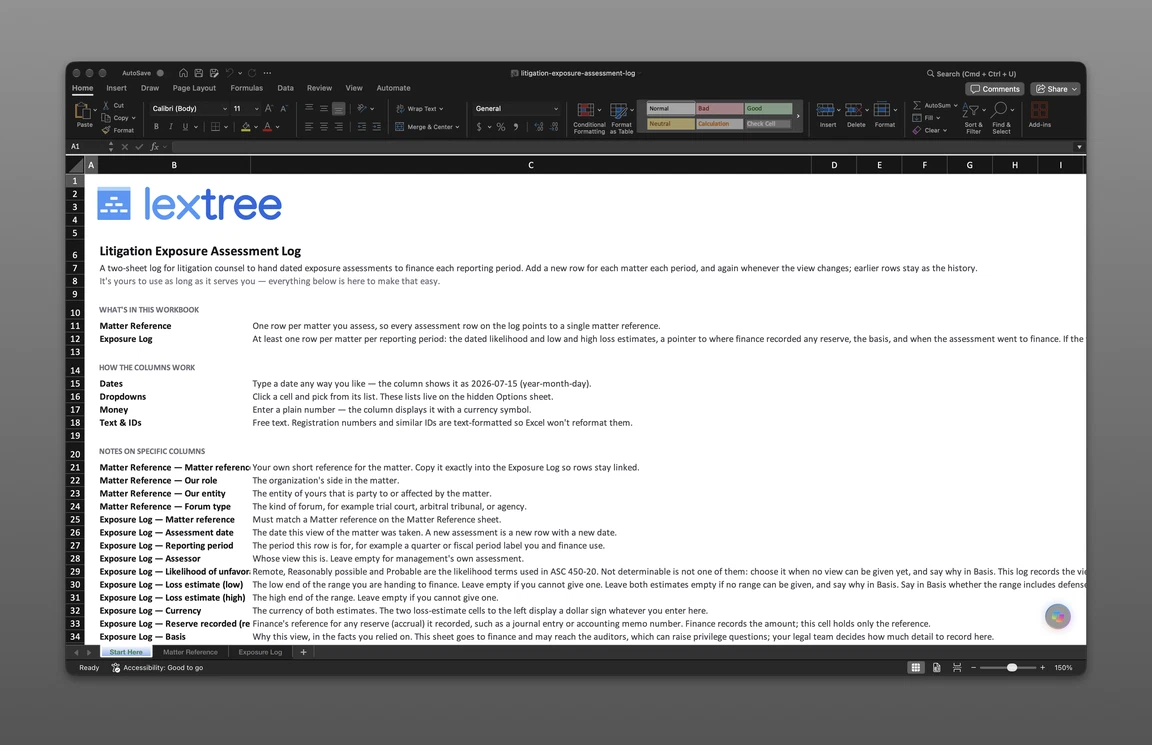
The companion log keeps a legal matter exposure assessment history in two sheets. Matter Reference holds one line for each matter you assess, so every assessment points to a single matter. Exposure Log holds at least one dated row for each matter in each reporting period, plus another dated row when the view changes before finance closes the period. It comes filled in with the sample matters below and is sent to your email.
Get the litigation exposure assessment log
Enter your email and we’ll send the litigation exposure assessment log to your inbox. Free — no credit card, no call, no follow-up sequence you didn’t ask for.
A Supplier Contract Dispute at Quarter-End
Sample Fasteners LLC, a fictional manufacturer on a calendar-quarter close, is the defendant in the Sample Supplier Contract Dispute, a lawsuit in trial court. Its litigation counsel assesses the matter each quarter and sends the result to the controller. The first two assessments appear below as they sit in the companion log. The example is illustrative and is not legal or accounting advice.
| Assessment date | Reporting period | Assessor | Low | High | Reserve reference | Intended response | Sent to finance |
|---|---|---|---|---|---|---|---|
| 2026-03-12 | Q1 2026 | Litigation counsel | USD 100,000 | USD 400,000 | None recorded | Contest | 2026-03-20 |
| 2026-06-17 | Q2 2026 | Litigation counsel | USD 200,000 | USD 500,000 | Sample accounting memo SAMPLE-0000003 | Seek settlement | 2026-06-24 |
The March Assessment
Litigation counsel dated the first assessment 2026-03-12, for Q1 2026. The complaint had arrived, and early document review showed the contract terms were disputed. Counsel recorded Reasonably possible, a range of USD 100,000 to USD 400,000, and an intended response of contest. Finance had recorded no reserve, so the reserve reference reads “None recorded”. The assessment reached the controller on 2026-03-20, eight days after its date.
The June Assessment
On 2026-06-17 counsel dated a new assessment for Q2 2026. The supplier’s delivery records had come in and supported part of its position, and the basis line names that fact. Counsel recorded Probable, the range read USD 200,000 to USD 500,000, and the intended response became seek settlement. The assessment reached the controller on 2026-06-24. Finance then made its own Q2 decisions on that and the other evidence it had, and the row’s reserve reference points to its sample accounting memo, SAMPLE-0000003. Whether to record a reserve, and how much, was finance’s call; the cell holds only the reference.
Later assessments for this matter follow in the log. A 2026-09-23 assessment follows the mediation session, and a 2026-10-07 row confirms that nothing had changed before finance closed Q3 2026.
The second sample matter, the Sample Customer Warranty Claim, shows the case with no range. Outside counsel assessed it on 2026-06-24, when the demand letter carried no quantified amount and facts were still being gathered. That row records Not determinable with both amounts blank. When the customer’s repair invoice arrived, a Q3 row recorded a range of USD 50,000 to USD 150,000.
When Assessments Sit on the Matter
In Lextree’s matter records, each assessment is an Exposure Assessment filed under its matter, with the date, assessor, likelihood, low and high estimate, intended response, basis, and audit period. A reserve recorded field holds the amount finance has accrued in the books, if any, as a pointer to the accounting system rather than a copy of the ledger. The log’s reserve cell, by contrast, holds only finance’s reference to its entry or memo. The matter’s current likelihood and its current low and high figures fill in from the assessment with the latest assessment date, so nobody copies the newest numbers across by hand. A file holds each row as typed and cannot do that.
The assessor is a link to the outside firm or person whose view it is, left empty for management’s own view, and that firm’s record then lists every assessment it has given. Module permissions on the Business and Enterprise plans, and item-level access groups on Enterprise, limit who can open matter records, which counts when the basis line carries counsel’s reasoning.
A file cannot remind anyone, either. In Lextree, an event with advance reminders can be attached to the matter record, so next period’s assessment has a date and recipients before the close begins. You create that event for the matter yourself.
Questions Legal and Finance Ask
Who Prepares the Assessment
Who prepares a litigation exposure assessment, legal or finance? Legal prepares it: in-house counsel, or outside counsel on the matters that firm handles. Finance receives it, and management, through finance, makes the accounting decisions.
Does outside counsel’s view replace management’s? No. Each is its own dated assessment with the assessor named, and finance sees both.
Is a FAS 5 assessment the same thing? In substance, yes. FAS 5 is the pre-codification name for what is now ASC 450.
Estimates, Timing, and Labels
What does finance need from legal each quarter? For each open matter: a dated view, a range or a statement that none can be made yet, and the basis. SEC registrants that file Form 10-Q report quarterly, and other companies follow their own reporting cycle. The opening section of this page covers what finance asks legal for.
What if counsel can’t estimate a range yet? Record that, with the date, what is missing, and what would produce a range. A bare “immaterial” does not take its place. For SEC registrants, SAB Topic 5Y says a statement that a contingency is not expected to be material does not satisfy ASC 450 where there is at least a reasonable possibility of a material loss beyond any amount already recognized.
How is this different from an early case assessment? Early case assessment is an evaluation near the start of a matter of its merits, likely cost, and potential exposure, used to choose a strategy such as early settlement or a full defense. The exposure assessment repeats each period for finance and records a view as of a date.
Lextree Editorial
Author