Annual Report Tracker for Companies Registered in Multiple States
Two records per state registration
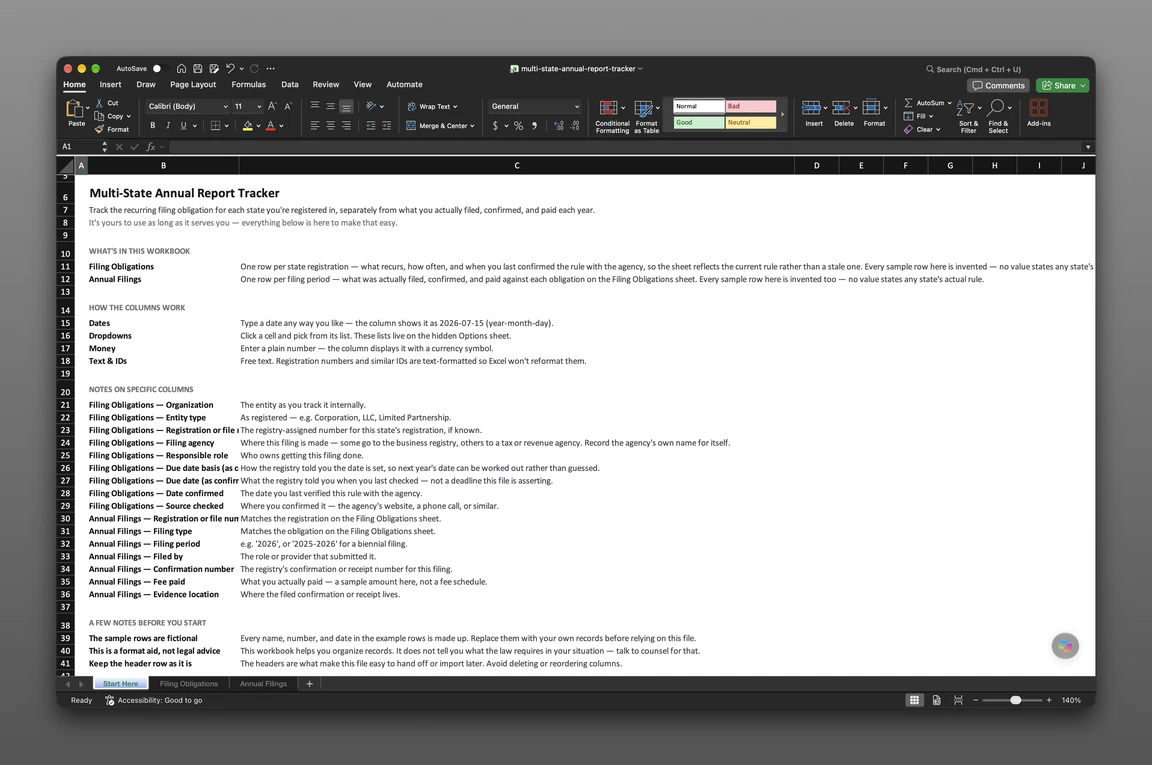
An annual report tracker for multiple states holds two kinds of record. One is a standing obligation for each state registration; the other is a separate filing record for the period it comes due. The obligation row states what recurs, how often, and who owns it; the filing row states what was filed, confirmed, and paid. Multi-state annual report tracking works because those two records key to each other. The same organization, state, and registration number ties an obligation to the filings that satisfy it, period after period.
Statutory due dates themselves stay the reader’s to confirm with each agency. The tracker’s job is to hold that confirmation as a dated, sourced field — not to assert the date on its own authority.
What recurs, per registration
The obligation record is one row per state registration, not per entity. Each row carries:
- Organization — which company holds the registration
- State — the jurisdiction the registration is in
- Registration type — formation or foreign qualification
- Entity type — how the entity is registered there
- Registration or file number — the agency’s identifier for the registration
- Filing type — the name that agency uses for the recurring filing
- Frequency — how often the filing recurs, as confirmed
- Filing agency — which office receives the filing
- Responsible role — who owns getting it done
A company formed in one state and qualified in three others carries four of these rows, not one. That distinction matters because foreign qualification annual report obligations multiply fast. A single entity, formed once, can still owe four separate agencies four separate recurring filings, each with its own cadence and its own contact.
Filing type earns its own field because agencies don’t share a name for the same recurring filing. One state’s registry calls it an annual report. Another calls the equivalent obligation a periodic report, a statement of information, an annual registration, a biennial statement, or an annual renewal.
A search of an agency’s own site for “annual report” can come back empty. The agency may require something functionally identical under a different name.
The obligation row records the name that particular agency uses, next to the agency itself. That way the tracker matches what the filer will find when they go looking, not a label invented for this record.
Frequency belongs on this row as a field with a confirmed source, not as an assumption carried over from last year. Some registrations recur annually, some on a longer cycle, and some depend on activity rather than a calendar date. The tracker records whichever cadence the agency confirmed for that registration — it does not guess at one.
What each period produces
Against every obligation row, each filing period produces its own record:
- Filing period — which cycle this row covers
- Filing status — where the filing stands right now
- Date filed — when it went in
- Filed by — who submitted it
- Confirmation number — the agency’s receipt for the filing
- Fee paid — what was paid, tied to the receipt
- Evidence location — where the proof is kept
This is a separate row from the obligation it satisfies, not a status field bolted onto it.
The distinction answers two different questions. The obligation row answers whether a filing is owed and on what cadence. The filing row answers whether it was filed, by whom, for what fee, and where the proof sits.
These are the questions a lender, auditor, or buyer asks separately — the ones a single due-date row can’t answer at all. Annual report filing confirmation and fee records live here, one row per period, tied back to the obligation that required them.
A regulatory filing confirmed this way produces its own receipt — a confirmation number and an evidence location — rather than a checkmark next to a date.
Confirming the rule each year
Three fields do work nothing else on the obligation row can do:
- Due date basis (as confirmed) — how the agency said the date is set: a fixed calendar date, an anniversary of formation or qualification, a fiscal year end, or a date the registry itself assigns
- Date confirmed — when someone last verified the rule
- Source checked — where it was verified: the agency’s own site, a phone call, a written confirmation
A dated confirmation beats a stored due date because it ages visibly. When a rule changes, a stale confirmation date surfaces the gap before a missed filing does. A due date typed in once and never revisited gives no such warning.
A stale date confirmed prompts a re-check of that one registration, not of every registration on the tracker.
A worked example in four states
Picture a fictional company, Sample Fixtures Group, Inc., formed in Delaware and foreign-qualified in California, Texas, and New York. Tracking annual reports across multiple entities starts here, at the level of one entity’s own registrations — before it ever scales to a portfolio.
Every value below is invented for illustration. None of it states any state’s actual filing type, frequency, due date, or fee — that’s a fact only the relevant agency can confirm, and this page is not a substitute for checking with it. This page is not legal advice.
Four registrations, four obligations
One entity, four registrations, four obligation rows:
| State | Registration type | Filing type | Frequency | Due date basis |
|---|---|---|---|---|
| Delaware | Formation | — confirm with agency | — confirm with agency | — confirm with agency |
| California | Foreign qualification | — confirm with agency | — confirm with agency | — confirm with agency |
| Texas | Foreign qualification | — confirm with agency | — confirm with agency | — confirm with agency |
| New York | Foreign qualification | — confirm with agency | — confirm with agency | — confirm with agency |
The entity count is one; the obligation count is four. That’s the miscount a single-row tracker makes every time — it tracks the company, not the registrations the company holds. Registration number, filing agency, and responsible role differ row to row too, even when the same person owns all four.
One year of filings
The same four registrations produce four filing rows for the same filing period. Each row carries its own status, date, confirmation, evidence location, and fee — none of them touching the obligation row that required it:
| State | Status | Date filed | Confirmation & evidence | Fee |
|---|---|---|---|---|
| Delaware | Filed | 2026-04-09 | SAMPLE-0000501; receipt saved in /compliance/annual-reports/sample-fixtures/de-2026.pdf | from the receipt |
| California | In progress | — | draft saved in /compliance/annual-reports/sample-fixtures/ca-2026-draft.pdf | — |
| Texas | Rejected — resubmitting | 2026-04-12 | rejection notice saved in /compliance/annual-reports/sample-fixtures/tx-2026-rejected.pdf | — |
| New York | Confirmed | 2026-04-18 | SAMPLE-0000504; receipt saved in /compliance/annual-reports/sample-fixtures/ny-2026.pdf | from the receipt |
The fee field records the amount on the receipt and who paid it. That figure ties the filing back to the ledger and to the evidence saved beside it.
It stays a placeholder here for the same reason the rest of this example does. The tracker records what the receipt says, not a guess at what a filing should cost.
Texas shows the exception worth designing for: a rejected filing, now resubmitting. Its status moves forward on the filing row — rejected, then resubmitting, then eventually confirmed — while the obligation row underneath it never changes. A newly acquired entity arrives the same way: it needs its registrations and filing history verified before its first filing period on your tracker even starts.
Who confirms and who files
Two roles sit on these records, and they’re frequently different people. Responsible role, on the obligation row, is whoever owns making sure a given registration’s recurring filing gets done. Filed by, on the filing row, is whoever submitted it that period — in-house staff one year, an outside provider the next. Multi-state annual report tracking is where that handoff gets recorded instead of assumed, so the obligation doesn’t quietly become no one’s job when the person who used to file it changes.
Scale is where this stops being a convenience and starts being necessary. A handful of entities across a few states can produce dozens of dated obligations once every registration is counted individually rather than by entity. A compliance calendar turns that count into a by-date view once it’s built; before that, it helps to know how many deadlines a portfolio actually carries in the first place.
The consequence of dropping one is real but bounded to the registration it touches. A missed filing in a given state puts that registration’s standing at risk, not the whole entity’s. That’s reason enough to keep the two records current — not reason to build a due-date list this page deliberately leaves out.
Keep both records in one file
The obligation record and the filing record belong in one file because they key to each other. The join is the organization, the state, and the registration or file number — the same three values on both sides. That join is what lets a filing row stand as proof that a specific obligation was met, rather than a filing floating free of the rule it satisfies.
Kept apart, the two records drift. An obligation row edited to reflect a rule change should never overwrite last year’s filing row — the filing already happened, on the rule that applied then. Kept together and joined by that shared key, both records stay legible on their own and readable against each other.
This tracker has a companion file, sent to your email, with two sheets: Filing Obligations, one row per state registration and what recurs against it, and Annual Filings, one row per filing period with its confirmation and fee. Both sheets open in Excel, and both carry the same invented-values caution as the worked example above.
Enter your email and we’ll send the multi-state annual report tracker to your inbox. Free — no credit card, no call, no follow-up sequence you didn’t ask for.
A file like this one holds a snapshot — accurate the day someone updated it, with no way to flag a rule that changed after. What replaces the snapshot is a legal entity tracking workbook kept current after every registration change. There, a confirmed basis and a source checked stay current because someone keeps returning to update them, not because the file was built well once.
Frequently asked questions
Scope and cadence
Does every state a company is registered in require its own annual report? Not necessarily, and not on the same terms. Confirm with each agency separately. A company’s formation state and each state where it’s foreign-qualified can set different requirements. That’s exactly why this tracker uses a registration-level obligation row, not an entity-level one.
What if a state requires a biennial report instead of an annual one? Handle it structurally rather than by exception. Frequency is a confirmed field on the obligation row, so a two-year cycle is just a different value in that field — no separate process, no state list to maintain, just the cadence the agency confirmed for that registration.
How do you keep each state’s filing rule current without re-checking all of them every year? The date-confirmed and source-checked fields do this work. Instead of re-verifying every rule on a fixed schedule, a stale confirmation date tells you exactly which registrations are due for a fresh check. It also flags which ones were confirmed recently enough to trust.
Proof and handoffs
What should be recorded when an annual report is filed? At minimum, record filing status, date filed, who filed it, the confirmation number the agency returned, the fee paid, and where the evidence lives. That’s enough to answer “was it filed” and “can you prove it” without reopening the obligation record it satisfies.
How do you keep proof that an annual report was filed? Record the confirmation number and the evidence location on the filing row the same day it’s filed. Do it while both are still easy to find. A filing status of “Filed” with nothing behind it is a claim; a confirmation number and a saved receipt are proof.
Who owns annual report filings in a multi-state company? Usually two roles, not one. A responsible role on each obligation is accountable for getting the filing done, and whoever files it that period can be a different person or an outside provider. Recording both, rather than assuming one person tracks everything, is what keeps a filing from being missed when someone changes roles.
Do filing reminders replace keeping your own record? No. A reminder tells you a date is coming. It doesn’t hold the confirmation number, the amount paid, or where the evidence is kept, and it only covers the registrations its sender knows about. The record keeps that detail regardless of who sent the reminder, and it survives a change in provider or staff.
Lextree Editorial
Author