Nursing Home Therapy Contract Renewal: Work Back From the Notice Date
Count Back From the Notice-By Date
Every nursing home therapy contract renewal rests on one document, the therapy services agreement (at many skilled nursing facilities, simply the rehab contract), and one date that follows from it. The agreement covers a contract therapy provider’s physical therapy, occupational therapy, speech-language pathology (PT, OT, SLP) or a single one of those, and its renewal clause fixes the last day to give notice. The checklist below and the file that goes with it fit any contracted therapy or rehab provider at any nursing home, skilled nursing facility or other long-term care facility. The federal rules named later are examples counsel may weigh, and the page describes no state’s rules. This is general information and not legal advice.
The facility administrator owns the decision. The director of nursing, compliance officer, privacy officer, purchasing lead and counsel each own a step. The sample follows “Sample Rehab Partners - Therapy Services Agreement” with Sample Rehab Partners LLC, as of 2026-11-23. The sample starts with little room to spare: it entered its terms on 2026-11-13, 31 days before the 2026-12-14 notice-by date, and every step is dated back from that day. Start earlier if a late license or certificate, a wait for counsel or a search for another provider could hold up the decision.
Read the Renewal Clause First
Step 1, needed by 2026-11-16, is complete. Pull the signed agreement and every amendment, then copy the terms exactly as stated. The sample records an effective date of 2024-03-18, a current term end date of 2027-03-14, auto-renewal for 12 months, a 90-day notice period, and notice by written notice to the provider’s notice address. It also records termination for convenience on 60 days’ written notice from either party.
A later amendment can change the term, so the end date comes from the latest document.
Find which clause actually ends the agreement before dating anything. As one example, a draft therapy services agreement one county posted in its contract records for its nursing home (Word file) renews for one-year periods with no separate non-renewal window. Either party can end it without cause on 60 days’ written notice, so the exit there is the termination clause. See which date the notice clause runs from.
An Internal Decision Date
Step 2, needed by 2026-11-18, is complete. The notice-by date is the current term end minus the notice period, so 2027-03-14 less 90 days is 2026-12-14. The sample worked that out on 2026-11-17 and leaves the clause’s own counting rule for counsel at step 10. Check a date with the notice-by date calculator.
The internal decision date is 2026-12-07, one week before the notice-by date, so any notice can go out the way the agreement states.
Needed-By Dates for Each Step
| Needed by | Steps | Work |
|---|---|---|
| 2026-11-16 | 1 | Agreement and amendments pulled, terms recorded |
| 2026-11-18 | 2 | Notice-by and internal decision dates on the calendar |
| 2026-11-25 | 3–5 | Director of nursing’s written view; therapist licenses; certificates of insurance |
| 2026-12-02 | 6–8 | Exclusion screening; staff screening and training; business associate question |
| 2026-12-03 | 9 | Procurement evidence |
| 2026-12-04 | 10 | Agreement and evidence to counsel |
| 2026-12-07 | 11 | Decision and sign-off (internal decision date) |
| 2026-12-10 | 12 | Any notice sent, with proof of delivery |
| 2026-12-11 | 13 | Handover plan if the provider is leaving |
| 2026-12-14 | Notice-by date | |
| 2026-12-18 | 14 | Outcome filed in the contract register |
Nursing Input and Contract Therapy Provider Evidence
The Director of Nursing’s View
Step 3 is in progress. Ask the director of nursing for a written view on the provider’s service: responsiveness, coverage, communication and any concerns, with no resident detail. The sample request went out 2026-11-17, and no reply had arrived by 2026-11-23.
The view joins the decision record at step 11 and goes to counsel at step 10. The file holds vendor and contract records only, so leave out resident names, therapy minutes, billing and plans of care.
Licenses for Each Therapist
Step 4 belongs to the purchasing lead and is in progress. Request the current professional license for each therapist and therapy assistant the provider assigns (PT, OT, SLP, PTA, OTA). Verify each with the issuing board’s online lookup or another method and compare its expiration with the current term end, 2027-03-14.
E-01, the lead physical therapist, expires 2027-04-29, was verified 2026-11-12 by online license lookup, in good standing. E-02, an occupational therapist, expires 2026-12-29, before the term ends, so a renewed copy was requested on 2026-11-19. E-03, a speech-language pathologist, was requested the same day. The issuing body reads “State licensing board (confirm with the agency)”.
Insurance the Agreement Requires
Step 5 is in progress. Request current certificates for the coverage the agreement’s insurance clause requires, and check that each matches the clause’s limits and endorsements.
E-04 is professional liability from Sample Mutual Insurance Co., running 2026-03-09 to 2027-03-09, with $1,000,000 per occurrence (some certificates show it as each claim) and $3,000,000 aggregate. No endorsements are shown, it meets the agreement’s requirements as verified 2026-11-20, and it ends five days before the term does, so ask for the renewed certificate.
E-05 is general liability, 2025-12-04 to 2026-12-04, with $1,000,000 each occurrence and $2,000,000 general aggregate limits and additional insured shown. It expires before the notice-by date. A certificate only reports coverage, so if the agreement requires the facility as an additional insured, ask for a copy of the endorsement and leave “meets agreement requirements” open until the renewed certificate and that copy arrive. For line-by-line dating, see keeping certificate dates line by line.
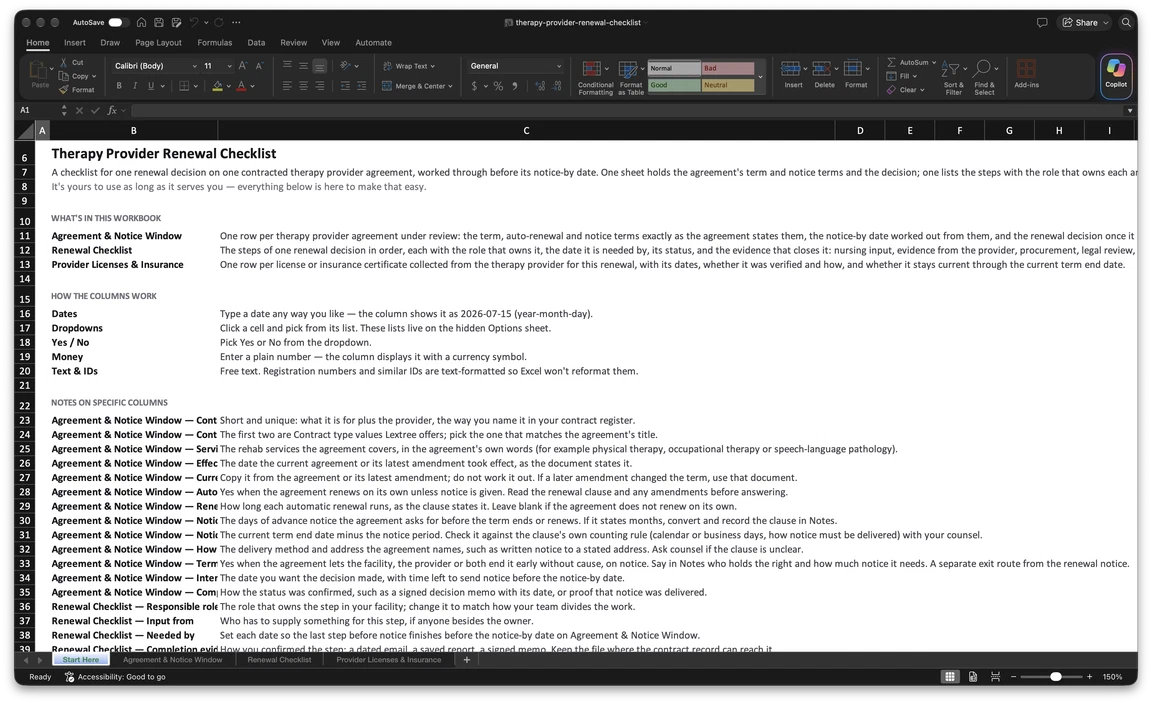
The renewal checklist is filled in with these Sample Rehab Partners rows and sent to your email. “Agreement & Notice Window” holds the agreement’s term, renewal and notice terms as written, the notice-by date and the decision. “Renewal Checklist” lists the steps in order with the role that owns each, its needed-by date and the evidence that closes it. “Provider Licenses & Insurance” records each license and certificate collected for the renewal and whether it stays current through the term end.
Get the therapy renewal checklist
Enter your email and we’ll send the therapy provider renewal checklist to your inbox. Free — no credit card, no call, no follow-up sequence you didn’t ask for.
Screening, Privacy and Procurement Checks
The facility runs the exclusion screening and keeps the dated results as its own records; the provider supplies the names to screen and confirms how it screens the staff it assigns.
Exclusion and Staff Screening
Step 6 belongs to the compliance officer. Screen the provider company, its owners and managing employees, and each therapist under your compliance policy, save the dated result, and repeat as often as the policy sets, not only at renewal.
Many facilities search the HHS OIG List of Excluded Individuals/Entities (LEIE). For example, 42 CFR 483.65(a)(2) asks that an outside provider of specialized rehabilitative services not be excluded from Federal or State health care programs. Agreements often carry a contract-level version: each party’s warranty that it is not excluded, with a duty to tell the other if that changes, as the county agreement does.
Step 7 sits with the administrator or compliance officer. Confirm that the provider screens the therapists and assistants it assigns the way your abuse-prohibition policy requires, for example background checks and license disciplinary history, and that they complete the training you give contract staff. For example, 42 CFR 483.12(a)(3) bars employing or otherwise engaging anyone found guilty by a court of abuse, neglect, exploitation, mistreatment or misappropriation of property, anyone with such a finding in the State nurse aide registry, and anyone with license discipline in effect because of such a finding. 42 CFR 483.95 extends the training program to individuals providing services under a contractual arrangement, consistent with their expected roles.
Privacy Review and Price Evidence
Step 8 belongs to the privacy officer. Ask whether the agreement needs a business associate agreement and, if one exists, whether it is signed, on file and current. For example, the HIPAA definition of business associate at 45 CFR 160.103 leaves out a health care provider for the resident information the facility discloses to it for the resident’s treatment. Work the provider does on the facility’s behalf beyond treatment, such as handling the facility’s own claims or other billing tasks, may change that, so the question goes to the privacy officer or counsel.
Step 9 belongs to the purchasing lead, needed by 2026-12-03. Compare current rates with the agreement’s rate schedule and any annual increase, add any competing quote, and note what the provider would change at renewal. Record the basis each rate is billed on, such as per patient day or per unit of service, and whether rates differ by payer, because a renewal can change the basis as well as the rate. The county agreement builds in a 3% annual increase on most of its rates.
Counsel Review and the Decision
Therapy Services Agreement Clauses
Step 10 belongs to the administrator, needed by 2026-12-04. Send counsel the agreement, any proposed changes and the evidence gathered, and ask for review of the notice clause (including its counting rule, left open at step 2), the pricing terms and any redlines. For example, OIG’s 2008 supplemental compliance program guidance for nursing facilities names rehabilitation companies and therapists among the arrangements to scrutinize and asks that pay be at fair market value and not tied to Federal health care program referrals, so counsel may also check the rates on that basis. Counsel also reads these clauses before the decision:
- The renewal and notice clause, which sets the date everything works back from.
- Termination for convenience and who holds it, because it can end the agreement on different terms than the notice does. In the county agreement, notice from the facility also makes every outstanding invoice due at once.
- Exclusivity during the term, which bars the facility from using another provider for the same services.
- Non-solicitation or no-hire of the provider’s therapists after the agreement ends. The county agreement bars the facility for a year, directly or through another therapy company, which matters if you might replace the provider or bring therapy in-house.
- The insurance clause, because it sets what the certificates in E-04 and E-05 are checked against, and, if a policy is claims-made, whether the provider must keep it in force or buy tail coverage for claims made after the agreement ends about services given during it.
- Claim denials and indemnification, because they decide who carries the cost when a payer refuses to pay for a therapy service. The county agreement credits the facility when a payer denies a service as not medically necessary, not covered or poorly documented by the contractor, but only if the facility forwards the denial notice within five business days, and it leaves denials caused by facility error with the facility.
- Return or transfer of records at the end, because it sets how the provider hands over records the facility has to keep on its own account.
One example for counsel is 42 CFR 483.70(f), “Use of outside resources,” which asks that an agreement with an outside resource state in writing that the facility stays responsible for services meeting professional standards and for their timeliness. Counsel checks that the renewed terms or amendment keep that language.
Making and Recording the Decision
Step 11, the administrator’s, is due by the internal decision date, 2026-12-07. Make the decision, record it with its date, and collect sign-off from whoever your facility requires.
The file offers six decision choices: Not yet decided, Renew as is, Renew with changes, Renegotiate terms, Do not renew and Replace provider. The sample still reads “Not yet decided” on 2026-11-23.
Notice, Handover and the Register
If the decision is Do not renew or Replace provider, or if new terms for Renew with changes or Renegotiate terms will not be signed before 2026-12-14, step 12 asks counsel whether to send notice. The sample needs it by 2026-12-10. Under an auto-renewal clause, if neither side has given notice by the notice-by date, open talks leave the agreement set to renew on its current terms at the term end, and the only way out without cause or the provider’s agreement is then termination for convenience, if the agreement has it, on that clause’s notice and conditions. Ask counsel about notice even when the relationship is staying, including whether the provider will sign a short amendment moving the notice-by date while talks continue. A notice sent only to protect the facility can still end the agreement at the term end if new terms are never signed, so have therapy coverage in view before sending it. Send any notice the way the agreement states, written notice to the provider’s notice address, and keep proof of delivery. The county agreement treats certified mail as given on receipt or three days after mailing, whichever comes first, one reason the sample sends notice four days before the notice-by date.
If the provider is leaving, step 13 plans the handover by 2026-12-11 so residents’ therapy continues without a gap and records return or transfer as the agreement provides. Whatever the decision, step 14 files the outcome in the contract register by 2026-12-18: the decision, any new term end and notice-by date, and the evidence set.
In Lextree, a Contract record holds the Renewal date, Notice requirement, Auto-renewal and Termination for convenience for the agreement’s renewal and notice fields. A Contract Renewal Notice Decision workflow is suggested 120 days before the Renewal date. For the sample that is 2026-11-14, 30 days before the notice-by date. The therapist licenses and certificates sit as records under the provider’s Counterparty, so licenses and certificates on the provider’s own record stay with the provider. Seeded labels and lead times are defaults you can change. Lextree for nursing home operators covers the wider setup, and you can run every contract renewal through the same steps.
Lextree Editorial
Author