Subsidiary Records Checklist After an Acquisition
Start with the entity record
A subsidiary records checklist after an acquisition confirms four things for every entity that came into the deal: its registered identity and formation jurisdiction, the parent that owns it, where it holds active registrations, and which governing documents are current and on file. Build it while the deal team is still reachable.
A post-closing subsidiary records checklist starts with one row per acquired entity. Everything else in this checklist — registrations, agents, governing documents, open requests — keys back to that row. The buyer’s compliance staff who inherit these entities pick up each one directly, instead of tracing gaps months after close.
Confirm identity and jurisdiction
Record each acquired entity’s legal name and any prior legal name. A name change, a conversion, or the acquisition itself can leave the two on different documents in what the seller hands over. Record the formation jurisdiction and entity type as registered, not as described in the purchase agreement; the two sometimes differ after a pre-closing conversion.
Capture the company or registration number the formation jurisdiction assigned, along with the tax ID — an EIN or the local equivalent — and the formation date. Add the acquisition close date on the same row. Later verifications are dated against the close date.
Record the ownership link
For each acquired entity, record its direct parent — the entity or person that owns it as of close, not an ownership percentage or a chart. A direct parent is enough to make the rest of this checklist retrievable. From any acquired entity, you can trace upward to the entity that controls it, and from any parent, downward to what it now owns.
Record the link once, and keep it current if an entity changes hands internally. Confirm it against the closing documents rather than an org chart someone drew from memory.
Verify registrations and standing
Confirming acquired entity good standing and registrations is where a post-closing checklist earns its keep. The acquisition close date on the entity record only matters once every registration has been checked against the registry that issued it. Don’t assume standing from what the seller provided before close — confirm it directly with the registry.
Many registries offer an online entity search for this. Where one isn’t available, or the result isn’t enough evidence, request a certificate or written confirmation and record which source you used.
Map every jurisdiction
Give every acquired entity one row per jurisdiction it’s registered in. Formation is one row; each foreign qualification, branch, or trade registration gets another. A holding company formed in one state and foreign-qualified in three more shows up as four rows, not one.
Record the registration type, and the registration or file number the jurisdiction assigned, on each row. Licenses and permits get their own rows too, separate from registrations — record the issuing authority and the licence or permit number for each one. Confirm with each issuing authority whether a change of control or a name change requires the licence to be amended or reissued.
This is the same entity registration tracking discipline a buyer’s own entities should already follow. An acquired entity just arrives with the row pre-filled by the seller’s history, unverified until you check it yourself. If a name change happened before or during the deal, confirm with each registry whether it requires an amended qualification.
The answer isn’t the same in every jurisdiction. A registration the group no longer needs stays on the register with its own status, rather than being deleted.
Confirm the registered agent
Record the agent of record for every row, and the date you confirmed the appointment — not a renewal date, the date you checked. A seller’s registered agent relationship doesn’t always transfer cleanly, and an acquired entity can carry an agent who no longer expects to serve it. Changing the agent is a procedure to confirm per registry, not a single company-wide action.
Some jurisdictions accept a straightforward change filing; others require the outgoing agent’s consent or a specific form. Until the change is confirmed, treat the seller’s agent as the agent of record. Route anything that arrives through that relationship immediately, rather than waiting for the registration to formally transfer.
Check standing with the registry
Confirm standing directly with each registry, not from a certificate the seller produced during diligence. Standing can lapse between when that certificate was issued and when the deal closed. For each registration:
- Pull the current status directly from the registry, not from a certificate dated before close.
- Record the certified status and the date you checked it.
- Confirm the next periodic filing date with the registry rather than calculating it yourself, and keep a recurring filing obligation record per state apart from that filing date.
- Note anything the registry flags — a lapsed qualification, an outstanding notice — as its own line for follow-up.
An annual report filing confirmed this way reflects what the registry says today, not what a pre-close certificate said weeks ago.
Review charter and governing documents
Every acquired entity should have its charter — articles of incorporation, articles of organization, or the local equivalent — plus every amendment filed against it, in order. Mark each document current or superseded, not by deleting older versions — an entity that converted forms or changed its name mid-life needs the full sequence on file. If the sequence has a gap, record the gap itself rather than assuming the missing document said what you’d expect.
Bylaws or an operating agreement should be on file for every acquired entity, along with the board or shareholder consents that authorized the transfer — the resolutions that approved the sale, not just the purchase agreement. Record who held each officer and director position as of the close date, and the document that appointed them, beside the consents that authorized the sale. These sit next to the charter documents because they answer who had authority to sell, not whether the entity exists.
A corporate minute book review after an acquisition means treating “reviewed” as a recorded state, not a feeling someone had while skimming a folder. Record who looked at each document, when, and against what — a registry extract, a prior counsel’s index, or the purchase agreement’s own schedule of entities. That review record is what corporate records management gives you that a folder of files doesn’t: proof the document was checked, not just received.
Build the post-closing checklist
A post-closing legal integration checklist works because of sequencing, not effort. Name an owner for each block of the checklist before the work starts — the entities, the registrations, the governing documents, the open requests. Request what only the seller can provide before access disappears. Track every request the same way you track a registration — as a row with a status, not a thread in email.
That way, no row waits on an assumption about who was handling it. The checklist carries its own status, so no one has to remember what’s still open.
Ask while access lasts
Seller access — to prior counsel, to the seller’s own records system, to whoever kept the acquired entity’s files — has a shelf life. It’s usually shorter than the buyer expects.
Tie that window to what the purchase agreement or a transition services agreement provides, rather than assuming a standard length. Record the date access ends beside your open requests, not as a separate note. Before it closes, request anything the acquired entity’s own files won’t produce on their own.
That means the minute book or written consents, the stock ledger or membership interest register, the officer and director list, and confirmation of the current registered agent. Address these requests to whoever actually holds the records — sometimes the seller directly, sometimes the entity’s prior counsel. Note who that was on the request itself — it’s the detail most likely to get lost once the transition team moves on.
Track what you requested
Every outstanding request deserves the same row-based discipline as a registration — a request date, a response-by date, and a current status: requested, followed up, received, or closed. This is a request register, not an inbox thread someone has to reconstruct from memory when a request goes quiet.
When a request goes unanswered, record the non-response and its date. Escalate through deal counsel, and note which records you’ll rebuild from registry sources instead — don’t mark the request closed until the record exists.
Paralegals tracking several acquired entities need to see which requests are open, and for how long, without digging through email. Update the status and its date whenever something changes. Leave closed requests on the register instead of deleting them — a closed row is proof the record was produced.
Keep the record as evidence
Every row needs the same closing detail once it’s confirmed: who checked it, on what date, and against what source — a registry extract, a signed consent, an email from prior counsel. Record the source next to the confirmation, not just the fact that something was confirmed.
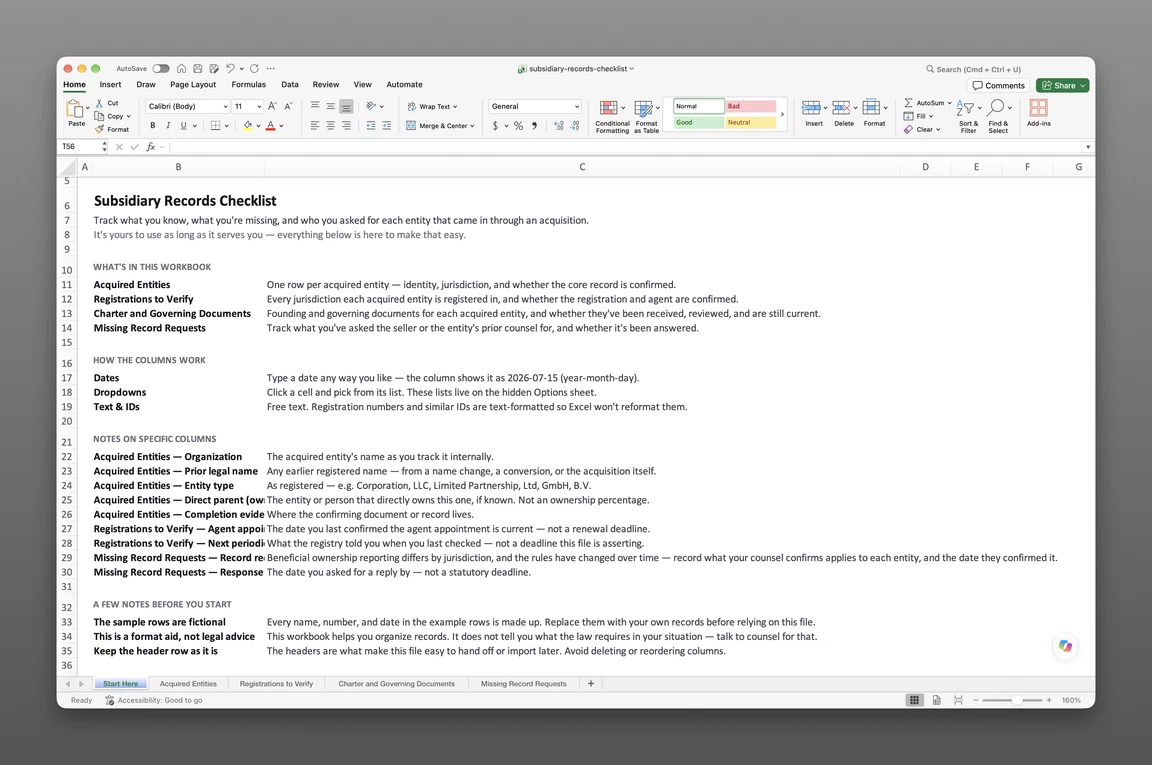
This checklist has a companion spreadsheet, sent to your email, with four sheets: Acquired Entities, one row per entity with its identity and parent link recorded; Registrations to Verify, one row per jurisdiction registration and its confirmed standing; Charter and Governing Documents, tracking what’s been collected and reviewed against what’s still open; and Missing Record Requests, the register for what you’ve asked the seller or prior counsel for and where it stands.
Enter your email and we’ll send the subsidiary records checklist to your inbox. Free — no credit card, no call, no follow-up sequence you didn’t ask for.
A spreadsheet like this one holds a snapshot — accurate the day someone updated it, with no reminder when a registration’s standing changes later. What replaces it is an ongoing register of entities and their registrations, kept current after each deal instead of rebuilt. Dedicated subsidiary management software carries registrations, agents, and governing documents forward as one record, not a new spreadsheet per acquisition. The same standing record is what makes audit readiness possible later — proof an entity was checked, not just a file that says it once was.
Lextree Editorial
Author