Share Transfer Checklist: Evidence to Keep for Each Transfer
Request, Restrictions, and Approvals
A transfer request usually arrives as an email with a name and a number of shares in it. Before anyone signs, a share transfer checklist should tell you what the file needs to hold when the transfer is done. This one follows US practice, where the signed paper is a stock power or a transfer instruction. The share transfer documents required for most transfers fall into six groups:
- Any waivers owed to other holders under the governing agreements
- A securities-law legend review
- The transferee’s joinder, where an agreement exists
- The signed transfer instrument for that form of holding
- A transfer tax or stamp duty status
- The date the company’s records show the new holder
Each group has its own owner and its own paper, and the sections below take them in the order they arrive. Give the transfer a reference on day one, something as plain as the holding company’s initials and a sequence number, and write it on every document that comes in. A loose waiver with no reference is the item that cannot be matched to its transfer six months later.
Right of First Refusal Waivers
Open the shareholders’ agreement, or whatever agreement binds the holders, and look for a right of first refusal or a co-sale right. If one applies, get the waiver or the notice showing the right expired, and file it with the transfer. Preemptive rights are a separate matter and usually concern new issuances. If the right works through a notice period, record the date the notice went out and the date the period ran. A waiver signed on day three and an expiry on day thirty are different evidence, and the file should show which one you hold. Record only whether the waiver was received and when.
Securities-Law Legend Review
Look at the certificate, or the notice for an uncertificated holding, for a restrictive legend. Per the SEC’s Rule 144 investor bulletin, only a transfer agent can remove a restrictive legend, and it does so with the issuer’s consent, usually shown by an opinion letter from the issuer’s counsel. The SEC’s restricted securities page adds that restricted securities typically bear that legend, and that it has to come off before a public resale. For a private company holding, the practical step is to ask early whether the issuer or its transfer agent wants an opinion, so the paralegal is not hunting for one on closing day. Whether one is needed is counsel’s call, so log the question and the answer.
Transferee Joinder and Consents
Where a shareholders’ or operating agreement exists, the transferee signs a joinder to it, and the paralegal files the signed copy with the packet. If the issuer asks for a board or owner consent, record “consent on file” with its date. Filing those consents the same way every time is its own discipline, covered in how to file the consent record.
Signed Instruments by Share Type
The signed paper depends on how the holding is kept. Certificated shares move on a physical certificate and a separate signed instrument. Uncertificated shares move on a written instruction and end in a statement. Check which form the holding takes before you send anyone a signature page. The transferor signs the stock power or the instruction, and the transferee signs the joinder where an agreement exists. Keep the purchase, gift, or contribution agreement beside them, since it supports the consideration entered on the log. If the transferor is an entity, add the officer’s authority to the packet, such as a signed incumbency certificate or a resolution naming the signer, since the transfer agent may ask who is behind the signature.
Certificated: Stock Power and Surrender
For certificated shares the transferor signs a stock power, sometimes called an assignment separate from certificate, or endorses the certificate itself. The transfer agent will want the transferor’s signature guaranteed. The SEC’s glossary entry on medallion signature guarantees says investors sign the certificates and securities powers, a legal document separate from the certificate, and must get the signature guaranteed before a transfer agent accepts the instructions. It names the Securities Transfer Agents Medallion Program (STAMP) as the program behind the guarantee. The SEC says the guarantee comes from a bank, credit union, or broker-dealer that takes part in one of the medallion programs, so ask the transferor’s own institution first.
Then the old certificate has to come back. File the surrendered original with a note that it was cancelled, and the new certificate to the transferee only after that. If part of the holding moves, a balance certificate goes to the transferor for the rest.
Uncertificated: Instruction and Statement
Uncertificated shares have no certificate to surrender. The transferor gives the issuer or its transfer agent a written instruction. For a Direct Registration System holding, the SEC’s guide to holding your securities explains that the holder receives a statement of ownership from the issuer instead of a certificate. Keep the transferee’s statement. For an uncertificated holding it plays the part the cancelled certificate plays for a certificated one.
Tax Status and Register Entry
Two items close the record. The first is transfer tax or stamp duty, which varies by jurisdiction. Record it as a status on the row and state no rule: “pending”, “confirmed with counsel”, or “not applicable per counsel”. The paralegal’s job is to see that the question was asked and answered, and to file the answer. Where a transfer is a gift or a contribution with no price, the same row still gets a status, because a blank price answers nothing.
The second is the register entry date. That is the date the company’s records show the transferee as the holder, and it is a different date from signing and from payment. To record a share transfer, enter the transferor and transferee, the class, the quantity, the consideration, and each of the three dates separately. Keep the three dates in their own columns, because someone will eventually ask who held the shares on the day a vote was taken or a distribution was paid. The reasons the register entry date matters, and where it sits next to the cap table, are laid out in why the register entry date matters.
Where Transfers Stall
Most transfers stall on a missing signature, a certificate nobody can find, or a transfer that moves only part of a holding. The checklist helps most at those points, because each one leaves a row open with a name beside it.
Partial Transfers and Balance Certificates
When part of a holding moves, three records change. The old certificate is cancelled, the transferee gets a new one, and the transferor gets a balance certificate. For uncertificated shares the transferee and the transferor each get a new statement. Reconcile before closing the row: the quantity transferred plus the balance must equal the original holding. If the numbers do not add up, the row stays open.
Missing Signatures and Lost Certificates
An unsigned stock power, or a signer whose signature carries no medallion guarantee, stops the transfer at the transfer agent. Leave the row marked pending and name the missing item in the notes. Do not backfill a date or a signature to tidy the file; the gap, and the day it closed, is the history. For a lost certificate, the same holding your securities guide says to contact the transfer agent and request a stop transfer, and the request goes into the packet.
Assembling the Evidence Packet
The share transfer record for one transfer is a packet. It holds the signed instruments, the consents and waivers, the joinder, the cancelled certificate or the statement of ownership, the tax status, and the register entry date. One transfer reference ties them together. A single row per transfer, with a link to each signed instrument, makes the share transfer evidence easier to audit than a folder of loose PDFs, because a reviewer starts from one line and follows it to the paper. Name each linked file after the transfer reference and the document, such as the reference followed by “stock power signed”, so the link still makes sense after the folder is reorganized.
A short example, with invented parties and not legal advice. Alder Holdings moves 12,500 of its 30,000 shares to Birch Capital. The row for the transfer shows the stock power, the right of first refusal waiver, Birch’s joinder and the board approval, each linked. It shows the old certificate as cancelled and a balance certificate for 17,500 shares. The tax status reads “pending” until counsel answers, and the register entry date stays blank until the company’s records change. In Lextree, each equity transaction is its own record with a date, parties, consideration, and supporting documents. The Complete Equity Transfer workflow takes a transfer from agreed terms through execution to a registered, settled change of ownership, in four steps: terms, execution, registration, and settlement. The module page covers tracking each equity transaction against its holding. If you keep the log in a file instead, a ready-made transfer log covers the running ledger around it.
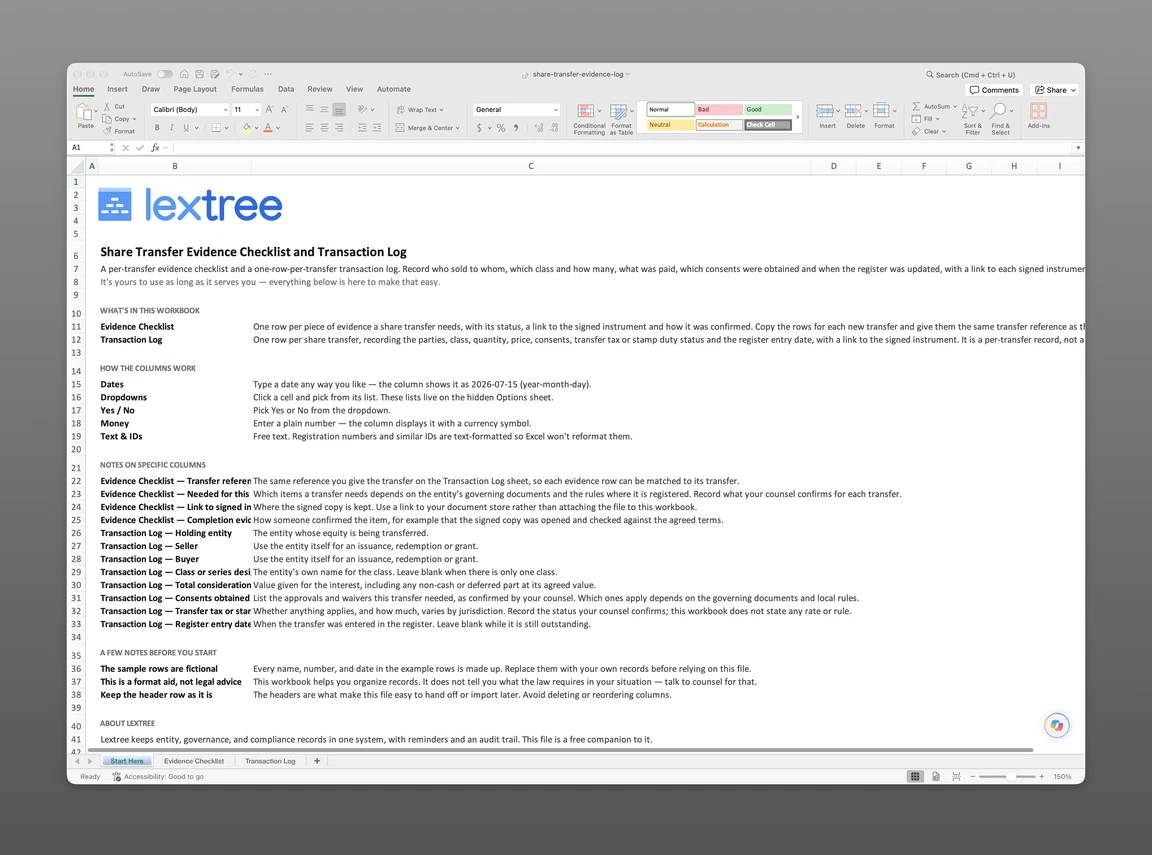
The file has 2 sheets. The Evidence Checklist has one row per piece of evidence a transfer needs, with its status, a link to the signed instrument, and how it was confirmed. The Transaction Log has one row per transfer, covering the transferor and transferee, class, quantity, consideration, consents, transfer tax or stamp duty status, register entry date, and a link to the signed instrument. Submit the form below and the file is sent to your email, ready to copy for each new transfer.
Get the share transfer checklist and log
Enter your email and we’ll send the share transfer evidence checklist and transaction log to your inbox. Free — no credit card, no call, no follow-up sequence you didn’t ask for.
Lextree Editorial
Author