Signing authority matrix: limits, co-signature rules and effective dates by legal entity
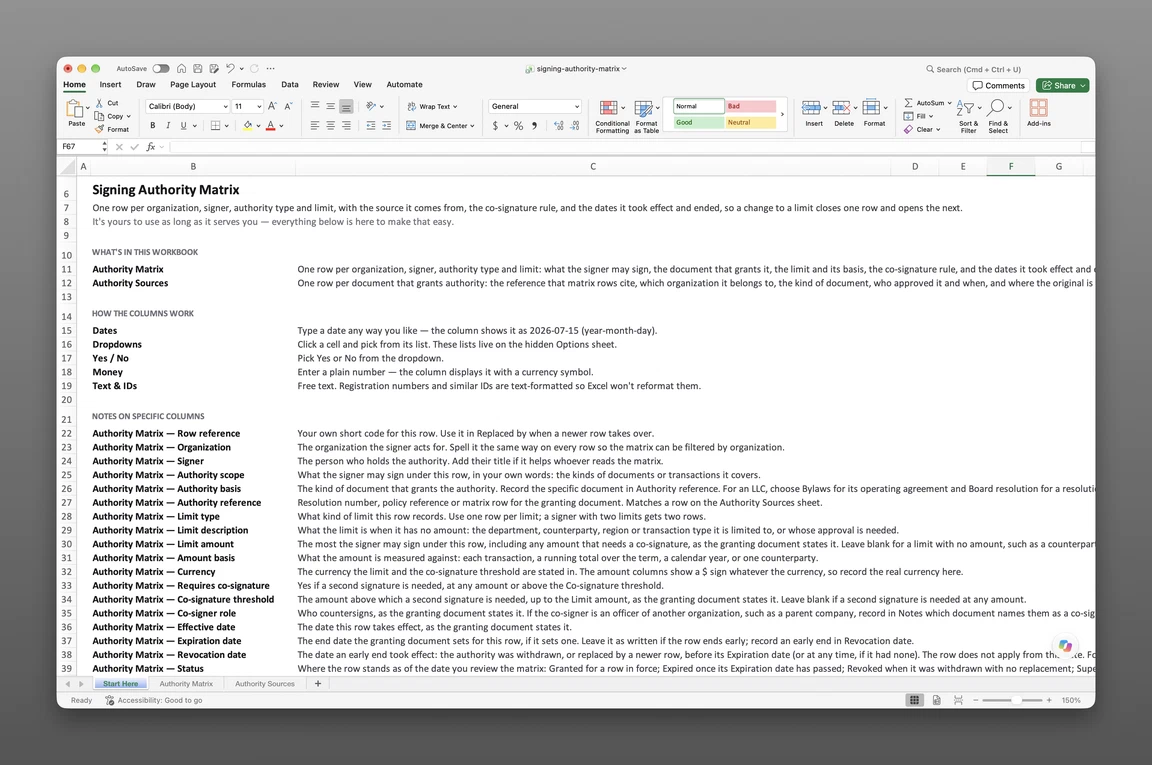
What is a signing authority matrix?
A signing authority matrix is a grid showing who may sign for each legal entity in a group. Each row names what the signer may sign, the limit and its basis, and when a second signer must countersign. It also cites the resolution or policy that grants the authority, with start and end dates.
A signature authority matrix is the same document under another name, and a broader delegation of authority matrix often adds internal approval levels. A reviewer reads across one row to confirm the signer, entity, document type, amount and date, then finds the document that proves it. Auditors testing contract approvals, lenders at closing and counterparties reviewing a signature page ask for that proof.
This page covers signing grants and the limits placed on them. Standalone powers of attorney, delegations, agent authorizations and corporate seals each have their own register in the authorized signatory list template.
The columns each row needs
Each row in a signing authority matrix is one organization, one signer, one authority type and one limit. A signer with a contract cap and a lease approval rule gets two rows. Four details do most of the work: the entity, the limit amount, the amount basis and the co-signature rule.
The remaining columns place the row in time and tie it to its source. Many signing policies print the same information as tiers, with document types down the side and dollar bands across. Filter the rows to one entity and one authority type to get that view, as the reading of SAMPLE-0000002 below shows.
Entity and transaction type
The organization column names the legal entity the signer acts for. Spell it the same way on every row so the matrix filters cleanly by entity.
A subsidiary’s rows cite that subsidiary’s own source document, not the parent’s. Governing documents and applicable law vary, so confirm with counsel which document grants authority for each entity.
Authority type names what the signer may sign: contracts, banking and payments, procurement, tax and regulatory filings, employment documents, legal documents, or all authorities. Authority scope narrows the type in plain words, such as “carrier and customer service contracts” or “outside counsel engagement letters”. Record the signer by name, with a title where it helps a reviewer.
The row reads the same whether someone signs in ink or through an e-signature platform. The platform records who signed, and the row records whether that person could.
Limits and second signers
Signing authority limits take several forms. Limit type says which one the row records: monetary, transaction type, counterparty, department or business unit, geographic, or approval required. A monetary limit carries an amount, while a limit with no amount leaves it blank and describes the limit in words.
Amount basis says what the amount covers: per transaction, aggregate over term, per calendar year, or per counterparty. A currency column handles limits not stated in dollars.
The co-signature rule records whether a second signer is needed, the threshold amount above which that signature applies, and the co-signer’s role. When a second signature applies at any amount, the threshold stays blank.
The threshold can sit below the limit, giving one row three bands. Up to the threshold, the signer signs alone. Above the threshold and up to the limit, the signer signs with a second signer; above the limit, the amount falls outside the row.
Source document and dates
Authority basis names the kind of source: a board resolution, a delegation of authority, an officer appointment, a signing policy or the bylaws. Authority reference holds the resolution number or policy reference, which leads a reviewer to the signed original, the approver and the approval date. That trail answers a counterparty’s question: how do you show this person can sign?
The same trail gives whoever prepares a secretary’s certificate or incumbency certificate the resolution and the officer to cite. A specimen signature on file is a yes/no that a bank or registry may ask about. A may-delegate flag records whether the holder can pass the authority on.
Three dates place each row in time. The effective date is when the authority starts. The expiration date is when the source says it ends, if it sets one.
The revocation date records an early end, when the organization withdraws the authority or a newer row replaces it. Status reads Granted, Expired, Revoked or Superseded, and a replaced-by pointer names the newer row.
The companion file has 2 sheets and is sent to your email. Authority Matrix holds one row per organization, signer, authority type and limit, with its source, co-signature rule and dates. Authority Sources lists the resolutions, policies and appointments those rows cite, with who approved each, when, and where the original is kept.
Get the free template
Enter your email and we’ll send the signing authority matrix to your inbox. Free — no credit card, no call, no follow-up sequence you didn’t ask for.
How to build a signing authority matrix
Build from the documents that grant authority, one legal entity at a time.
- List every legal entity in the group, the parent and each subsidiary, under the exact name the rows will use.
- Collect each entity’s board resolutions and officer appointments, plus signing policies, delegations and bylaws, with approval dates and filing locations.
- Write a row per signer, authority type and limit, quoting the limit and its basis as the source states them.
- Record the co-signature rule on that row: whether a second signer is needed, above what amount, and in which role.
- Date each row from its source, entering the effective date and any expiration date, then set its Status.
- Close the old row and open a new one whenever a resolution or appointment changes a limit.
Re-read the rows against their source documents at a fixed point, such as quarter close or after each board meeting. Check them again when an appointment, a resignation or a new resolution touches a row. Send any row whose source you cannot find to counsel.
Changing signing authority limits without overwriting
A changed limit gets a new row, and the old row stays. Enter the change date as the old row’s revocation date, mark it Superseded and point it at the new row. The new row starts on that same date and cites the new source.
A revocation with no replacement fills in the revocation date alone. An authority that runs out with no successor stays in the matrix as Expired. The signing authority matrix then shows which limit applied on any past date.
A worked example, three entities
Sample Holdings Inc. is a fictional parent with two subsidiaries, Sample Logistics LLC and Sample Software LLC. The table shows five of its rows, read as of 2026-10-06.
| Row | Organization | Signer and scope | Limit and basis | Second signer | Source | Term and Status |
|---|---|---|---|---|---|---|
| SAMPLE-0000001 | Sample Holdings Inc. | Chief Financial Officer: commercial and vendor contracts in the ordinary course | $250,000 per transaction | None | Board resolution, SAMPLE-0000101 | 2024-03-12 to 2027-03-11; ended early on 2026-06-18. Superseded by SAMPLE-0000002 |
| SAMPLE-0000002 | Sample Holdings Inc. | Chief Financial Officer: commercial and vendor contracts in the ordinary course | $500,000 per transaction | General Counsel, above $250,000 | Board resolution, SAMPLE-0000102 | 2026-06-18 to 2028-06-20. Granted |
| SAMPLE-0000004 | Sample Holdings Inc. | General Counsel: outside counsel engagement letters and matter-related agreements | $300,000 aggregate over term | None | Officer appointment, SAMPLE-0000104 | 2025-05-13 to 2027-05-12. Granted |
| SAMPLE-0000007 | Sample Logistics LLC | Managing Director: real property leases | Approval required, no amount: prior written approval of the General Counsel of Sample Holdings Inc. before each lease is signed | None | Board resolution, SAMPLE-0000106 | 2025-07-09 to 2027-07-08. Granted |
| SAMPLE-0000009 | Sample Software LLC | Vice President, Engineering: offer letters and contractor agreements | Department or business unit, no amount: engineering team only | None | Delegation of authority, SAMPLE-0000108 | 2025-10-14 to 2026-09-23. Expired, no replacement row |
Every name, amount, date and reference in this example is invented. The example illustrates a record-keeping layout and is not legal advice.
Reading the five rows
- SAMPLE-0000001 to SAMPLE-0000002. The Chief Financial Officer’s contract limit rose from $250,000 to $500,000. The old row keeps its original expiration date, 2027-03-11, and takes a revocation date of 2026-06-18, the day the new row starts. Its Status becomes Superseded and a pointer names the new row, which cites a new resolution, SAMPLE-0000102.
- SAMPLE-0000002. The threshold ($250,000) sits below the limit ($500,000), so this row has three bands. The Chief Financial Officer signs alone up to $250,000, and with the General Counsel as second signer up to $500,000. Anything higher falls outside the row, and the reviewer looks for another row or a new resolution.
- SAMPLE-0000004. The basis is aggregate over term. The $300,000 cap applies to a running total of the fees estimated in every engagement letter signed during the term. The running total comes from the contract records.
- SAMPLE-0000007. An approval-required limit has no amount, so the limit amount, amount basis and currency stay blank. The parent’s General Counsel approves each lease in writing before the Managing Director signs. The row records an approval, not a second signature, and the subsidiary’s own resolution, SAMPLE-0000106, names that approver.
- SAMPLE-0000009. The delegation expired on 2026-09-23 and no successor row exists. Because the matrix keeps the row instead of deleting it, the lapse shows up at review.
The same rows in Lextree
In Lextree, each grant is a Signing Authority record that belongs to an organization and names a signer. The record holds the authority type, scope, basis and reference, plus the effective, expiration and revocation dates. It also notes whether a specimen signature is on file and whether the holder may delegate.
The dollar thresholds and co-signer requirements sit beneath each grant as Limit records. Each Limit record holds the limit type, limit amount and amount basis. It also records whether a co-signature is required, the threshold, the co-signer’s role and what the limit applies to.
In the file, each row is one limit and carries its own dates. In Lextree, the effective, expiration and revocation dates are fields on the grant, and a Limit record has no dates of its own.
The grant’s timeline moves through Granted, Expired and Revoked from those dates, and you enter Superseded by hand. The module comes set up with these states, and a company can configure them.
A Signing Authority Expiration Reminder comes with the module. Lextree suggests it whenever you fill in an expiration date, with reminders 90, 60 and 30 days before.
Lextree holds the record of who may sign and under what limits, and it serves as the reference during contract review. It does not run the approval of a given transaction.
Lextree Editorial
Author