Tracking Tax Filings Across Multiple Entities and Jurisdictions
What stays true between periods
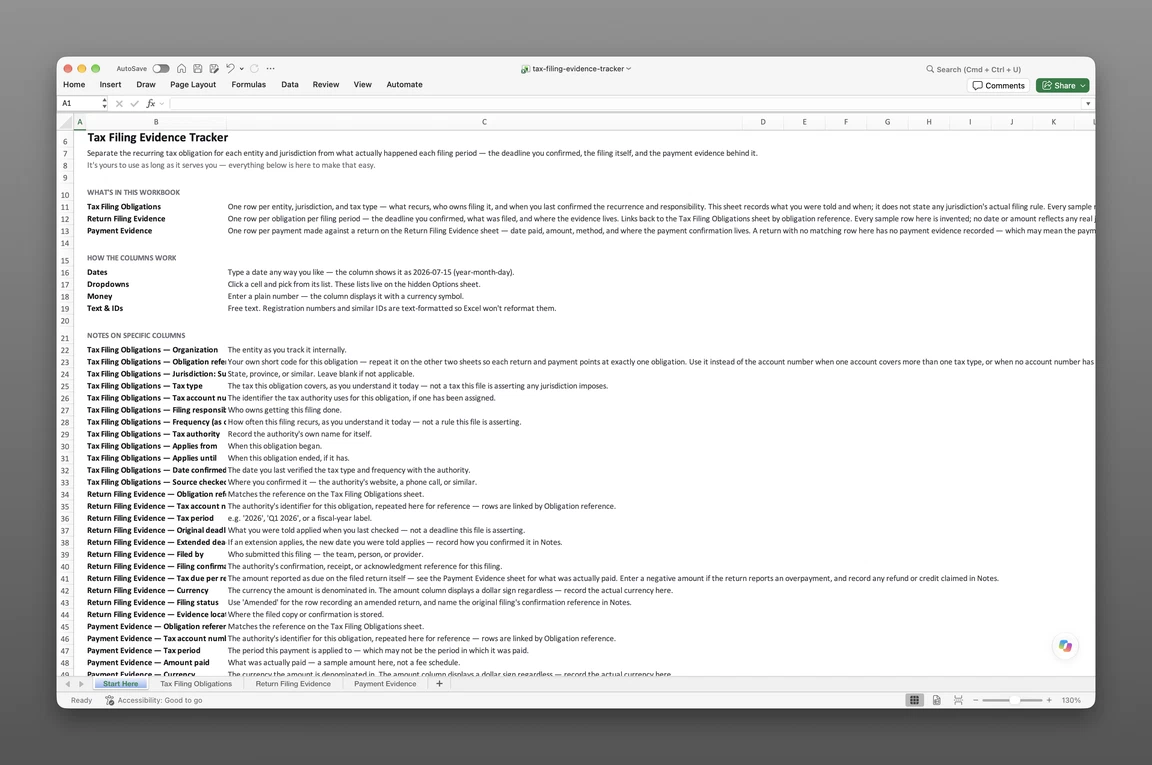
Tracking tax filings across multiple entities and jurisdictions rests on three records: a recurring obligation for each entity, jurisdiction, and tax type; a return record for what was filed each period; and payment evidence for what was paid. Multi-entity tax filing records work when those three stay separate and joined by a shared reference.
What the obligation record holds
An obligation row is keyed to the entity, the jurisdiction, and the tax type — not to the entity alone. A group of three entities can still produce four obligation rows. An entity filing both an income tax and a payroll tax in the same jurisdiction needs two rows, not one. Collapsing them into an entity-level row is the miscount that breaks most trackers before they start.
Each row is a recurring tax obligation record by entity and jurisdiction. It carries organization, obligation reference, jurisdiction (country and subdivision), tax type, tax account number, filing responsibility, frequency (as confirmed), tax authority, the dates the obligation applies from and until, when it was last confirmed, and where that confirmation came from.
The tax account number earns its own sentence. It is the authority-facing identifier for the obligation, recorded here and repeated on the other two records for reference. It is not what joins the three records: one account number can cover more than one tax type, and an obligation can exist before an account number is assigned.
Frequency and tax type are recorded as confirmed, not asserted. The field is literally named frequency (as confirmed), paired with a date confirmed and a source checked, so the row states what someone was told and when — not a rule the record itself is asserting. Rules differ by jurisdiction and tax type; confirm with the tax authority. Turning these obligations into dates on a compliance calendar is a separate step, built from this record rather than replacing it.
What the return record carries
Against each obligation, a return record exists for every filing period. What to record when a tax return is filed:
- Organization and obligation reference, tying the row back to the obligation it satisfies
- Tax account number, tax period, and tax period end
- Original deadline (as confirmed), date filed, and who filed it
- Filing confirmation reference
- Tax due per return, and the currency it is stated in
- Filing status and evidence location
Tax return filing confirmation records exist for exactly this reason: a filing status of Filed is a claim, and the filing confirmation reference plus the evidence location are what make that claim checkable by someone else.
The tax period is its own field rather than a date on a calendar. A period label may be a quarter, a fiscal-year label, or a year that does not line up with the reader’s own financial year. Keying the record to the period, not to a calendar year, is what keeps a regulatory filing and the confirmation receipt behind it readable against whichever period it actually covered.
The reference that joins them
The obligation reference is a short code the reader assigns — OBL-001 in the companion file’s sample rows — and it appears on all three records. A return points at exactly one obligation; a payment points at one obligation plus one tax period, since more than one payment can land against the same return.
The reference matters more than it sounds. Without it, editing an obligation row to reflect a changed rule would silently overwrite the history of what was filed under the rule that applied before — and the filing already happened, under whatever rule was in force that period. Keeping them separate and joined by the reference means the obligation can change without rewriting the period, and the period can still be read back against whichever version of the obligation it was filed under.
The same obligation-vs-period split applies to registration filings, one level up from tax.
Payment evidence, period by period
A return record says what the return reported as due. A payment record says what actually left the bank, when, against which period, and where the receipt is kept. They are separate facts, recorded as separate rows, because they can diverge in several ordinary ways.
Recording what was actually paid
The payment record carries organization, obligation reference, tax account number, tax period, date paid, amount paid, currency, payment method, payment type, a payment confirmation reference, and an evidence location.
Payment type does the most work here, and nothing else on this page models it: a payment with the return, an estimated payment ahead of it, a payment against an assessment or notice, or a credit or overpayment applied from an earlier period. One filing period can carry several payment rows, each of a different type.
Currency is its own field: an entity filing outside the group’s home jurisdiction holds amounts in more than one currency, and a single currency symbol would misstate every row not denominated in it. Recorded this way, the record holds tax filing evidence by period and jurisdiction that a single “amount paid” column never could.
When filing and payment diverge
A few ordinary situations explain why the return and payment records rarely match row for row:
- The amount paid differs from the amount reported as due — a credit applied, an earlier estimated payment, or a partial payment against the balance
- A payment is applied to a period other than the one in which it was made, which is exactly why the payment record carries its own tax period field
- One return can draw several payments; one payment covers exactly one period
- A return exists with no payment row against it at all
That last case is the page’s key judgment, and it deserves care. A missing payment row means only that no payment evidence has been recorded — it may mean the payment was never made, or it may mean it was made and never logged. The record tells the reader which question to ask; it does not answer it on its own. There are two different kinds of absence worth telling apart. A period marked “not started” because the period itself is not yet complete is an expected blank. A period marked “filed” with no payment row behind it is an evidence gap to go and chase.
A group filing in three jurisdictions
Picture a fictional group: Sample Meridian Holdings, Inc., filing income tax in Delaware; its subsidiary Sample Meridian Retail LLC, filing franchise tax and payroll tax in Texas; and Sample Meridian Foods B.V., filing income tax in the Netherlands. Three entities, three jurisdictions, and four tax obligations — because the Texas subsidiary files two tax types in the same state.
Where the group files
| Organization | Obligation reference | Jurisdiction | Tax type | Filing responsibility | Frequency (as confirmed) | Date confirmed |
|---|---|---|---|---|---|---|
| Sample Meridian Holdings, Inc. | OBL-001 | United States — Delaware | Income Tax | In-house tax team | Annual | 2026-01-10 |
| Sample Meridian Retail LLC | OBL-002 | United States — Texas | Franchise Tax | External tax preparer or accountant | Annual | 2026-01-12 |
| Sample Meridian Retail LLC | OBL-003 | United States — Texas | Payroll Tax | In-house tax team | Quarterly | 2026-01-12 |
| Sample Meridian Foods B.V. | OBL-004 | Netherlands | Income Tax | Outside service provider | Annual | 2026-01-15 |
Every value in these three tables is invented for illustration — none of it states any jurisdiction’s actual tax type, frequency, deadline, or fee, and nothing here is legal advice. Rules differ by jurisdiction and tax type; confirm with the tax authority.
Three entities produced four obligation rows — the Texas subsidiary carries two because it files two tax types in the same jurisdiction, which is why the record is keyed to entity, jurisdiction, and tax type, not to the entity alone. Three different parties are responsible across those four obligations: an in-house team, an external preparer, and an outside service provider. Filing responsibility is a field on the row, not an assumption carried over from last year.
Once obligations are counted this way rather than by entity, it becomes possible to see how many dated obligations a portfolio actually carries before building a full filing calendar around them.
Filed, confirmed, and paid
One pass through the group’s four obligations produces five return rows, because the Delaware obligation has already opened its next period:
| Obligation reference | Tax period | Original deadline (as confirmed) | Date filed | Filed by | Filing confirmation reference | Filing status |
|---|---|---|---|---|---|---|
| OBL-001 | 2025 | 2026-04-09 | 2026-03-20 | In-house tax team | SAMPLE-0000601 | Accepted |
| OBL-001 | 2026 | 2027-04-09 | — | — | — | Not started |
| OBL-002 | 2025 | 2026-05-21 | 2026-08-10 | External tax preparer or accountant | — | Filed |
| OBL-003 | Q1 2026 | 2026-05-08 | 2026-04-28 | In-house tax team | SAMPLE-0000603 | Accepted |
| OBL-004 | 2025 | 2026-07-09 | 2026-05-25 | Outside service provider | SAMPLE-0000604 | Filed |
Amounts and evidence locations stay off this table to keep it readable, but they live on the same rows: the 2025 income return for Sample Meridian Holdings reported 48,250.00 USD due, with its filed copy and acceptance saved to the entity’s own tax folder; the Netherlands return for the same period reported 61,500.00 EUR due.
Those five return rows produced only three payment rows:
| Obligation reference | Tax period | Date paid | Amount paid | Currency | Payment confirmation reference |
|---|---|---|---|---|---|
| OBL-001 | 2025 | 2026-03-18 | 48,250.00 | USD | SAMPLE-0000701 |
| OBL-003 | Q1 2026 | 2026-04-27 | 3,120.00 | USD | SAMPLE-0000702 |
| OBL-004 | 2025 | 2026-05-20 | 61,500.00 | EUR | SAMPLE-0000703 |
Two return rows have no payment row behind them, and the difference between the two is the whole lesson. OBL-001’s 2026 return has no payment row because the period is not complete and the return has not started — an expected blank. OBL-002’s 2025 return, by contrast, is marked Filed with no filing confirmation reference and no payment row at all: that is an evidence gap to chase, two things to go get from two different places, not a finding about what was owed or paid.
Handing the record to someone else
At the start of an engagement, a tax manager hands an external preparer, for each entity, the obligation reference, the jurisdiction, the tax type, the tax account number, the prior period’s filed return with its filing confirmation reference, and the evidence location behind it. Handing over a folder of PDFs is not the same as handing over this record — the record tells the preparer which obligations already exist and which are already someone else’s to file. That handoff only works because what a corporate tax manager is accountable for is already clear before the folder changes hands.
The question that arrives later from an auditor, a lender, or a buyer’s diligence team is narrower and more specific: which returns were filed, for which entities, for which periods, and what stands behind each one. A record organized by obligation and period answers that kind of point-in-time proof by reading down two columns.
The companion file for this record, sent to your email, holds three sheets: Tax Filing Obligations, one row per entity, jurisdiction, and tax type, with who owns filing it and when the recurrence was last confirmed; Return Filing Evidence, one row per obligation per filing period, with what was filed and where the evidence lives; and Payment Evidence, one row per payment made against a return, with its confirmation reference. It opens in Excel.
Enter your email and we’ll send the tax filing evidence tracker to your inbox. Free — no credit card, no call, no follow-up sequence you didn’t ask for.
What a file cannot do is notice. A frequency confirmed once stays whatever it was on the day someone typed it, however long ago that was, and nothing in the file marks it as ageing. A tax compliance tracker template carried into the Taxes module holds the same three records where a confirmation date is visible to everyone and re-confirming is somebody’s job.
Frequently asked questions
Records and periods
How to track tax filings across multiple entities and jurisdictions? Keep three records and one join key:
- A recurring obligation — one row per entity, jurisdiction, and tax type.
- A return record — one row per obligation per filing period.
- Payment evidence — one row per payment made against a return.
Assign each obligation a short reference and repeat it on the other two records.
What is the difference between a recurring tax obligation and a tax return record? A tax obligation is what recurs — the entity, jurisdiction, and tax type, confirmed and re-confirmed over time. A tax return record is what happened in one period against that obligation: filed or not, on time or not, evidenced or not. Rules differ by jurisdiction and tax type; confirm with the tax authority.
How do you track tax filings by tax period instead of calendar year? Record the tax period as its own field — a quarter, a fiscal-year label, or a plain year — separately from the tax period end date. That keeps the record correct even when a jurisdiction’s period does not match the reader’s own financial year.
Where do you record a tax account number for each entity and jurisdiction? On the obligation row, as the authority-facing identifier for that obligation. Repeat it on the return and payment records for reference, but never treat it as the join key — one account number can cover more than one tax type.
Evidence and responsibility
What do you record when a tax return is filed? The date filed, who filed it, the filing confirmation reference the authority returned, the amount reported as due and the currency it is stated in, the filing status, and where the evidence is stored — enough to answer whether it was filed without reopening the obligation it satisfies.
How do you keep evidence that a subsidiary’s tax return was filed? Two values go on the return row at the moment of filing: the reference the tax authority returned, and the path where the filed copy and any acceptance notice are stored. Recorded then, they stay findable by whoever asks later — a subsidiary’s records are usually requested by someone who was not there.
Who is responsible for filing each entity’s tax returns? Two fields, not one: filing responsibility on the obligation row states who owns getting it done, and filed by on the return row states who submitted it that period. They are often different people, and an outside provider counts as an answer to either.
How do you show an auditor which returns were filed for which entity? Read the obligation rows for that entity, then the return rows against each obligation reference, then the payment rows against each return period. This is record production, not examination — the auditor here is a financial-statement auditor or a diligence reviewer asking for records, not a tax authority.
Lextree Editorial
Author