Trademark Maintenance Filing Tracker: Confirmed Due Dates and Evidence
The Mark Record and Its Due Date
Most teams keep a trademark maintenance filing tracker in two layers. Each registered mark gets one row holding the due date its registry or counsel confirmed, and each post-registration filing gets one row holding its status and the document that proves the outcome.
Registry, Owner, and Numbers
Start with the owner of record. The registration belongs to a specific entity, and in a group the entity on the certificate is often a subsidiary, not the parent. Put one row on the mark register per registration, with that entity in the Owner column, so a question like “which of our marks does the Ohio subsidiary hold?” has an answer you can filter for. The declaration is filed in that owner’s name, and the USPTO warns that a filing can be refused when its ownership information does not match the USPTO’s records.
Then the registry or office, the application or serial number, the registration number, the filing date, and the registration date. Keep the same spelling of the mark name on the filings log, because that is the only thing matching a filing to its mark.
A Madrid mark needs a little care. The international registration is one row, held at WIPO. Because the US extension of protection has a separate registration date and separate declaration deadlines, give it a second row under the USPTO.
Due Date and Its Source
The column that matters most holds the registry-confirmed due date. For a USPTO registration, it is copied from the Maintenance button on the registration’s status page in TSDR (Trademark Status and Document Retrieval), where the USPTO shows “Next maintenance filing required”. Otherwise it comes from counsel in writing or from the certificate.
Next to it sit two small fields that do most of the audit work. Date source says where the date came from: registry record, counsel advice, certificate, registry reminder notice, or a renewal service report. Date confirmed on says the day a person actually looked.
Record the deadline itself, never the end of the grace period. If the registry or counsel has confirmed when the grace period ends, put that date in Notes, labeled as such. When a deadline falls on a Saturday, Sunday or federal holiday, the USPTO treats a filing received the next business day as timely, but schedule against the recorded date anyway. Miss both the deadline and the grace period and the registration is cancelled or deemed expired.
Use Status and Classes
Every maintenance declaration of use rests on the mark being in use, so the mark row carries one of three values: In use, Not yet in use, or Use discontinued. List the Nice classes the registration covers. The USPTO tells owners to delete goods or services promptly if they are no longer in use, which makes the class list a working field.
A row marked Use discontinued goes to counsel before anyone signs the next declaration. The tracker does not judge whether nonuse is excusable. It makes sure the question reaches the person who can answer it.
Logging Each Post-Registration Filing
The filings log records post-registration trademark maintenance, one row per filing made after registration. Prosecution events from before registration, such as examination responses, statements of use and oppositions, stay out of it. An office action issued against a maintenance filing is different, and it belongs in the Notes of that filing’s row.
Filing Type by Section
The window column is the USPTO’s general schedule, and a six-month grace period with a surcharge follows each Section 8, 9 and 71 deadline. The due date on the mark row still comes from TSDR or counsel.
| Filing type in the log | USPTO filing name | General USPTO window |
|---|---|---|
| Declaration of use (US §8) | Declaration of Use and/or Excusable Nonuse of a Mark under Section 8 | Between the 5th and 6th year after registration |
| Combined renewal and declaration of use (US §8 & §9) | Combined Declaration of Use and/or Excusable Nonuse/Application for Renewal under Sections 8 and 9 | Between the 9th and 10th year after registration, then every 10 years |
| Declaration of incontestability (US §15) | Declaration of Incontestability of a Mark under Section 15 | Optional; within one year after any five consecutive years of continuous use following registration |
| Combined declaration of use and incontestability (US §8 & §15) | Combined Declaration of Use and Incontestability under Sections 8 and 15 | The §8 window, once five consecutive years of continuous use have run |
| Declaration of use (Madrid §71) | Declaration of Use and Excusable Nonuse under Section 71 | The same windows, counted from the US registration date of the extension |
| Renewal | Not a USPTO filing: renewal with a non-US registry, or of the international registration at WIPO | Set by that registry; the international registration renews every 10 years at WIPO |
The USPTO lists these US trademark maintenance filings on its maintain page. That page also announced that the TEAS versions of these forms retire on October 31, 2026, so the form name on older paperwork may not match the one on a newer receipt.
Pending Until the Registry Responds
A filing is Pending from the day it is submitted. The USPTO’s own guidance on keeping your registration alive puts review at roughly one to two months, and its advice on checking status is to look at least every three to four months after filing any post-registration maintenance document. A Pending row older than three to four months deserves a TSDR check.
Record who filed it: in-house, outside counsel, or a renewal service. When the examiner finds the filing not acceptable, a post-registration office action issues, the row moves to Refused, and the response and its deadline go in Notes. The filing is not over at that point: the maintain page gives six months from the office action’s issue date to respond, and the row moves to Accepted if the response succeeds. If no response is filed on a Section 8, 9 or 71 filing, the registration is cancelled or expires. A Section 8 notice of acceptance moves the row to Accepted, and its date becomes the status date. A Section 15 declaration is acknowledged rather than accepted, and it is recorded under Accepted all the same. The USPTO also advises filing early in the deadline year, so a correctable error can be fixed without an extra fee.
The Documents Behind Each Status
Three columns on the filings log hold the proof: Evidence on file, Evidence location, and Registry reference. Pick the one document that best proves the outcome, write down the folder path or link where it lives, and copy the registry’s own reference, such as the TSDR document reference. List any other documents in Notes. The specimen is the evidence of use filed with the declaration, while the evidence columns hold proof of what the registry did with it. Keep the specimen as filed with the receipt, because a refusal over the specimen, like Epsilon’s below, is answered against it. What counts as that one document depends on the status. These are the titles as they appear in a registration’s TSDR document list:
- Pending: the filing receipt, the declaration as filed, and the specimen (listed in TSDR as “PR-Section 8” for a Section 8 alone and “Specimen”).
- Accepted: “Notice of Acceptance - Email” for a Section 8, “Notice-Acceptance-Renewal” for a combined Sections 8 and 9, “Notice of Acceptance Acknowledgement” for Sections 8 and 15, plus the fee payment confirmation. The Prosecution History on the TSDR status page records the outcome too, for example “REGISTERED - SEC. 8 (6-YR) ACCEPTED” for a six-year Section 8 or “REGISTERED - SEC. 8 (10-YR) ACCEPTED/SEC. 9 GRANTED” for a combined Sections 8 and 9. For a non-US renewal, keep the registry’s registration or renewal confirmation.
- Refused: the office action itself and counsel’s response to it.
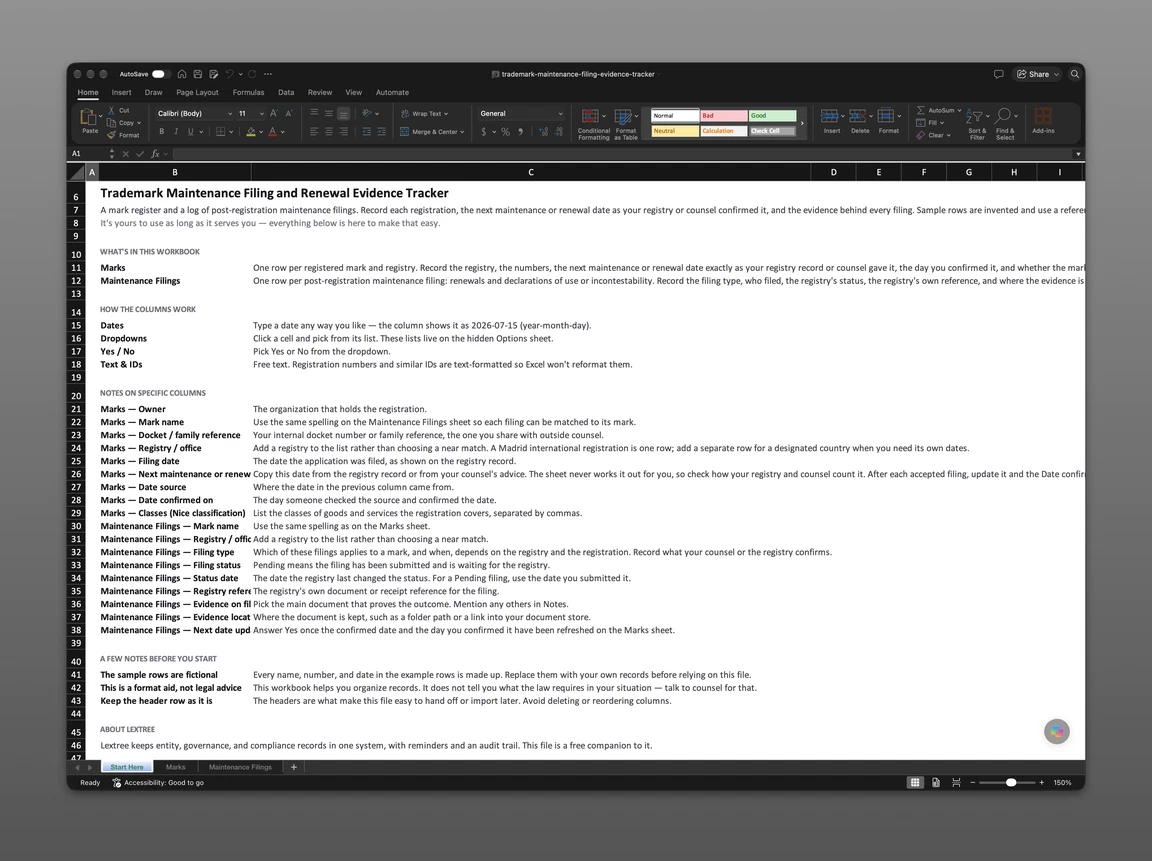
The companion file is a tracker with a Marks sheet for one row per registered mark and its confirmed due date, and a Maintenance Filings sheet for one row per post-registration filing and its evidence. It opens with a Start Here sheet and is filled with the sample filings worked through below. It is sent to your email after the form, and it covers trademarks only, so for a portfolio that includes patents and domain names see the full intellectual property register, patents through trade secrets.
Get the trademark maintenance filing tracker
Enter your email and we’ll send the trademark maintenance filing tracker to your inbox. Free — no credit card, no call, no follow-up sequence you didn’t ask for.
Keeping Due Dates Current
A trademark maintenance tracker stays accurate only when someone re-checks the registry after each filing.
Checking TSDR Between Filings
A confirmed date goes stale. Between filings, open each active registration in TSDR every so often, re-read “Next maintenance filing required” on the Maintenance button, and refresh Date confirmed on even when the date has not changed, so the record shows that someone looked. Save a copy of the status page each time with the mark’s records; the USPTO notes it can support a later request for corrective action.
Do not lean on the USPTO’s emails. Courtesy messages such as “Courtesy E-Reminder of Sec. 8 (6-yr)” and “Courtesy E-Reminder of Sec. 8/Sec. 9” go only to the email address on file, and that address is often a former employee’s or a law firm’s old docketing inbox. The USPTO says plainly that it does not extend filing deadlines even when you do not receive its messages. Official USPTO email comes only from uspto.gov. The USPTO warns about mailings from private companies it is not associated with, so a notice from one is not a registry reminder notice and should never be the date source.
After Each Notice of Acceptance
When a Section 8, a combined Sections 8 and 9, or a Section 71 filing is accepted, three things change on the mark row: the due date, its source, and the day it was confirmed. A Section 15 acknowledgement alone leaves the due date where it was. Then set “Next date updated on Marks sheet?” to Yes on the filing row.
The same record shape sits inside Lextree’s intellectual property module, with the filing history kept on the trademark record itself. The date goes in the trademark’s Registration section as shown by the registry or advised by counsel, and a Trademark renewal due event is suggested with reminders at 180, 90, 60 and 30 days. Maintenance filings are recorded under the trademark with their filing type, filing date, status of Accepted, Pending or Refused, and a registry reference such as the USPTO’s TSDR document reference.
Trademark Maintenance Filing Tracker Example
Four filings from the sample data show how the statuses and documents fit together. The reference date is October 29, 2026, and the schedule behind the windows is on the USPTO’s keeping your registration alive page. The marks and rows below are invented, and the schedule is general guidance, not legal advice.
| Mark | Filing type | Filing date | Filed by | Filing status | Status date | Registry reference | Evidence on file |
|---|---|---|---|---|---|---|---|
| Sample Mark Alpha | Combined renewal and declaration of use (US §8 & §9) | 2024-10-15 | Outside counsel | Accepted | 2025-01-07 | SAMPLE-0000202 | Notice of acceptance, renewal or acknowledgement |
| Sample Mark Beta | Declaration of incontestability (US §15) | 2026-09-22 | Outside counsel | Pending | 2026-09-22 | SAMPLE-0000204 | Filing receipt |
| Sample Mark Epsilon | Declaration of use (US §8) | 2026-04-22 | In-house | Refused | 2026-06-10 | SAMPLE-0000207 | Declaration as filed |
| Sample Mark Delta | Declaration of use (Madrid §71) | 2023-11-14 | Outside counsel | Accepted | 2024-01-30 | SAMPLE-0000206 | Notice of acceptance, renewal or acknowledgement |
Sections 8 and 9 Accepted
Alpha was registered on January 20, 2015, so its combined filing fell in the ninth-to-tenth-year window. The document that came back in TSDR was the “Notice-Acceptance-Renewal”, and that is the evidence on file, with the fee payment confirmation in the same folder. Because the Section 9 portion is the trademark renewal, the mark row’s due date moved ten years forward to January 20, 2035, sourced to the registry record, and the filing row’s update question reads Yes.
Pending and Refused Declarations
Beta’s Section 8 was accepted in 2025, and its Section 15 declaration went in on September 22, 2026. It is Pending, the only evidence is the filing receipt, and the update question reads No because nothing has changed on the mark row.
Epsilon is In use. On June 10, 2026 the USPTO issued a post-registration office action refusing its Section 8 declaration over the specimen, so the row reads Refused. The response is under review with outside counsel. The row keeps the declaration as filed as its evidence and says in Notes that the date must be re-confirmed. The mark row still shows December 8, 2026 from a registry reminder. The office action adds a separate response deadline, and until counsel confirms both dates, the record says so.
The Madrid Extension’s Declaration
Delta shows why a Madrid mark gets two rows. The international registration sits under WIPO with its own confirmed date, and it is renewed directly with the International Bureau on its own cycle. The US extension has its own registration date, October 2, 2018, and the Section 71 declaration runs from that date, as the USPTO explains for inbound Madrid post-registration filings. The accepted declaration is logged against the USPTO row.
Lextree Editorial
Author