Trustee Transition Checklist: Handover Pack and Successor Sign-Off
Trustee Transition Checklist: What Gets Handed Over
A trustee transition checklist is the list of records the outgoing trustee hands to the successor: appointment and acceptance instruments, evidence of authority, prior accountings, and open requests. Each item carries a date and proof of receipt, and both trustees sign off on the finished list.
Trust administrators, corporate trust officers, family offices, and paralegals all end up running this list. The change itself can come from a resignation, a removal, a death, or incapacity, and each of those is recorded as the reason the outgoing trustee stopped serving. The same trustee handover checklist works for all four. The checklist groups the pack into six parts:
- Change documents: resignation or removal instrument; appointment instrument, tagged by type; successor’s signed acceptance; who chose the successor.
- Authority evidence: certification of trust issued; trust instrument plus every amendment and restatement; effective date and ceased-to-serve date; who checked the evidence.
- Records the successor inherits: asset schedule; prior accountings; letter of wishes; tax registration and filed returns; client due diligence records; open beneficiary and adviser requests.
- Accounts and title: bank and custody signatories updated; each account’s retitling status; transfers outstanding.
- Notices: beneficiaries; tax adviser, custodians, counsel.
- Sign-off: open items with owner and date; outcome recorded; both trustees sign; list filed against the trust.
For the standing view of which trusts and trustees exist, a running list of every trust and its serving trustees is the companion to this one-off event record.
Change of Trustee Documents
Three kinds of document make the change itself: the instrument that ends the outgoing trustee’s service, such as a resignation letter or a removal notice; the instrument that appoints the successor; and the successor’s signed acceptance.
For each, record what the document is, who signed it, the date, and where the signed copy is filed. Tag the appointment instrument by type: a deed of appointment, a written acceptance only, a protector’s direction, or a court order. Record who chose the successor as a plain fact: the trust instrument, a protector or appointor, the grantor, the co-trustees, the beneficiaries, or a court. The record shows what happened. It does not argue who was entitled to choose.
After a death or incapacity, nobody signs the handover from the departing side. The same list still works. Record who each item came from: a co-trustee, the trust administrator, counsel, or the prior trustee’s office. Where the outgoing signature would go, record who confirmed the pack is complete.
Evidence of the Successor’s Authority
Banks, custodians, and advisers each ask the new trustee for something that shows who is now serving. The usual item is a certification of trust: a short summary of the trust and the successor’s appointment, given to an institution in place of the full instrument. Record who issued it and the date it went out.
Behind it sits the trust instrument and every amendment and restatement. Handing over the instrument without confirming the amendment set is how a successor ends up working from a partial file, so list the instrument and each amendment as separate items.
Add the successor’s effective date as recorded, the date the outgoing trustee ceased to serve, and the file where the evidence of appointment sits. One more field earns its place: who checked the evidence, with the checker’s name and date. It turns a filed document into a verified one.
Records the Successor Inherits
Beyond the instruments, the successor inherits the working file. These successor trustee records take longest to gather:
- The current asset schedule, with each holding, its custodian, and the account it sits in.
- The trust’s tax registration and the returns already filed, with the tax adviser’s contact.
- The client due diligence records the outgoing trustee holds on the settlor and beneficiaries.
- The letter of wishes, where there is one.
- The insurance policies covering trust property.
Record each as its own item, and note whether the original or a copy is handed over.
The accounting history comes with it. For each prior accounting, record the period, the type (annual, interim, final, or court-ordered), the delivered date, whether the beneficiaries’ response was received, and whether a copy sits in the pack. When the outgoing trustee was removed, that trustee’s own accounting for the months up to removal is one more entry, marked as still owed. It is the removed trustee’s accounting, not the accounting of a trust that has ended.
Open requests come last: beneficiary information requests, distribution requests, and adviser questions still pending at the change date. Record who asked, what they asked, the date received, and the date a response was requested. The successor then knows what is owed to whom, which is the part of the pack that protects the new trustee’s first month.
Notices, Retitling, and Bank Signatories
The change reaches third parties through notices. Record the notices sent to beneficiaries, and to the tax adviser, custodians, and counsel, with the date each went out and who confirmed receiving it.
Account-level items sit beside the notices, and an outgoing trustee handover is incomplete until they are recorded:
- Bank and custody signatories updated, with the date each institution confirmed.
- Each account’s retitling status: Complete, In progress, or Not required.
- Transfers still outstanding, with an owner and a target date.
- Online banking and portal access transferred, with the date the outgoing trustee’s credentials were revoked.
These items come after the documents because each institution acts only once its own records show the change. Until then, the instruments are in the right hands and the accounts are still in the old name. Confirm each institution’s own procedure with the institution, and with counsel where the instrument is unclear.
How the Successor Confirms Receipt
Recording Receipt Item by Item
Each item on the pack gets a status, a date received, a note on how receipt was confirmed, and the file where the evidence sits. Also record who holds each item: the original or a copy, and where the outgoing trustee keeps the other. Six steps build the list:
- List every item the outgoing trustee hands over.
- Tag each item by phase: instruments, accounts and title, or notices.
- Mark who holds it now, and whether the pack carries the original or a copy.
- Record receipt with a date and the evidence that proves it.
- Carry anything not yet received onto the open items.
- Have both trustees sign off, and file the list against the trust.
Status words matter less than keeping them consistent. A short set works well: not started, requested, received, checked by successor. Each step forward needs a date and its own evidence. An item marked received with no date and no proof is the entry a later reviewer cannot rely on, and it is the one that sends the successor back to the outgoing trustee months later.
A Sample Handover Pack
Sample Harbor Family Trust changes trustees. The reference date for this example is September 22, 2026. The outgoing trustee resigned, and the successor has accepted.
| Item | Evidence of receipt | Status |
|---|---|---|
| Resignation letter and successor’s written acceptance | Transfer email from the outgoing trustee | Received |
| Certification of trust issued to the successor | Copy filed with the issue date | Received |
| Trust instrument and both amendments | Signed receipt, scan indexed | Checked by successor |
| Delivered annual accountings, last two periods | Periods matched to the accountings list | Checked by successor |
| Log of beneficiary requests awaiting a reply | Requested September 22; reply pending | Requested |
| Notice to the tax adviser | Sent; acknowledgment on file | Received |
| Custody account retitling | Institution’s confirmation not yet in | In progress |
Sample Lindenwood Trust shows the harder case. Its trustee was removed on a protector’s notice, so the departing trustee’s accounting from January 2026 to removal is still owed and sits on the list as not yet started.
Every name, date, and identifier here is invented. This page describes what a handover file can hold and is not legal advice.
Open Items and Sign-Off
At Sample Harbor Family Trust, two items are still open at the change date: the custody account retitling and the unanswered beneficiary requests. Each gets an owner and a target date, and both carry onto the open items the successor owns.
Record whether the outgoing trustee asked for a release or an indemnity, what was asked, and its status at sign-off. Whether one is given, and on what terms, is a question for counsel and the trust instrument; the handover record only shows that it was raised and where it stands.
Record the outcome of the change as one of three states: Confirmed, successor serving; Confirmed with follow-ups; or Not confirmed. These are record states, not a legal status. Both trustees sign off, and the signed list and its evidence are filed against the trust. Confirm with counsel before treating any item as closed where the trust instrument is silent or unclear.
An item that stays open past its target date goes back to its owner with a new date and a note on what changed. Nothing leaves the open items quietly. When the last follow-up closes, update the outcome from Confirmed with follow-ups to Confirmed, successor serving, and date the update, so the file shows when the handover finished and not only when it began.
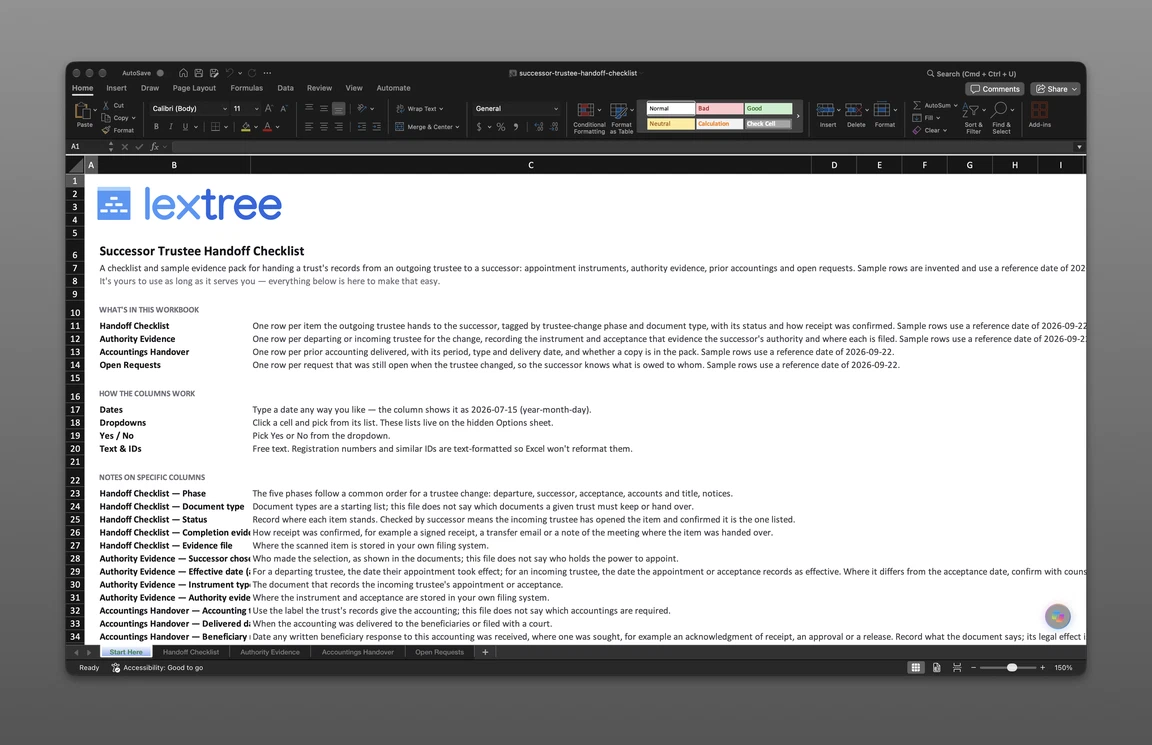
The checklist file that goes with this trustee transition checklist follows the same groups. Handoff Checklist lists each item the outgoing trustee hands over, with its phase, status, and how receipt was confirmed. Authority Evidence records the instrument and acceptance behind each departing and incoming trustee and where each is filed. Accountings Handover lists each prior accounting with its period, type, and delivery date, and whether a copy is in the pack. Open Requests holds the requests still open at the change, so the successor knows what is owed to whom. The file is sent to your email after the short form below.
Get the free checklist
Enter your email and we’ll send the successor trustee handoff checklist to your inbox. Free — no credit card, no call, no follow-up sequence you didn’t ask for.
Keeping the Handover in Lextree
Lextree’s Trusts module records each trustee, successor trustee, and protector appointment as its own record with start and end dates, so the Timeline shows who held each role on any given date. Trustees carry their own appointment history kept with start and end dates, which keeps the outgoing trustee’s term visible after a successor takes over.
The module comes set up with a Trustee Change workflow template that works the change as five steps, and the Activity Stream logs each action taken on it: who acted, what they did, and when. A company can change the seeded steps and labels. Accountings are tracked as records covering a period, which matches how the accountings list above is organized.
Lextree tracks the governance side of a trust. The day-to-day accounting of trust assets and distributions stays in the fiduciary accounting platform, since Lextree does not replace a trust accounting system.
Frequently Asked Questions
The Handover Pack
What should an outgoing trustee give the successor trustee? The change documents, the evidence of the successor’s authority, the records the successor inherits (including prior accountings and open requests), and the confirmations that accounts, title, and notices have moved. What a particular trust’s records hold depends on the trust, so build the list from the instrument and the file.
Do originals or copies go to the successor? Record which one is handed over and who keeps the other. Original instruments and signed acceptances are the items most often tracked as originals; most other items travel as copies with a note on where the original sits.
What is a certification of trust used for in a handover? It is the summary of the trust and the successor’s appointment that the successor gives institutions in place of the full instrument. Record who issued it and when it went out.
Receipt and Sign-Off
How does a successor trustee confirm receipt of trust records? Give each item a status, a date received, the evidence that proves receipt, and the file where that evidence sits. Both trustees then sign off on the finished list. When an item cannot be confirmed yet, leave its status at requested and say why in the notes rather than marking it received to keep the list tidy.
What happens to requests left open at the change? They carry onto the open requests list with the requester, the date received, and the response-requested-by date, and they pass to the successor on a recorded date. Once the successor owns a request, the outgoing trustee’s name comes off it, so nobody assumes the previous trustee is still answering. A request that arrives after the change date goes straight to the successor’s own list, not the handover pack.
Where should the handover record be kept afterward? File the signed list and its evidence against the trust. Teams that keep trusts in Lextree can attach them to the trust’s own record next to the trustee appointments.
Lextree Editorial
Author